
- This topic has 27,906 replies, 54 voices, and was last updated 13 hours, 40 minutes ago by GVI Forex 2.
-
AuthorPosts
-
May 17, 2025 at 11:24 pm #25023
re Moody’s downgrade
How will futures open ?Wall Street Strategists React to Moody’s US Credit Rating Cut
May 17, 2025 at 9:50 pm #25022May 17, 2025 at 11:23 am #25020May 17, 2025 at 11:15 am #25019This came out too late on Friday to impact markets although a late end of week dip in the NASDAQ suggests someone had the news
With Moody’s downgrade, US loses treasured Aaa credit rating
NAS=100 15 Minute
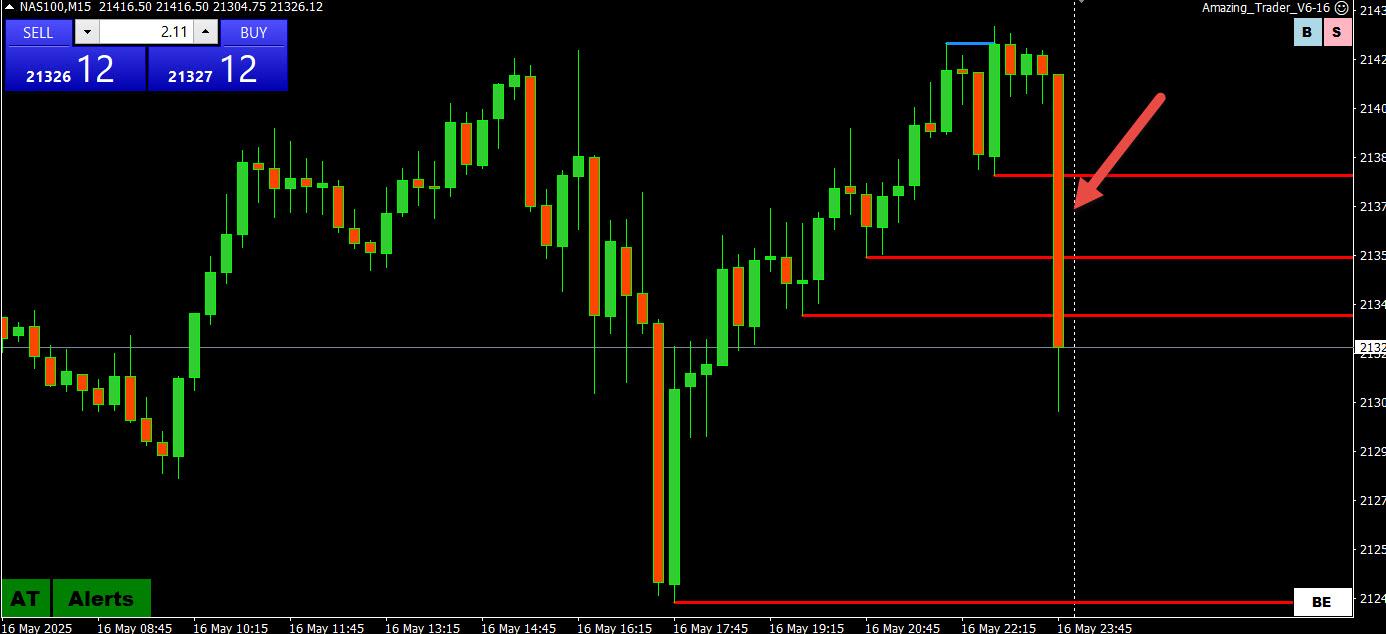
May 16 (Reuters) – Moody’s downgraded the U.S. sovereign credit rating on Friday due to concerns about the nation’s growing, $36 trillion debt pile, in a move that could complicate President Donald Trump’s efforts to cut taxes and send ripples through global markets.
Moody’s first gave the United States its pristine “Aaa” rating in 1919 and is the last of the three major credit agencies to downgrade it.
Friday’s cut by one notch to “Aa1″ follows a change in 2023 in the agency’s outlook on the sovereign due to wider fiscal deficits and higher interest payments.
Successive US administrations and Congress have failed to agree on measures to reverse the trend of large annual fiscal deficits and growing interest costs,” Moody’s said on Friday, as it changed its outlook on the U.S. to “stable” from “negative.”
Successive US administrations and Congress have failed to agree on measures to reverse the trend of large annual fiscal deficits and growing interest costs,” Moody’s said on Friday, as it changed its outlook on the U.S. to “stable” from “negative.”…. truncated
May 17, 2025 at 9:03 am #25014US dollar rises after data, set for fourth straight weekly gain
Key points:
· Import prices unexpectedly rise
· Gauge of consumer sentiment falls, inflation expectations jump
· Dollar poised for fourth straight week of gains
The dollar strengthened on Friday after the latest round of economic data showed a rebound in import prices while consumer sentiment remained subdued as tariff worries jumped, putting it on pace for a fourth straight weekly advance.
The Labor Department said import prices gained 0.1% last month after dropping 0.4% in March as a jump in the cost of capital goods outweighed cheaper energy prices. Economists polled by Reuters had forecast import prices, which exclude tariffs, would decrease 0.4%.
The dollar began to strengthen after a separate reading from the University of Michigan Surveys of Consumers showed its Consumer Sentiment Index dropped to 50.8 this month, below the 53.4 estimate, from a final reading of 52.2 in April. In addition, the 12-month inflation expectations of consumers shot up to 7.3%, the highest level since November 1981, from 6.5%.
The greenback began the week with a surge of more than 1% on Monday after the United States and China announced a 90-day pause on most of the tariffs imposed on each other’s goods since early April, easing fears of a global recession, but had been trending lower throughout the week in part due to tepid economic data.
 May 17, 2025 at 8:56 am #25013
Ethereum Price Risks Further Crash To $2,350 With Lower Lows Formation
The Ethereum price has ranged low now after making a new monthly high back on Tuesday. This increase had come as a much-needed relief for the crypto market, which had watched the ETH price struggled while Bitcoin thrived. However, the bullish breakout has not lasted long as bears have once again taken control and sellers are now dominating. Given this recent trend, it is possible that the Ethereum price has seen the end of price decline.
Ethereum Lower Lows Present Troubling Trend
The opening range for the week had established the current monthly high before breaking low. This showed an entry of large players into the market as the Ethereum price was pushed up rapidly to touch the $2,700 mark for the first time in over a month. This had set a bullish tone for the week, following into the next day as Tuesday also showed recovery strength,
The next day, Tuesday, the Ethereum price did pump once again and placed a higher high than Monday, suggesting that a continuation was in play. The day also closed out in the green as ETH bulls remained dominant through the trading day.
By Wednesday, there had been a turn in the market, whereas the previous days were dominated by bullish rallies, consolidation was the order of the day. This brought the Ethereum price back inside the opening range high of the week and then marked the first red close of the week.
This first red close,was a bearish signal. It initially didn’t signal that the Ethereum price would continue to crash. However, it did show that the bullishness that began on Monday might finally be over. Then, by Thursday, it was already a full-blown reversal as the market tested the previous day’s lows. Thursday’s red close was just as bearish as the market turned in expectation of bearish news.
There could be a possible breakdown of the price. In this case, the Ethereum price could again crash back below $2,400, wiping out a notable amount of gains accumulated over the last few weeks.
 May 17, 2025 at 8:49 am #25012
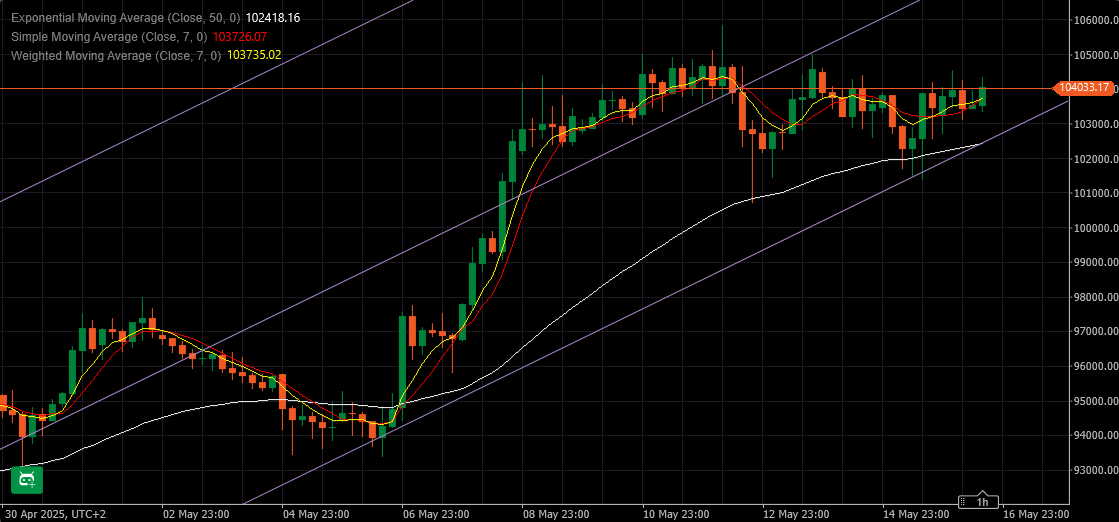
Bitcoin Rally Hits Wall as Price Stalls Below $104K, Analyst Cites Derivatives Pressure
Bitcoin experienced a notable surge earlier this week, climbing above the $104,000 mark and registering a weekly gain of nearly 10%. However, after reaching this level, the asset appears to have encountered resistance, with upward momentum slowing and price action remaining relatively flat in recent days.
At the time of writing, BTC is trading at $103,663, reflecting a modest 1.7% increase over the past 24 hours.
Derivatives Market Activity Signals Short-Term Uncertainty
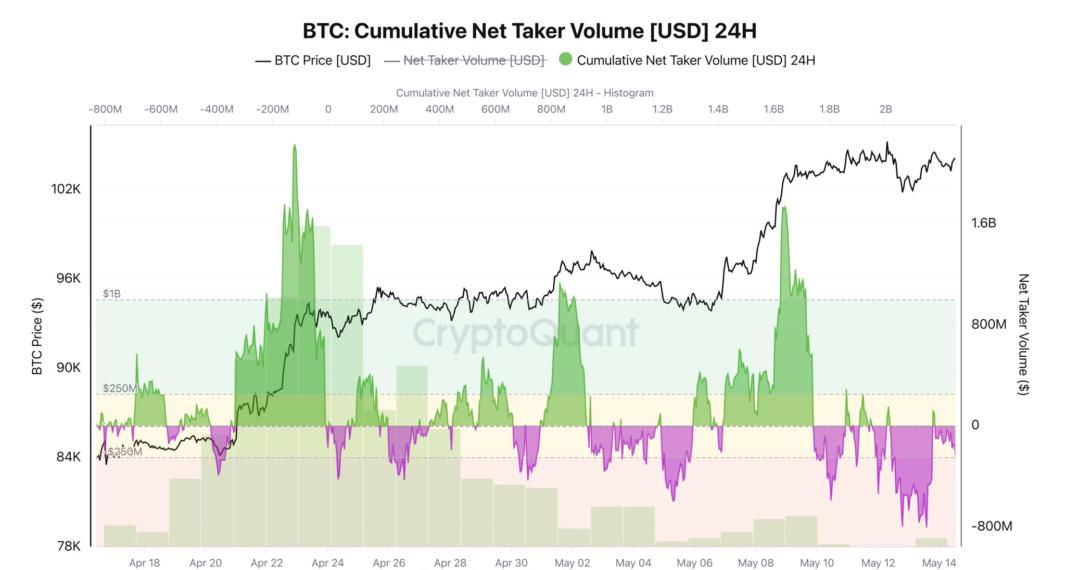
The root of the slowdown appears to stem from the derivatives market. Specifically, the cumulative net taker volume, a metric that tracks the net volume of market orders, remaining in negative territory since BTC crossed above the psychological $100,000 threshold.
This suggests that there are more aggressive sell orders (shorts) than buy orders (longs), creating persistent downward pressure on price. Net taker volume is a useful gauge of real-time trader sentiment, and when it trends negative, it typically signals that market participants expect prices to drop, prompting more short-selling.
 May 16, 2025 at 9:33 pm #25011
This seemed to be ignored but a shift away from a 90 day pause to make trade deals.
Today, May 16, 2025, President Donald Trump made significant announcements regarding U.S. trade policy during a business meeting in the United Arab Emirates. He stated that the United States will begin unilaterally setting new tariff rates for numerous trading partners within the next two to three weeks. This move marks a shift away from individualized trade negotiations, citing logistical challenges in managing separate deals with over 150 countries. Instead, Treasury Secretary Scott Bessent and Commerce Secretary Howard Lutnick will issue letters to affected nations outlining the new tariff rates for their exports to the U.S. … The Guardian
May 16, 2025 at 7:05 pm #25004XAUUSD – Gold
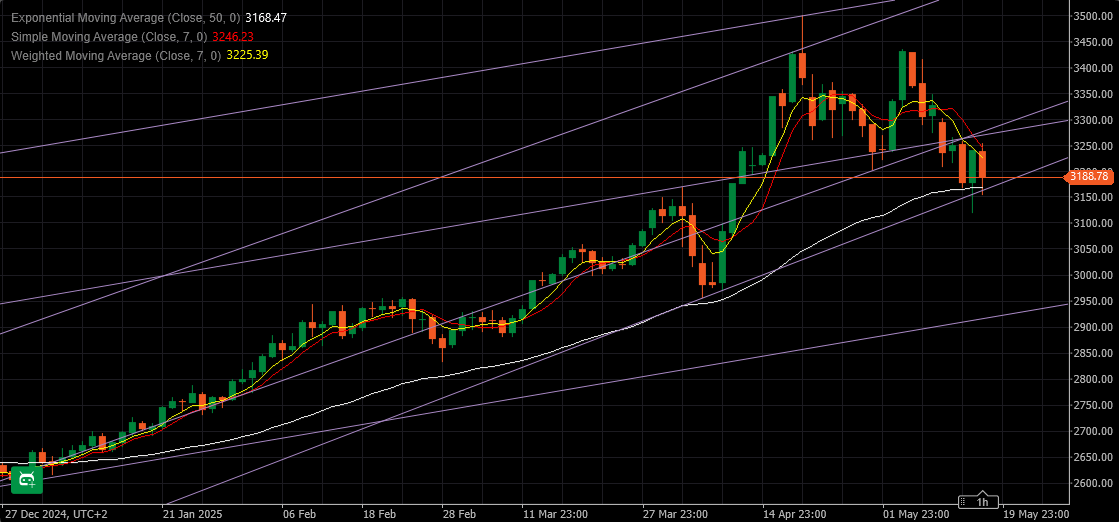
Gold is still on defensive – it is capped at around 3255.00
For return to the uptrend has to take out 3280.00
Support right now at 3170.00
As I commented earlier this week, we have double top in place and it is going to be very difficult for Gold to regain upper levels.
If goes below 3120.00 it will directly target 2925.00
 May 16, 2025 at 6:59 pm #25003May 16, 2025 at 6:52 pm #25002May 16, 2025 at 6:47 pm #25001May 16, 2025 at 6:43 pm #25000May 16, 2025 at 5:11 pm #24999
DAX – Week’s end
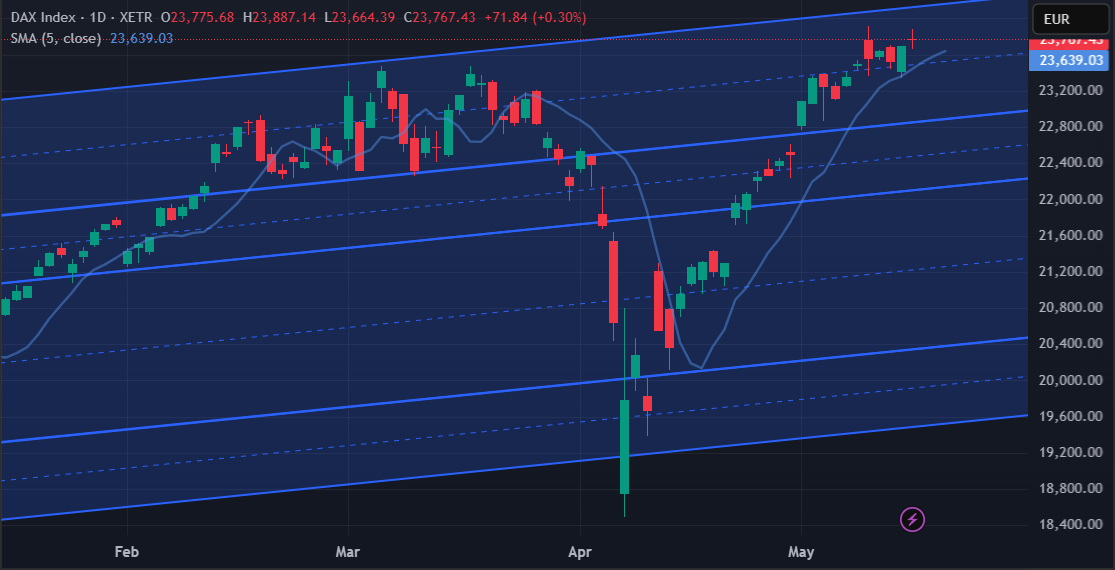
Dax tested previous high today, but fell just a bit short of it.
It is not particularly indicative – but this Close of the Day is muted – and that is usually the first sign that things are not going well…
For DAX to be able to continue the uptrend , it has to go over 23.915 first thing on Monday, or will risk start of at least a consolidation.
However, in my opinion it needs a good correction, before continuing a rally.
Resistance – 23.915
Supports: 23.665, 23.500 & 23.335
 May 16, 2025 at 4:36 pm #24998
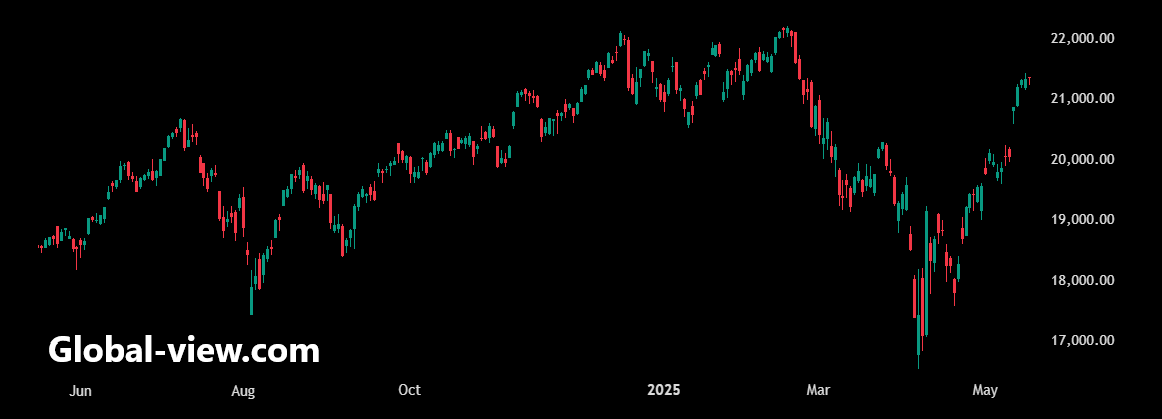
US Equity Indexes Rise in Midday Trading
US equity indexes rose in midday trading Friday even after a consumer sentiment gauge slumped and inflation expectations surged.
The Nasdaq Composite advanced 0.2% to 19,142.1, the S&P 500 rose 0.2% to 5,929.2, and the Dow Jones Industrial Average climbed 0.2% to 42,412.3. Health care and utilities led the gainers, and technology and energy posted the only declines.
In economic news, the University of Michigan’s preliminary consumer sentiment index fell to 50.8 in May from 52.2 in April, compared with expectations for an increase to 53.5 in a survey compiled by Bloomberg. According to a report from Trading Economics, the reading marks the fifth consecutive monthly decline, the lowest since June 2022 and the second-weakest on record.
Respondents pegged one-year inflation expectations at 7.3%, up from 6.5% in April, while five-year inflation expectations rose to 4.6% from 4.4%.
The survey period closed on May 13, two days after the pause on tariffs on Chinese imports.
Most US Treasury yields fell with the 10-year down 2.1 basis points to 4.43%.
Gold futures dropped 1.5% to $3,205.13 per ounce.
West Texas Intermediate crude oil futures rose 0.4% to $61.89 a barrel.
Nasdaq Chart
 May 16, 2025 at 4:05 pm #24997May 16, 2025 at 4:01 pm #24996May 16, 2025 at 3:13 pm #24995May 16, 2025 at 3:09 pm #24994May 16, 2025 at 3:09 pm #24992May 16, 2025 at 3:09 pm #24993May 16, 2025 at 2:57 pm #24991May 16, 2025 at 2:56 pm #24990May 16, 2025 at 2:54 pm #24989May 16, 2025 at 2:52 pm #24988May 16, 2025 at 2:52 pm #24987May 16, 2025 at 2:39 pm #24986May 16, 2025 at 2:36 pm #24985May 16, 2025 at 2:13 pm #24984
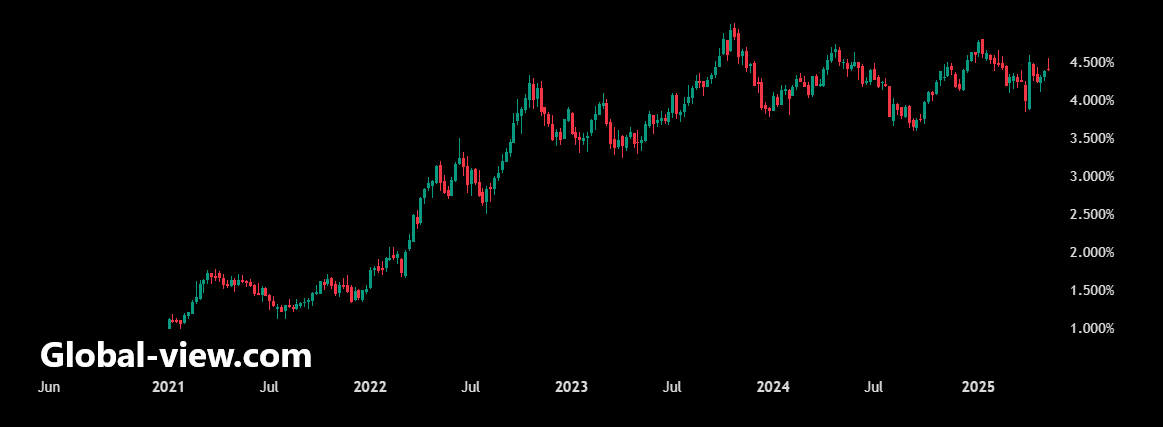
US yields fall on signs of weaker housing market
Yields on U.S. Treasuries fell on Friday after data showed weaker housing starts than expected, as tariffs and high mortgage rates cooled activity in construction.
The benchmark 10-year yield US10Y fell 6.1 basis points to 4.394%. The two-year (US2YT=TWEB) yield, which typically moves in step with interest rate expectations, fell 4.1 basis points to 3.932%.
U.S. single-family housing starts fell 2.1% on a seasonally adjusted basis in April as tariffs on imported materials and high mortgage rates remained obstacles for the housing market.
“Also the housing inventory seems to be increasing, so that may also be helping the market softness,” said Guy LeBas, chief fixed income strategist at Janney Montgomery Scott.
Investors gave more importance to the deceleration of the housing market than to the unexpected rise in import prices last month, which may have influenced currency fluctuations.
US10Y Yield Chart
 May 16, 2025 at 1:55 pm #24982
 -
AuthorPosts



- You must be logged in to reply to this topic.
Search
© 2024 Global View