
- This topic has 28,643 replies, 54 voices, and was last updated 5 hours, 37 minutes ago by GVI Forex 2.
-
AuthorPosts
-
June 23, 2025 at 6:42 pm #26641
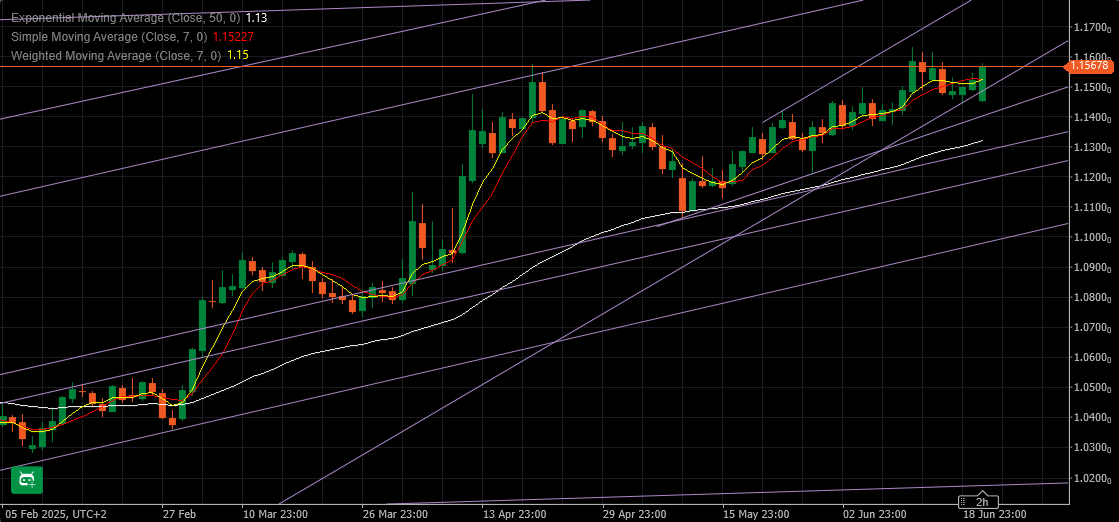
EURUSD Daily
After all support at 1.14500 held firmly.
As always I will look at it strictly technical – pattern recognition of different bombs being thrown is not operational, yet 😀
Supports: 1.15450, 1.15300 & 1.14700
Resistances: 1.15800, 1.16150 & 1.16300
This is a Bullish pattern, but I would like to see the close tonight around 1.15450 to be sure that next move will be up.
 June 23, 2025 at 6:00 pm #26640June 23, 2025 at 4:52 pm #26639June 23, 2025 at 4:29 pm #26638June 23, 2025 at 4:24 pm #26637June 23, 2025 at 3:48 pm #26636June 23, 2025 at 3:45 pm #26635June 23, 2025 at 3:23 pm #26634June 23, 2025 at 3:15 pm #26633June 23, 2025 at 3:07 pm #26632
What’s Hot and What’s Not?
What’s Hot?
Dollar is no longer hot after giving back some or all of its gains (down vs C HF, GBP, EUR in that order) and well off its highs vs, others)
GOLD is trying to trying to turn hot but still below 3400
US bonds (yields lower)
US stocks rebounding from early losses but cautiously.
What’s Not?
The dollar giving back its safe haven gains
Crude oil after failing to follow through on an early spike higher
 June 23, 2025 at 2:51 pm #26631June 23, 2025 at 2:37 pm #26628June 23, 2025 at 2:34 pm #26627
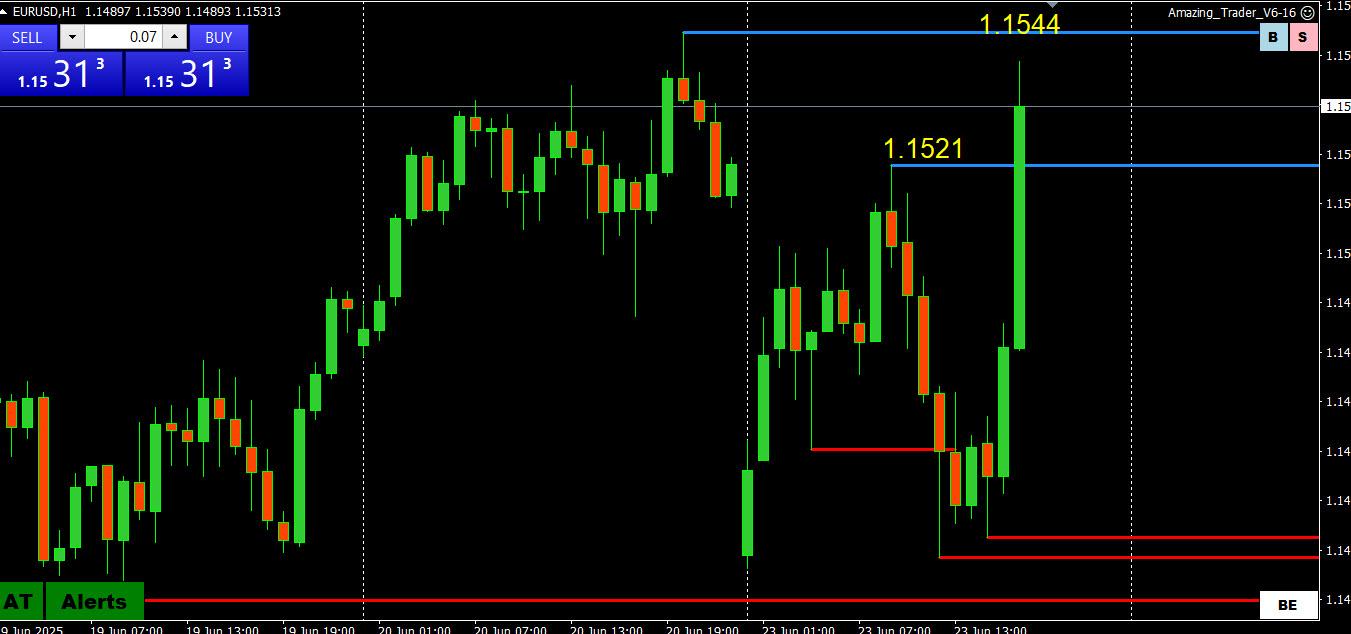
Looking for a ctalyst for the sudden turnaround to risk oin and a weaker USD, a shift to a dovish stance may have been the catalyst.
 June 23, 2025 at 1:49 pm #26626June 23, 2025 at 1:42 pm #26625June 23, 2025 at 1:36 pm #26624June 23, 2025 at 1:35 pm #26623
US Dollar Rises Early Monday; Focus on Powell, Home Sales Data, Gross Domestic Product, Personal Income
The US dollar rose against its major trading partners early Monday, with testimony by Federal Reserve Chairman Jerome Powell, home sales data, the final estimate of Q1 gross domestic product and personal income, sales and price data for May the focus for this week after the military action taken by the US against Iranian nuclear facilities Saturday.
On Monday, S&P Global flash manufacturing and services data for June are due to be released at 9:45 am ET, followed by existing home sales data for May and an appearance by Fed Vice Chair for Supervision Michelle Bowman, both at 10:00 am ET.
Chicago Fed President Austan Goolsbee is scheduled to speak at 1:10 pm ET, followed by Federal Reserve Governor Adriana Kugler and New York Fed Governor John Williams at a Fed Listens event at 2:30 pm ET.
Tuesday’s highlights include the first day of Powell’s testimony, current account data for Q1, nonmanufacturing data for June from the Philadelphia Federal Reserve bank, conditions data from the Richmond Fed and consumer confidence data for June.
Powell’s second day of testimony, new home sales data for May and weekly mortgage applications and oil stocks inventory data are due Wednesday.
GDP data for Q1, weekly jobless claims, durable goods orders, advance trade data and pending home sales data for May are the highlights Thursday.
Personal income, spending and price data for May and the final University of Michigan consumer sentiment reading for June are due to be released Friday.
A quick summary of foreign exchange activity heading into Monday:
USDEUR fell to 1.1470 from 1.1520 at the Friday US close and 1.1515 at the same time Friday morning. The Eurozone manufacturing purchasing managers’ index held steady just below the breakeven point in June while services PMI indicated no change activity in the sector, according to preliminary data released earlier Monday. European Central Bank President Christine Lagarde is due to speak at 9:00 am ET. The next European Central Bank meeting is scheduled for July 24.
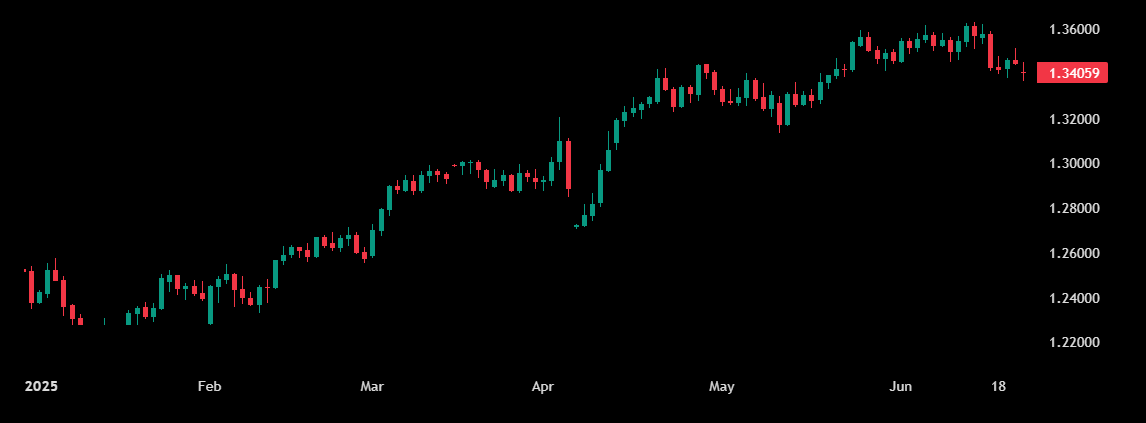
GBPUSD fell to 1.3378 from 1.3449 at the Friday US close and 1.3491 at the same time Friday morning. UK manufacturing PMI rose in June, but still indicated contraction, while services PMI indicated faster expansion, according to preliminary data released earlier Monday. The next Bank of England meeting is scheduled for Aug. 7.
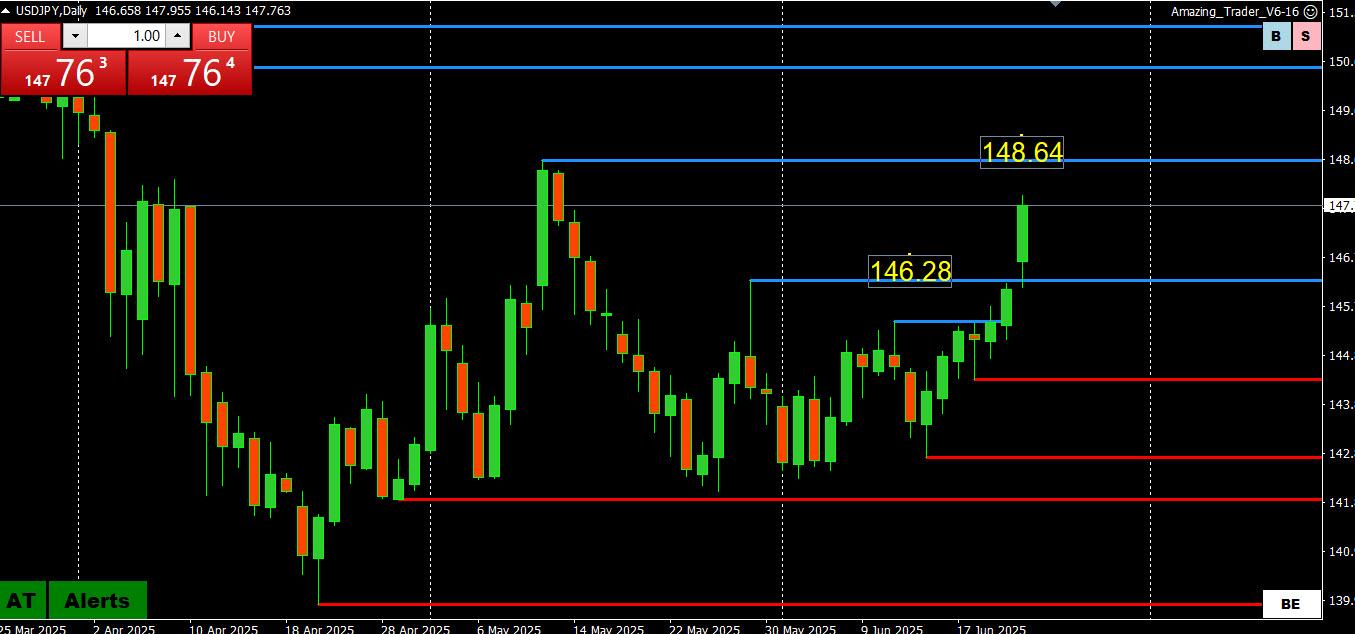
USDJPY rose to 147.8561 from 146.1292 at the Friday US close and 145.6061 at the same time Friday morning. Japanese manufacturing PMI rose back above the breakeven point in June while services PMI moved further into expansionary territory in the month, preliminary data released overnight showed. The next Bank of Japan meeting is scheduled for July 30-31.
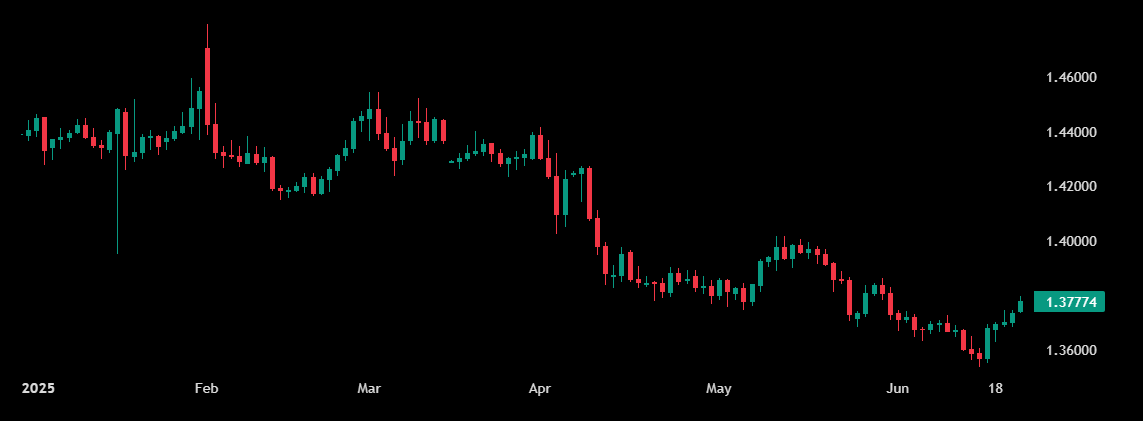
USDCAD rose to 1.3790 from 1.3740 at the Friday US close and 1.3710 at the same time Friday morning. There are no Canadian data on Monday’s schedule. The next Bank of Canada meeting is scheduled for July 30.
GBPUSD Chart
 June 23, 2025 at 1:32 pm #26622
SocGen’s Comment on Currencies After U.S. Strike on Iran
So far, the market reaction to the weekend strikes undertaken by the United States on Iranian nuclear facilities has been relatively “muted,” said Societe Generale.
The US dollar (USD) is a little stronger, with the Swiss franc (CHF) the only G10 currency up against it — and the Israeli shekel (ILS) is the top currency over the weekend, wrote the bank in a note to clients. The yen (JPY) is the biggest loser, with South Korea’s KRW, Australia’s AUD, New Zealand’s NZD also softer.
Oil prices are up 0.3%, drifting back down after an initial spike. Equities are mixed, but U.S. futures are higher, and bond yields are, on average, slightly higher.
SocGen doesn’t have the most up-to-date short-term speculative positioning data, but the chart plots CFTC data for 4our currencies against the USD, as a share of open interest. AUD and Canadian dollar (CAD or loonie) are still significant shorts, while the euro (EUR) and JPY are significant longs.
The JPY is comfortably the G10 currency that is most vulnerable to short-term nerves, stated the bank: Too many longs, too reliant on imported oil. China is the world’s biggest consumer of oil imported through the Strait of Hormuz, but Japan is a little more reliant — nearly 50% of its oil imports come through the Strait.
China may be important as a potential negotiator against closing the Strait, but Japan strikes SocGen as having more to lose economically and given foreign exchange positioning, that leaves those JPY longs looking exposed and both AUDJPY and CADJPY have upside from here, along with USDJPY.
In the last few weeks, foreign exchange markets have been getting more sensitive to economic data, but that might be out of the window now, added the bank. PMIs are on show Monday and neither JPY, nor AUD got any help from stronger data.
German PMI data were better than expected, but is anyone watching, asked SocGen. The bank will be watching U.S. PMI and existing home sales on Monday, but not with any expectation they will affect the US dollar.
Mostly, the bank will be waiting for any communications from Iran’s Ayatollah Khamenei, or any other indications of retaliation.
Overall, though, markets have a muted reaction, with the USD and CHF benefiting. JPY and KRW are suffering the most.
USDCAD Chart
 June 23, 2025 at 1:28 pm #26621
…”all”…
“Israel is very close to achieving its goals in Iran, Prime Minister Benjamin Netanyahu said on Sunday, having inflicted significant damage both to its ballistic missile program and its nuclear facilities.
He promised not to let Israel be dragged into a “war of attrition” with the Islamic Republic, but stressed that this did not mean he would be prepared to end the campaign before all its objectives had been met.” Times-of-
June 23, 2025 at 1:23 pm #26620June 23, 2025 at 1:04 pm #26619June 23, 2025 at 12:58 pm #26618June 23, 2025 at 12:40 pm #26617June 23, 2025 at 12:19 pm #26616advantage
The GENIUS Act, which stands for “Guiding and Establishing National Innovation for US Stablecoins,” sets a framework for how US companies can issue and manage dollar-backed stablecoins for payments.
It bans members of Congress and their families from earning profits from stablecoins but not President Trump and his family.
Sooo … become a “US companies” ?
June 23, 2025 at 12:02 pm #26615XTIUSD (WTI)
Waiting for the next headline
As I posted, 2 indicators of risk to watch: Crude Oil (bounced off low) and US stocks moving down after US500 stalled below 6000 but all well within today”s ranges.
Opening gap more than filled… low 74.41, high 78.85
Above 80.00 would signal heightened risk off
XTIUSD 4 HOUR CHART
 June 23, 2025 at 11:56 am #26614
10am Newsquawk – “DXY benefits from the US attack on Iran”
–
courtesy zh:
“In A World Of Deeply Indebted Nations, It’s Hard To Pick Which Currency Will Suck The Worst”
The real trade is to borrow these depreciating pieces of paper, irrespective of which sovereign prints them, and exchange that currency for assets that are truly scarce.June 23, 2025 at 10:29 am #26610THIS WEEK’S MARKET-MOVING EVENTS (all days local)
In the upcoming week, economic indicators across Asia, Europe, and the United States will provide important clues on inflation trends, industrial activity, and consumer sentiment. In Asia, Australia’s monthly CPI, steady at 2.4% for three months, could prompt another rate cut by the Reserve Bank of Australia. Meanwhile, Singapore’s industrial production and inflation data may influence the Monetary Authority of Singapore’s policy stance, especially after recent trade weakness. Japan’s Tokyo CPI is forecast to stay above 3% but slightly ease due to subsidies and falling energy prices, while its retail sales are expected to slow, reflecting subdued domestic demand.
In Europe, preliminary June PMI figures will shed light on the economic pulse, with the Eurozone composite index expected to stay just above expansion territory. Germany and France, however, remain in contraction, and consumer sentiment continues to lag due to cautious spending behaviors. The U.S. will see a wave of key releases, including Chair Powell’s congressional testimony, which is unlikely to diverge from the recent FOMC stance unless unforeseen events arise. Home sales and consumer sentiment remain fragile under high mortgage rates, and the final Q1 GDP revision is expected to confirm a slight contraction. Durable goods orders are forecast to rebound, largely due to aircraft sales, while inflation data from PCE remains subdued, aligning with the Fed’s cautious outlook
Econoday
June 23, 2025 at 10:00 am #26607June 23, 2025 at 9:55 am #26606USDJPY
Trend: Up
Trading technically: Break of 146.28 exposes 148,64 as a target.
With that said, 148 is one of those “magic” pivotal levels that has potential to cause a pause.
What stands out is JPY’s failure to act as a safe haven in a geopolitical crisis that often sees repatriations back home that weigh on USDJPY.
Supports: Use short-term charts as it has been straight up from just above 146 after filling the opening week gap
USDJPY DAILY CHART
 June 23, 2025 at 9:45 am #26605
-
AuthorPosts







- You must be logged in to reply to this topic.
Search
© 2024 Global View