
- This topic has 28,643 replies, 54 voices, and was last updated 1 day, 6 hours ago by GVI Forex 2.
-
AuthorPosts
-
July 10, 2025 at 10:21 am #27333
ING Comments on Euro, Norway’s Krone, Czech Republic’s Koruna
EURUSD one-week historical volatility is back below 7.0, confirming markets’ extra caution in dealing with United States President Donald Trump’s tariff announcements, said ING.
By comparison, this peaked at 20 in April and was above 9.0 only a couple of weeks ago. What is also worth noting is that the one-month 25-delta EURUSD risk reversals — the difference in price between calls and puts — have returned to zero, wrote the bank in a note.
That had fallen to negative territory in June, but bounced back rapidly. Should this decline prove sustainable, it would signal markets are seriously scaling back bullish views on the pair — another testament of how the US dollar (USD) isn’t bearing the risks associated with this round of tariff announcements for now, stated ING.
A U.S.-European Union trade deal seems imminent, with reports suggesting the European Commission’s interim draft should include asymmetrical tariffs on EU products — likely the 10% base tariff — effectively choosing to de-escalation path, according to the bank. That is likely priced in by now, and barring major surprises in the details of the deal, EURUSD may stay attached to the 1.170-1.175 area for now.
In the absence of relevant eurozone data, ING will keep monitoring European Central Bank speeches. Wednesday, Governing Council member Robert Holtzmann reaffirmed his ultra-hawkish stance by saying rates shouldn’t be lowered any further, while the more moderate Joachim Nagel didn’t rule anything out. Thursday, investors will hear from three dovish-leaning members: Fabio Cipollone, Jose Luis Escriva and Francois Villeroy de Galhau.
Norway released June consumer price index figures earlier Thursday. While headline inflation undershot expectations for an increase by staying flat at 3.0% year over year, underlying CPI accelerated from 2.8% year over year to 3.1%, faster than the consensus 3.0%. A key argument for Norges Bank’s surprise June rate cut was that underlying inflation was back below 3.0%, pointed out ING.
As that drop didn’t prove sustainable, there is little room for Norges Bank to cut again already in August, it added.
EURNOK has been little touched by the release, as markets were already pricing in little to no chance of an August cut, while the dovish tilt in June may prevent substantial unwinding of September rate cut bets.
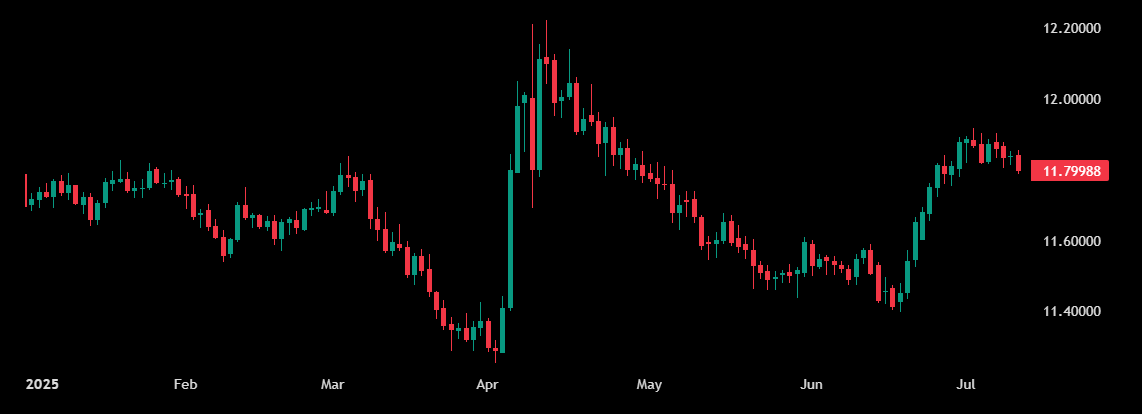
The bank’s EURNOK view is bearish. The impact on risk sentiment from Trump’s new wave of tariff announcements has been minimal, and the pair is trading 3.0% above its short-term fair value according to ING’s model. This is primarily due to the euro’s (EUR) outperformance, which may, however, lose some steam as concerns about eurozone growth may arise in the coming months. A return to the 11.50 handle in EURNOK would be entirely in line with fundamentals.
ING believes a rate hike may be more likely than rate cuts for the Czech central bank (CNB).
This leads the bank to a bullish view on the koruna (CZK) despite currently strong levels. While the first hike may still be a long way off, the persistent hawkish tone versus Central and Eastern European (CEE) peers and the Federal Reserve and ECB still in a cutting cycle should further support EURCZK lower.
ING sees 24.500 as a first stop, outperforming CEE peers.
EURNOK Chart
 July 10, 2025 at 10:14 am #27332
SocGen’s Overnight Economic News Summary
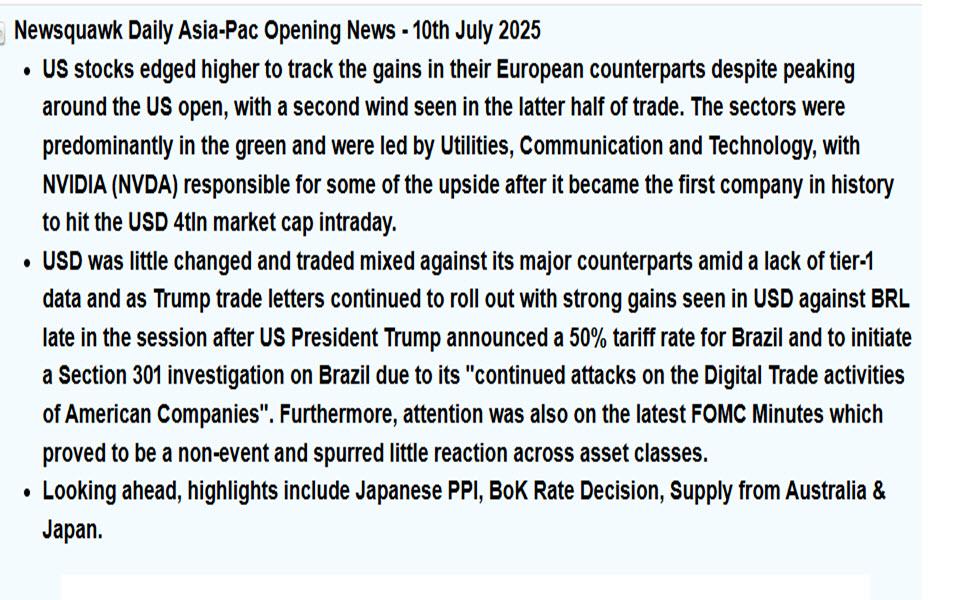
— Bond yields retreat following German long-end supply and solid 10-year United States Treasury auction, stop through 0.4bp, non-dealer bidding 89.1%, bid-cover 2.61 times. Brazil’s real (BRL) slides 2.3%, trades through 50dma (5.5889) after President Trump announced 50% tariff on Brazil starting Aug. 1, citing unfair trade practices and criticizing the trial of former President Bolsonaro.
— FOMC minutes: most members saw risk of persistent tariff impact on inflation, ‘a couple’ of members open to rate reduction at next meeting, many observed tariff impact on prices might take time, most officials expected to lower interest rates this year.
— Bank of Korea leaves key rate on hold at 2.50%, says monetary policy will remain accommodative, further rate cuts possible depending on shifts in global and domestic conditions, price stability, and financial market volatility. USDKRW -0.2% at 1,372.
— Day ahead: U.S. weekly jobless claims, 30-year UST auction, Federal Reserve speakers Musalem and Daly. European Central Bank’s Cipollone and Villeroy. Bank of England’s Breeden. Norway’s and Brazil’s consumer price index.
— Nikkei -0.5%, EUR 10-year IRS to resume at 2.62%, receiving bias post supply. Brent crude -0.1% at $70.1/barrel, Gold +0.3% at $3.322/oz.
US 10Y Bond
 July 10, 2025 at 10:08 am #27331
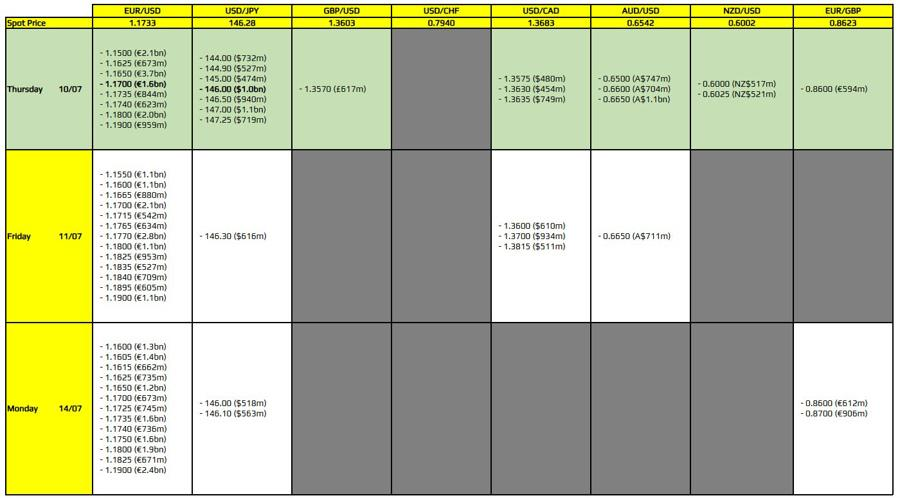
FX option expiries for 10 July 10am New York cut
There are just a couple to take note of on the day, as highlighted in bold.
The first one being for EUR/USD at the 1.1700 level once again. The expiries there have been helping to limit downside price action on the week and will play the same role again today in the run up to the US weekly jobless claims. In the bigger picture, it’s still all about trade headlines and broader market sentiment is taking it all in rather well for now.
The next is for USD/JPY at the 146.00 mark. The expiries are not likely to factor too much into play, as it doesn’t tie to any technical significance. The 100-hour moving average around 145.77 currently is still the key near-term support level to watch out for, resting near the 100-day moving average at 145.83 as well. Those are the two more important levels for USD/JPY, with the expiries above just adding some mild interest nearby.
 July 10, 2025 at 10:07 am #27330July 10, 2025 at 10:05 am #27329
Canada seeks pact with Southeast Asian countries to diversify trade
Canada is seeking to finalise a free trade deal with Southeast Asian nations as part of a push to expand into new markets, its top diplomat said, responding to the hefty tariffs imposed on it by the United States, its neighbour and largest trade partner.
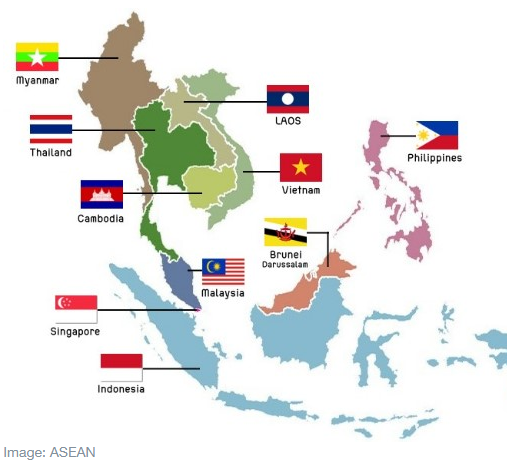
Foreign Minister Anita Anand said Canada intends to continue a mutilateral trade relationship with the 10-member Association of Southeast Asian Nations. Canada believes the global economy will be driven by the Indo-Pacific region in the years ahead, she added.
“The work is being done with alacrity to finalise the text of the free trade agreement,” Anand told Reuters in an interview, following her meeting with counterparts from the ASEAN bloc in the Malaysian capital.
“It is complex but we are very much looking forward to it being completed as soon as possible,” she said, without providing further details.
Anand said the ASEAN-Canada FTA is one of the ways Canada can diversify its trade relations beyond the Group of Seven nations.
Beyond trade, Canada will also work with ASEAN on energy, food security, digital economy and artificial intelligence, she added.
Canadian companies are boosting trade with allies other than the United States, and with smaller markets, as they try to minimise the economic damage from President Donald Trump’s tariffs, government data has shown.
Canada, the top supplier of steel and aluminum to the United States, faces tariffs imposed by Trump on both metals and on auto exports.
The government is hoping to reach a trade deal with Washington by July 21 and could impose counter-duties on the United States if no agreement is reached.
Anand declined to comment on how the talks are progressing, but said Canada was looking forward to a constructive deal with the United States.
“Our trade negotiators… are engaged in the complex trade negotiations to ensure that Canada’s interests are put forward in the best possible way,” she said.
 July 10, 2025 at 9:38 am #27328
EURUSD
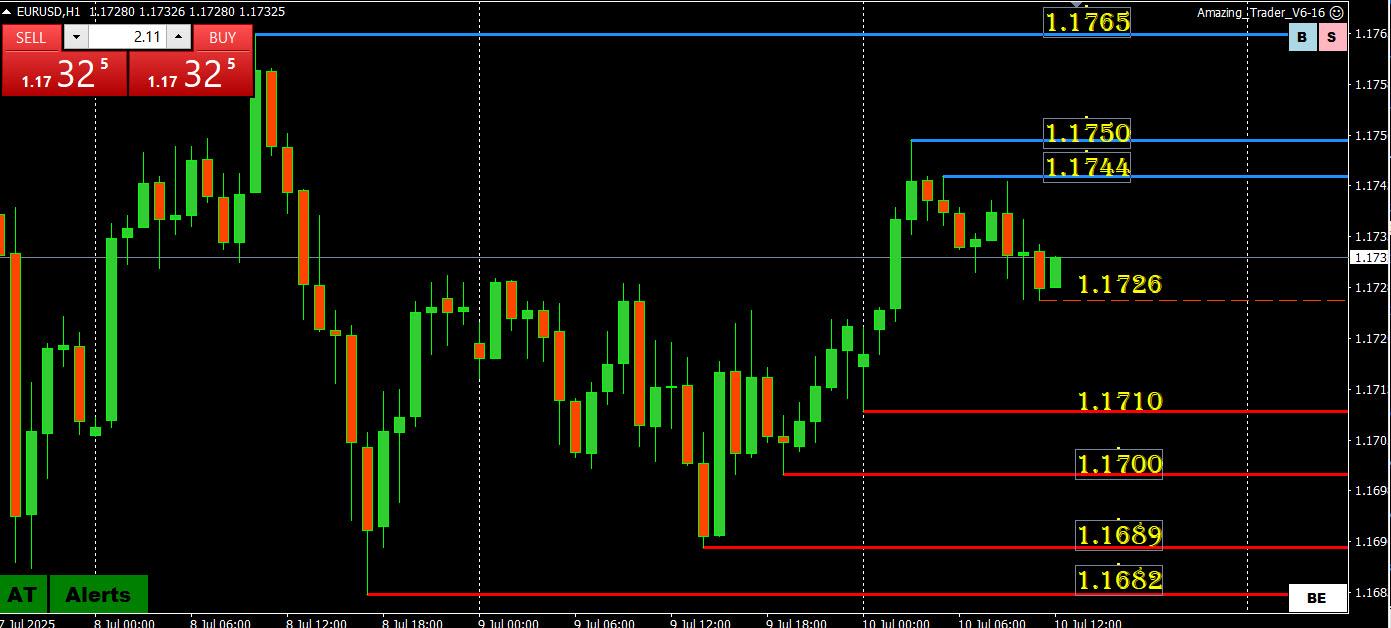
EURUSD catching a bid after repeated attempts to squeeze the shorts by running stops below 1.1680 has so far failed this week
However, so far, the upside has been capped by 1.1750 and then a 1.1744 double top below it.
To shift the focus back to 1.1800 and a zero sum game week, 1.1750-65 resistance would need to be taken out.
On the downside, keeps its bid while above 1.1710.
EURUSD 1 HOUR CHART
 July 10, 2025 at 9:35 am #27327July 10, 2025 at 9:24 am #27326July 10, 2025 at 9:13 am #27325
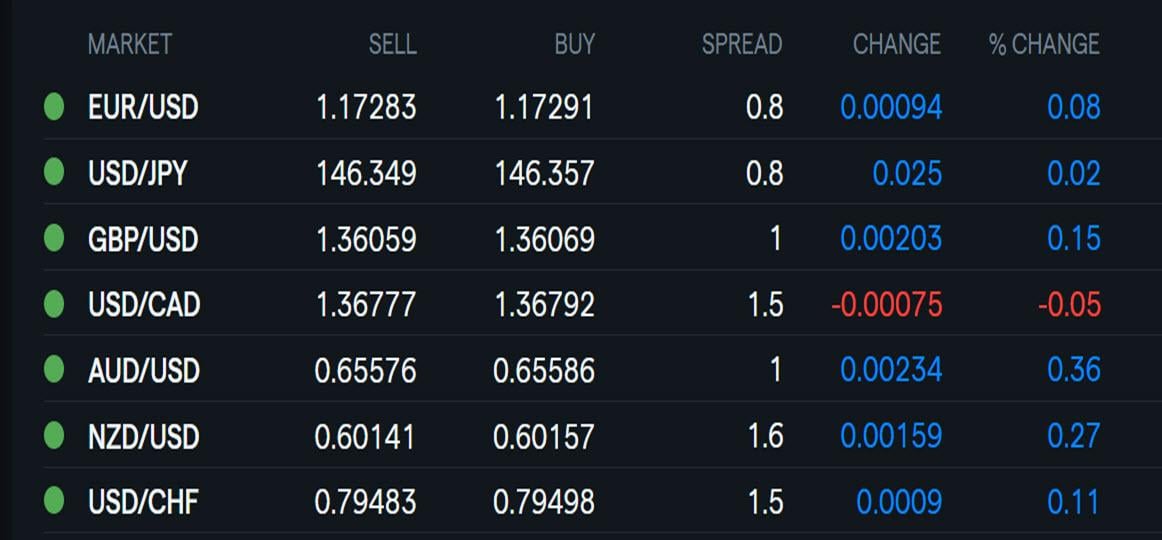
Using my platform as a HEATMAP shows…
Markets trading cautiously as Trump ramps up tariffs
Dollar trading mixed to slightly defensive after its overnight fall did not follow through
EURUSD backed off after its rally stalled at the “50”. (1.1750) level
USDJPY retreat from 147.19 ran stops below 145.82 before bouncing back above 146 to trade around unchanged on the day.
AUD and NZD modest ouyperformers
Gold is up as it consaolidates in its range
US bonds are steady after the drop in yields yesterda
US stocks treading water
Data due: US weekly jobless claims
 July 10, 2025 at 9:07 am #27324July 10, 2025 at 9:02 am #27322July 10, 2025 at 9:02 am #27323July 10, 2025 at 1:07 am #27321July 10, 2025 at 1:04 am #27320July 10, 2025 at 12:09 am #27319
Timely article with EURUSD trying to regain a bid
In our blog
Will the ECB Change Its Tune on the Euro’s Rise?
 July 9, 2025 at 10:21 pm #27318July 9, 2025 at 10:11 pm #27317July 9, 2025 at 9:35 pm #27316
USDJPY
After extending its high to 147.19 correlations took over with a fall in US bond yields seeing USDJPY follow.
Correlations can be fickle so keep an eye on bond yields to see if the relationship is more than a one day wonder.
In any case, the move down is just a retracement as USDJPY would need to break 145.82 and then the trendline to indicate the high is in.
What has changed on the upside, is the deck is cleared of buy stops until above 147.19
USDJPY 4 HOUR CHART
 July 9, 2025 at 8:25 pm #27315
Top U.S. Imports from Brazil (by category)
1. Mineral Fuels and Oil
Crude oil (a major import)
Refined petroleum products
Brazil is a key source of crude for U.S. Gulf Coast refineries.
2. Iron and Steel
Semi-finished iron and steel products
Stainless steel and ferroalloys
Brazil is among the top exporters of semi-finished steel to the U.S.
3. Precious Stones and Metals
GoldDiamonds
Other precious metals
4. Agricultural Products
Coffee (Brazil is the world’s largest producer)
Orange juice (especially frozen concentrated OJ)
Soybeans and soybean meal (less frequent due to U.S. domestic supply)
Sugar and ethanol
5. Wood and Pulp Products
Pulp for paper (especially bleached eucalyptus pulp)
Tropical hardwoods
6. Aircraft and Aircraft Parts
From Embraer, Brazil’s aerospace giant, which supplies regional jets and parts
7. Machinery and Equipment
Industrial and electrical machinery components
(from the web)
July 9, 2025 at 8:23 pm #27314July 9, 2025 at 8:16 pm #27312NAS100 (NASDAQ)
You can see by a new record high today why I said yesterday, no matter what charts say, even suggesting a potential top in the NAS triggers a bout of PTSD.
With that said, with no resistance other than the record high (22935), use that as the key level.
Expect support as long as it trades above 22600-22662. Would re-evaluate if that support is broken.
NAS100 4 HOUR CHART
 July 9, 2025 at 7:55 pm #27307
US500 (SP500)
Why Amazing Trader (AT) levels matter
I noted this earlier and as you can see by the chart, why I keep suggesting signing up for AT
6220 => 6272 (high 6274) => 6235 => 6265
In any case, downside limited while above 6200-=20 BUT still needs a firm break of 6272-74 to chasllenege the 6287 high
US500 4 HOUR CHART
 July 9, 2025 at 7:41 pm #27306
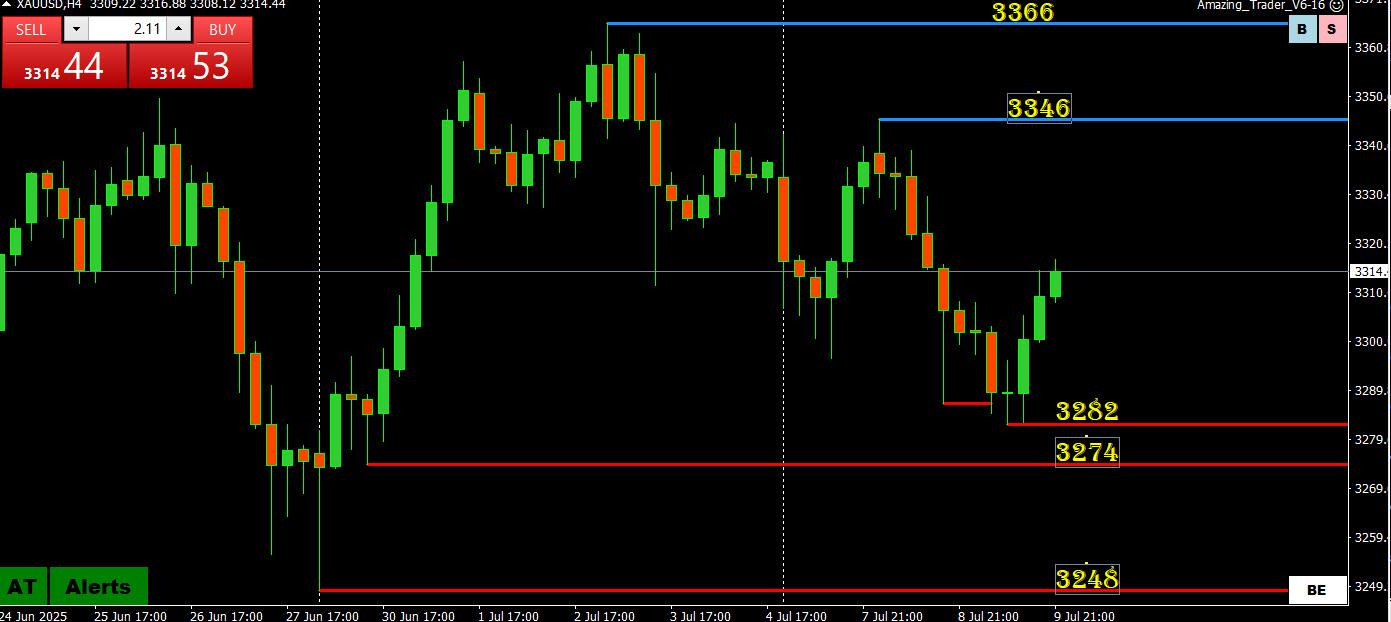
XAUUSD ((gold)
This is a glass half empty, glass half filled situation, depending on your view
Glass half empty: Failure to build on rallies that require a firm move through 3346-66 to build momentum to the upside.
Glass half filled: Repeated attempts to run to test 3274 for a run at 3248 have been repelled.
So, is XAUUSD bid in an offered market or offered in as bid market?
What is clear that unless the 3248 low is taken out, any stops on the downside will be limited.
Trade the range until momentum builds on either side.
XAUUSD 4 HOUR CHART
 July 9, 2025 at 7:29 pm #27305
XRPUSD
XRP in front of major resistance at 2.4135
Break of would open a road to 2.90 and higher
Supports: 2.35, 2.3235 & 2.2565
XRP is becoming bullish and unless cut short at this resistance this would be just a beginning of uptrend
However, if stopped and losses support at 2.00 it might lose more than half of its current value.
 July 9, 2025 at 7:18 pm #27304July 9, 2025 at 7:05 pm #27303July 9, 2025 at 6:58 pm #27302July 9, 2025 at 6:02 pm #27301
Mixed but cautious views, rate cuts this year still expected, no surprise
Minutes of the Federal Open Market Committee, June 17–18, 2025
July 9, 2025 at 5:52 pm #27300July 9, 2025 at 5:41 pm #27299 -
AuthorPosts




- You must be logged in to reply to this topic.
Search
© 2024 Global View