
- This topic has 28,643 replies, 54 voices, and was last updated 5 hours, 44 minutes ago by GVI Forex 2.
-
AuthorPosts
-
June 23, 2025 at 9:30 am #26604
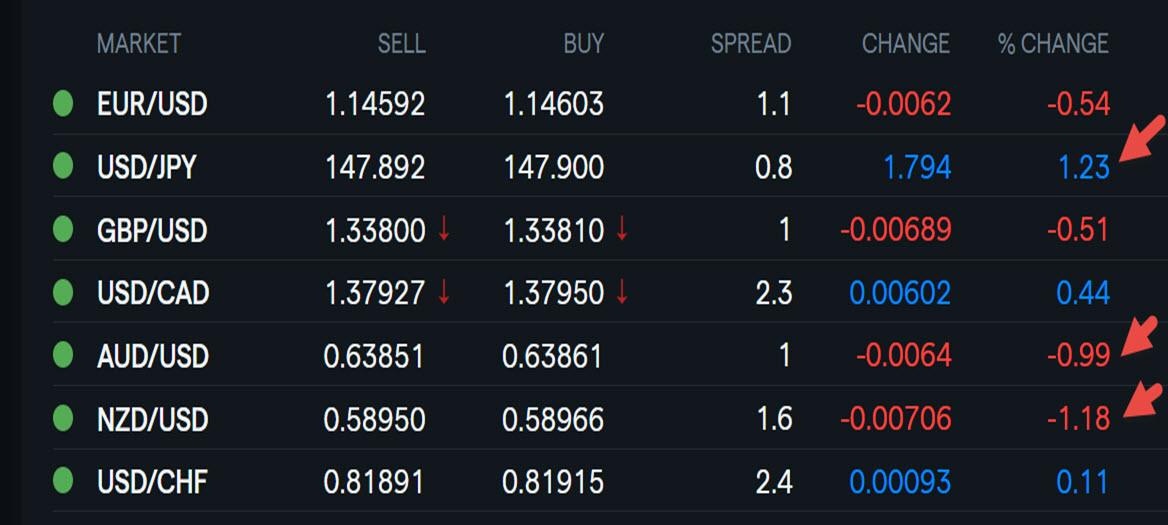
Using my platform as a HEATMAP shows ..
… a market in a wait and see mode
Wait for the Iran retaliation to the U.S. attack
See if Iran carries out its threatto close/disrupt the Straits of Hormuz
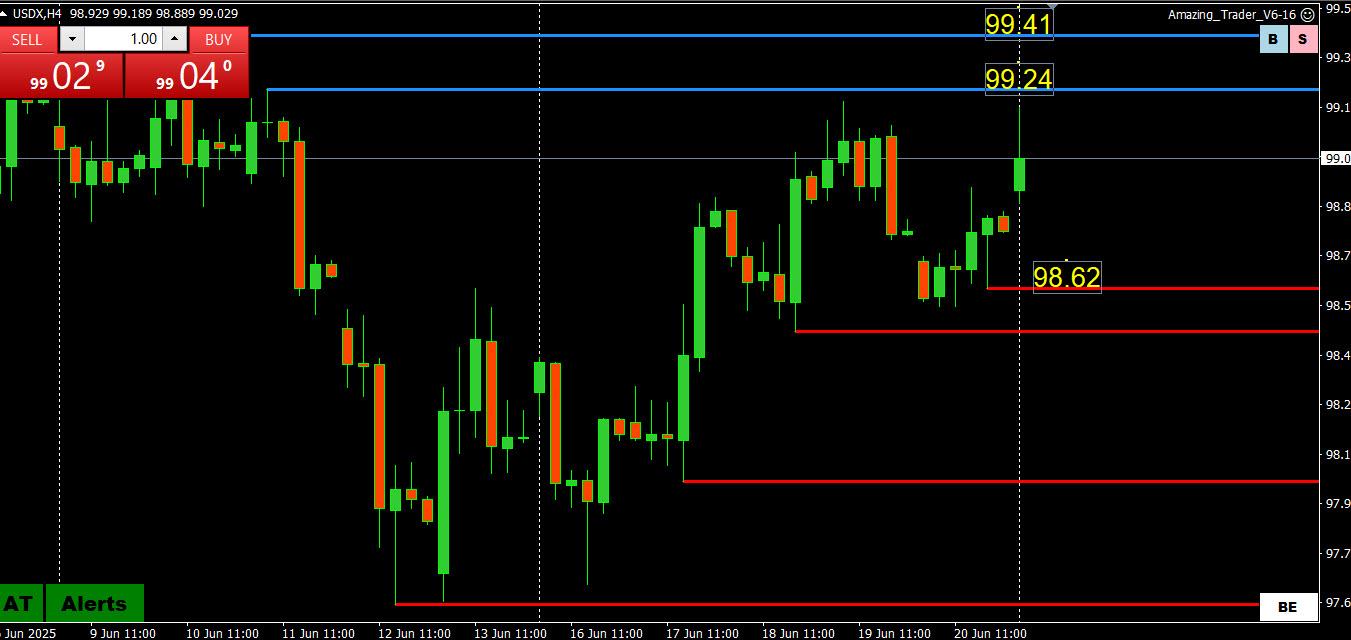
Dollar is firmer… led by a weaker JPY, AUD, NZD
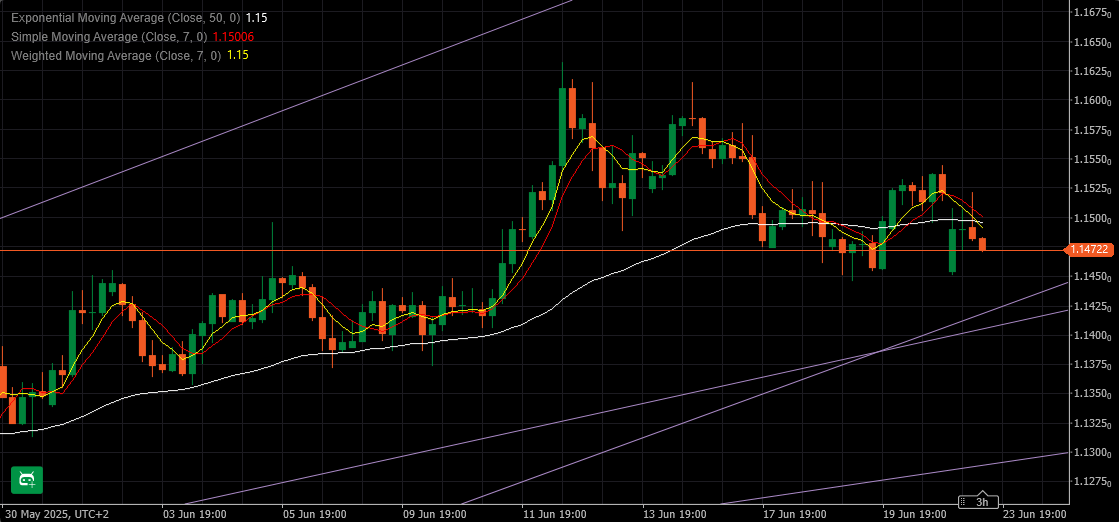
EURUSD is back on the defensive after a bounce failed to hold above 1.15 that more than filled its opening week gap.
CHF lagging on safe haven flows
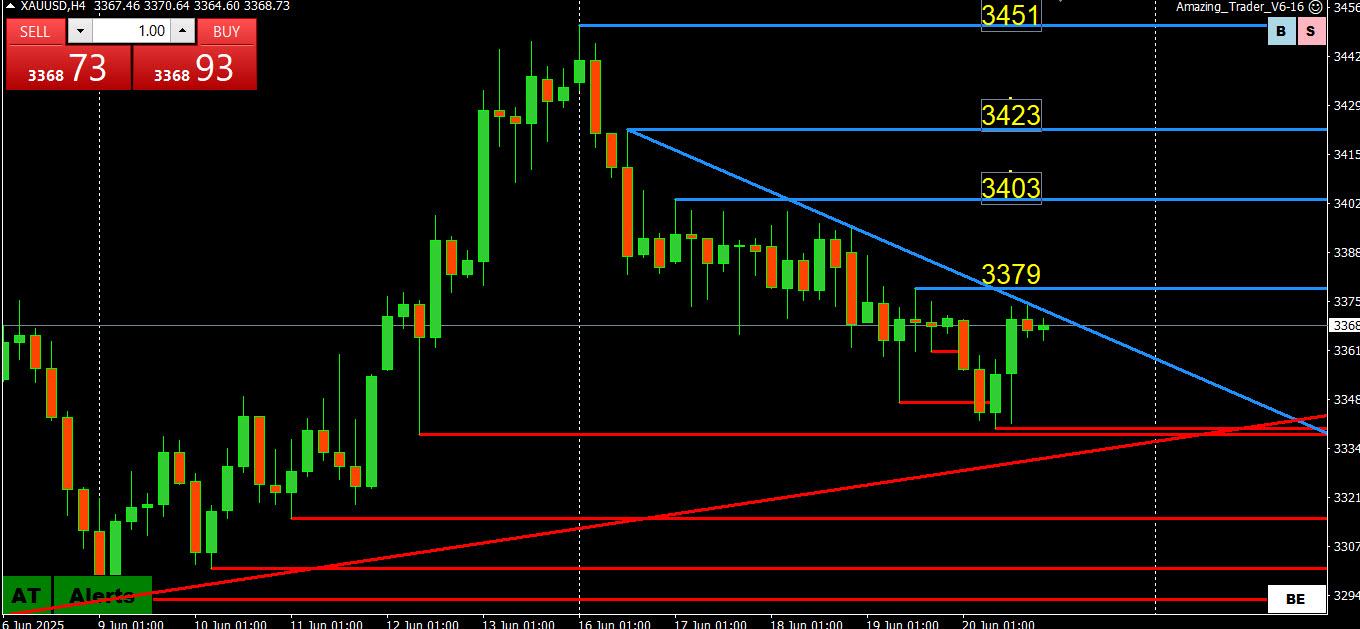
Gold is consolidating as it struggles to regain a safe haven bid
US stocks have bounced from an opening week gap lower but US500 remains below 6000
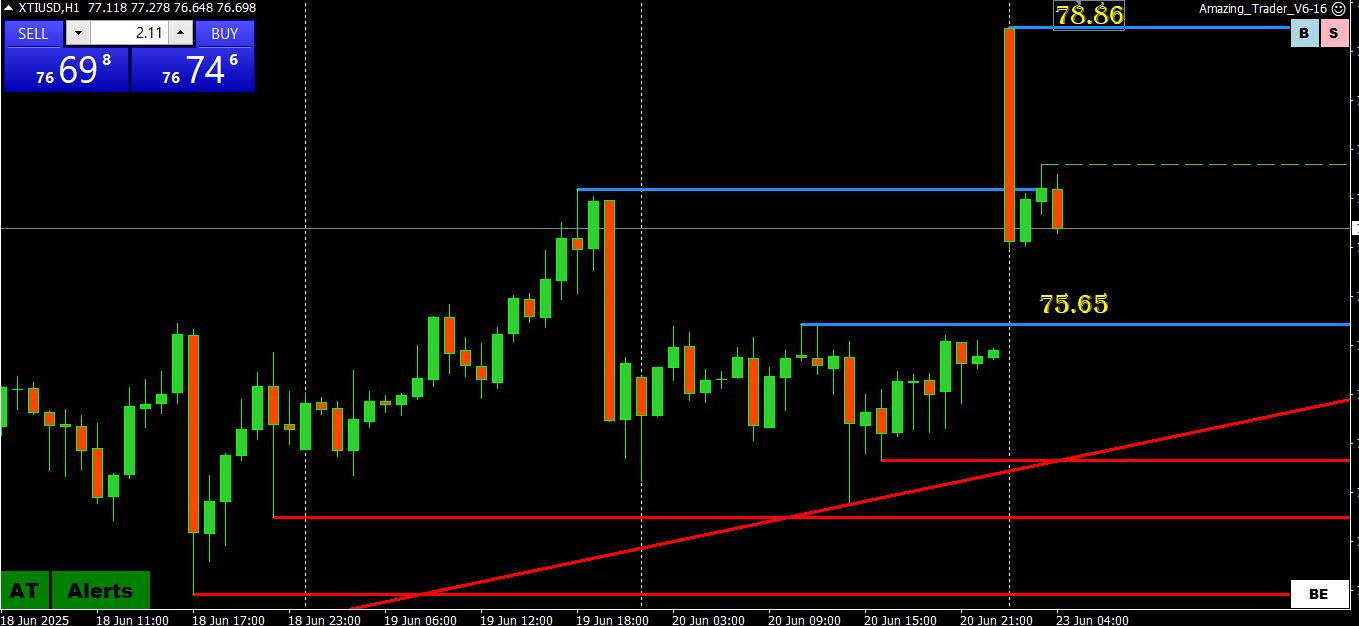
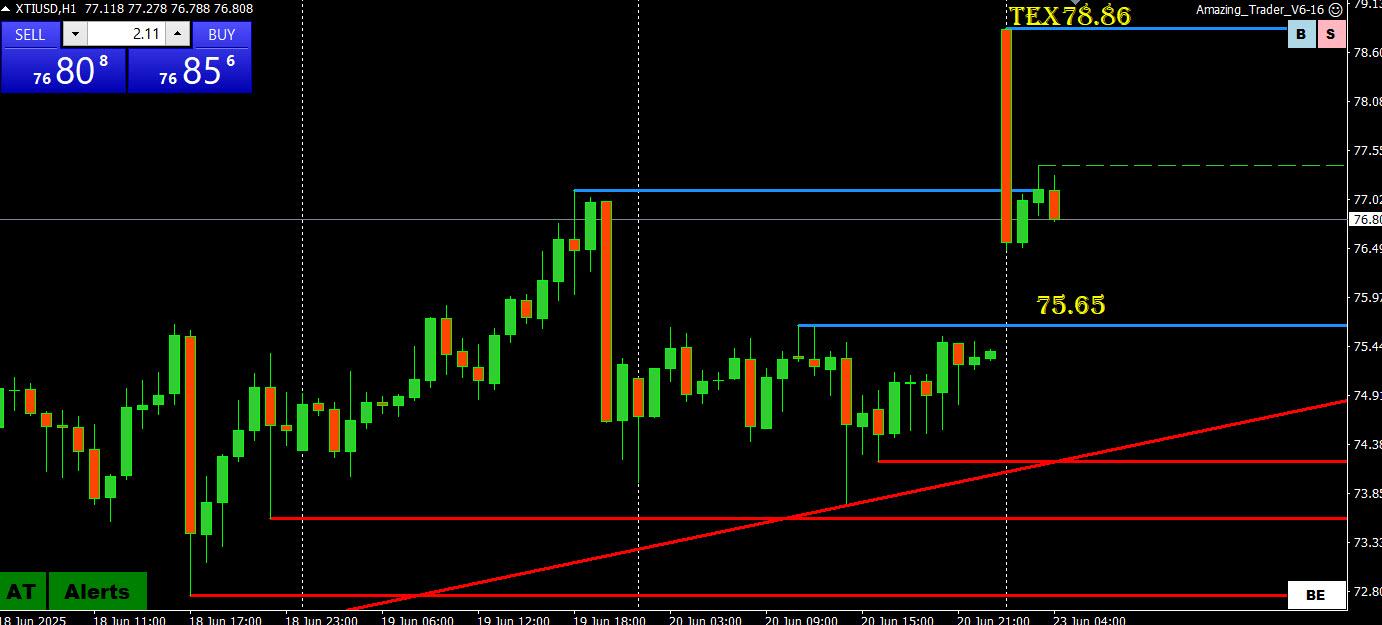
Crude oil has given back gains after its opening week gap higher.
Wait and see…
 June 23, 2025 at 9:15 am #26603
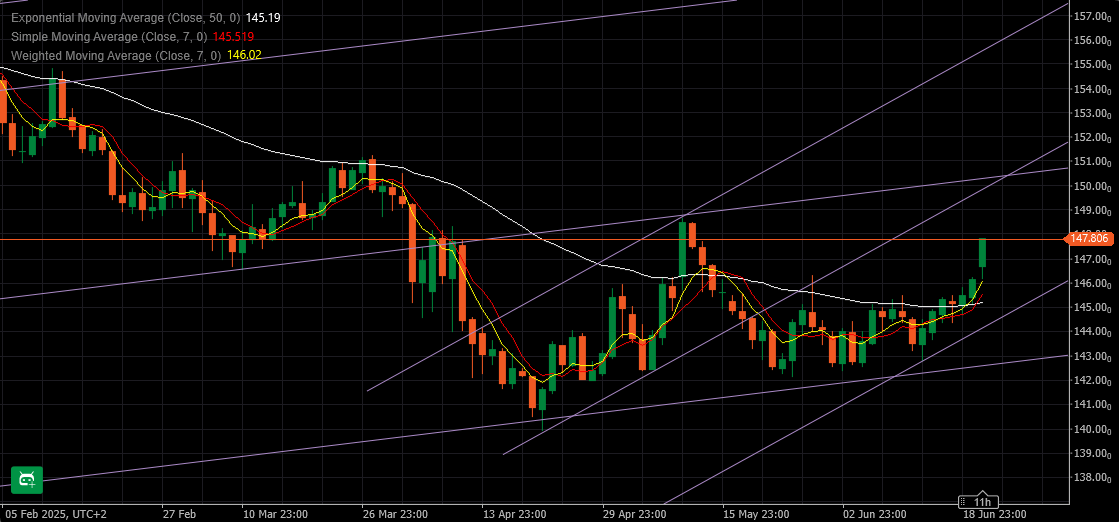
USDJPY
Yen opened with a gap to the upside , but couldn’t fill it completely
Resistances: 148.650, 149.750 & 150.300
Supports: 146.600, 146.200 & 145.950
It is clearly going for the upper trend line and in my opinion only question is can it go above 150.300 – and if so road would be open for 155.000
Intraday pressure – UP
 June 23, 2025 at 9:10 am #26602June 23, 2025 at 9:03 am #26601
DAX
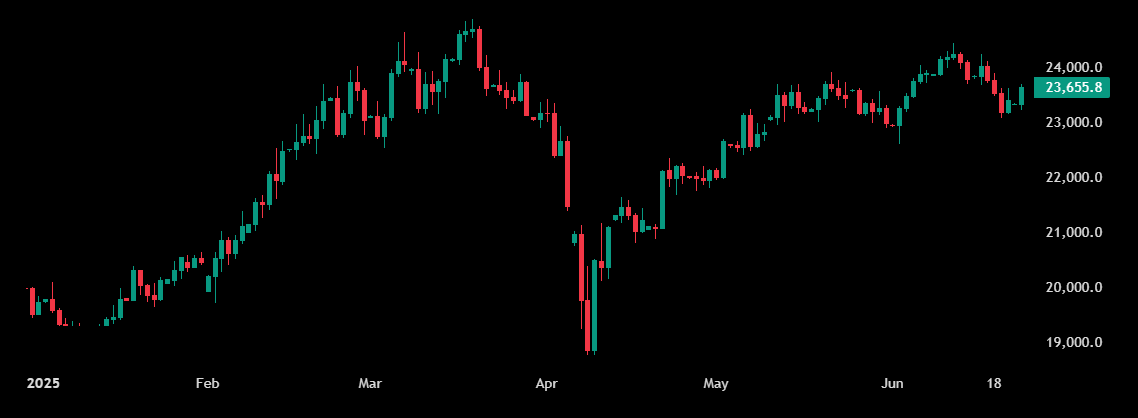
Dax is hovering just above the support at 23.200 – that was breached two days ago, but it managed to spike back.
Resistances: 23.385, 23.480 & 23.605
If support at 23.200 lost again ( and it closes below it ) next target is at 22.515
On a positive note, Dax didn’t react violently on the current geo political crisis.
 June 23, 2025 at 8:41 am #26599
Hang Seng Reverses Early Losses to Finish Higher
The Hang Seng rose 159 points or 0.7% to close at 23,689 on Monday, rebounding from early losses and marking the second straight gain.
All sectors ended higher, led by property, tech, and financials.
Sentiment improved amid a notable rise in mainland markets ahead of China’s top legislature meeting later this week, where fresh stimulus measures might be proposed.
Traders looked past signs of a weaker Wall Street open after San Francisco Fed Mary Daly suggested rate cuts may come in the fall, compared with Governor Christopher Waller’s projection of a July move.
Meanwhile, geopolitical tensions stayed elevated after the U.S. launched strikes on Iranian nuclear facilities, prompting Iran to vow retaliation and leading the U.S. State Department to issue a worldwide caution alert.
Still, the conflict had limited immediate impact on local stocks.
CSPC Pharma gained 1.3% after securing approval for a pain treatment, while Laopu Old (7.8%), SMIC (4.8%), and Akeso Inc. (4.8%) also gained.
 June 23, 2025 at 8:38 am #26598
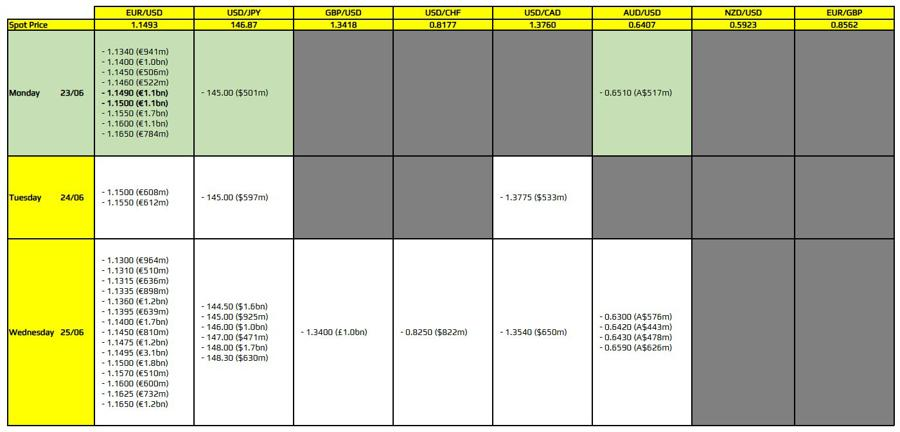
FX option expiries for 23 June 10am New York cut
There are a couple to take note of on the day, as highlighted in bold.
That being for EUR/USD at the 1.1490 to 1.1500 levels. The expiries could play a role in pulling price action, particularly with the key hourly moving averages at 1.1503-15 currently. That being said, trading sentiment is largely driven by the dollar flows in reaction to the Middle East developments. So far today, the dollar is sitting higher but the overall impact to the risk mood is rather measured. As such, there might not be too much in it.
However, USD/JPY is one to keep an eye out for with the pair now running to near 147.00 with the 100-day moving average seen at 146.78. A firm break there could help to underpin the dollar in the session ahead.
 June 23, 2025 at 8:36 am #26597
Euro Stays Weaker After Eurozone PMI Data
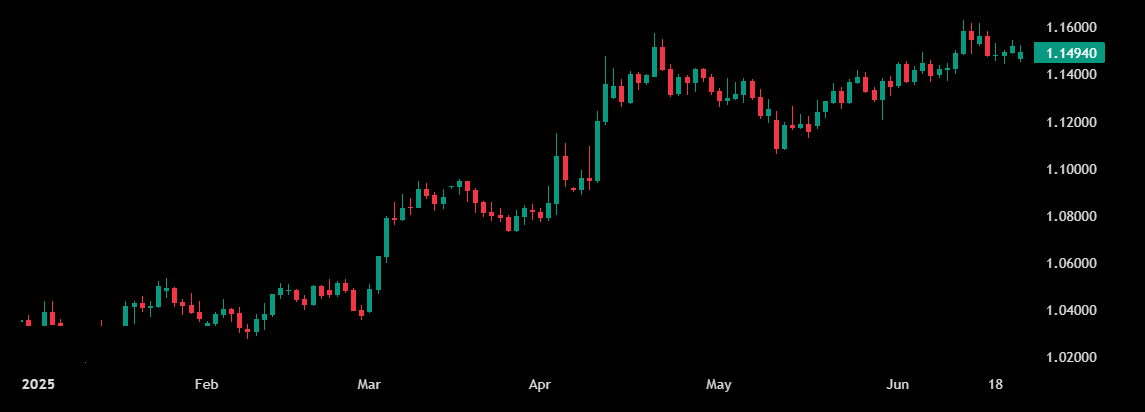
The euro stays weaker against the dollar after the latest eurozone purchasing managers’ survey missed expectations. The composite purchasing managers’ index remained at 50.2 in June, with a level above 50 indicating expansion in business activity. Economists in a WSJ survey expected a reading of 50.5. For the European Central Bank, the price environment for services remains slightly tense with companies still facing significant cost increases, Hamburg Commercial Bank economist Cyrus de la Rubia says in the survey’s press release. “Overall, however, the ECB can remain relatively calm, as the strong euro and the deflationary effect of U.S. tariffs argue against a short-term rise in inflation.” The euro falls 0.3% to $1.1495, little changed from levels before the data.
 June 23, 2025 at 2:04 am #26596June 23, 2025 at 1:57 am #26595
US500 (SP500)
Performing technically with the break of 5948 making a run at 5900. Below 5900 would put 5840-50 in plsy.
Back above 5950 would slow the risk, only 6000 negates it.
Watch US500 as an indicator of risk and the reaction to headline news for a clue as it will likely be geopolitical negative.
US500 4 HOUR CHART
 June 23, 2025 at 1:49 am #26594June 23, 2025 at 1:43 am #26593June 22, 2025 at 10:22 pm #26592June 22, 2025 at 8:44 pm #26591
BTCUSD – Bitcoin
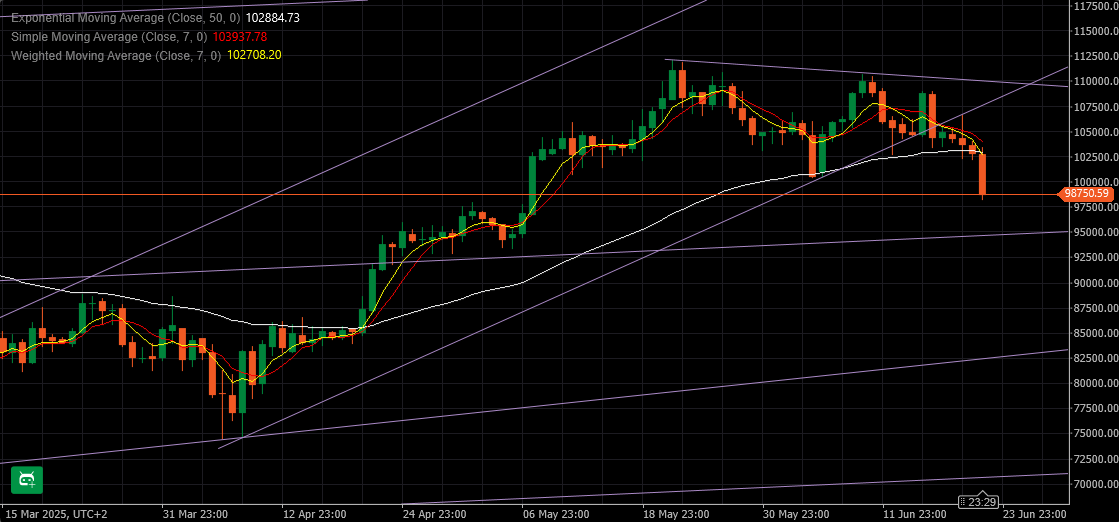
BTC clearly going to test 95K as I warned yesterday.
Now I am going to put some perspective on BTC behaviour in this crisis…
You might not like what I have to say, but keep it in mind.
First of all Bitcoin is not a currency like other ones – it is more of a commodity that are being bought for strictly speculative purposes and even those buying it long term have an exit strategy – the moment when they would like to feel some real cash in their hands ( or on their accounts)
So it is not a safe haven anything….
Second, BTCUSD is bitcoin vs US Dollar – and have no doubt – in crisis like this USD is the ONLY safe haven around.
So when USD gains, others lose….
And third – just imagine a Nuke being dropped….no internet, no cloud, no electronic anything….
And you would like to keep a winners currency in your pocket.
Don’t be naive….
 June 22, 2025 at 8:36 pm #26590
EURUSD – Gap or No Gap
Scenario:
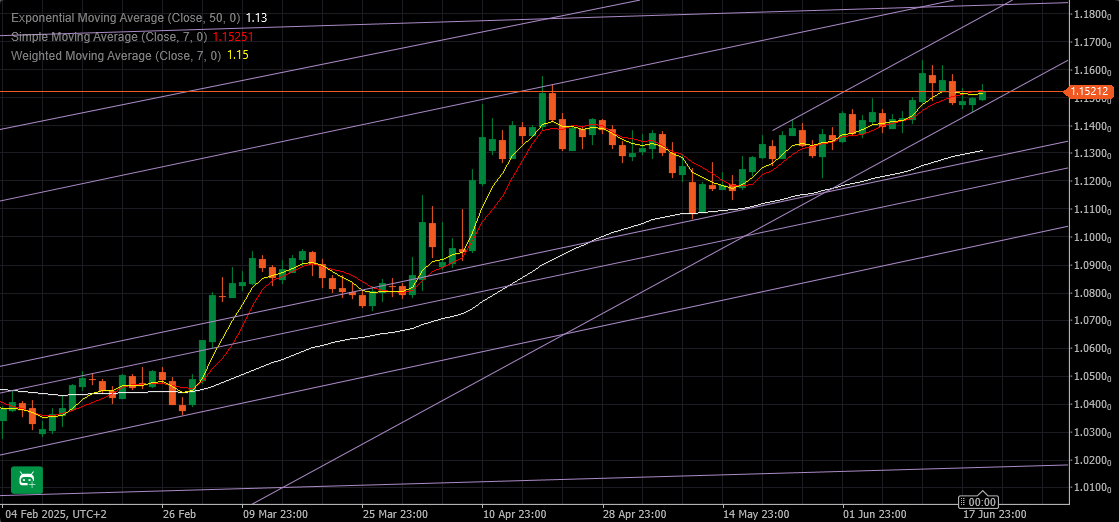
1. EURUSD opens with a gap to the downside – real danger is if it opens below 1.14800 , as it would open a way for attack at 1.14050 – last line before 1.12800 comes to play.
2. EURUSD opens with a gap to the upside – not a problem as it would be in line with the current trend
However it plays out, watch for gap filling as well – that can take you off your feet, even if you are right on direction.
 June 22, 2025 at 8:10 pm #26589
Iran orders closure of Strait of Hormuz — putting one-fifth of world’s oil supply at risk
Iran’s parliament has voted to close the Strait of Hormuz, the vital shipping channel through which around 20% of the world’s daily oil flows.
The move, which could block $1 billion in oil shipments per day, is likely to send oil prices soaring.
It will come into effect pending a final decision by Iran’s Supreme Council. NYP
June 22, 2025 at 8:04 pm #26588June 22, 2025 at 12:25 pm #26587US strikes on Iran nuclear sites are real-life test of hard power’s limits
Key points:· You can bomb away sites but not knowledge, experts warn
· Exact impact from latest strikes remains to be seen
· Status of Iran’s enriched uranium stock is still unclear
· North Korea-style race for bomb is one possible scenario
· Many open questions on programme’s present and future
U.S. military strikes overnight in which President Donald Trump said Iran’s main nuclear sites were “obliterated” will put to the test the widely held view that such attacks can delay a nuclear programme but not kill a determined push for atom bombs.
As Iran’s nuclear programme has expanded and become more sophisticated over the past two decades, many officials and nuclear experts have warned: You can destroy or disable a nuclear programme’s physical infrastructure but it is very hard or impossible to eliminate the knowledge a country has acquired.
Western powers including the United States have publicly suggested as much, complaining of the “irreversible knowledge gain” Iran has made by carrying out activities they object to.
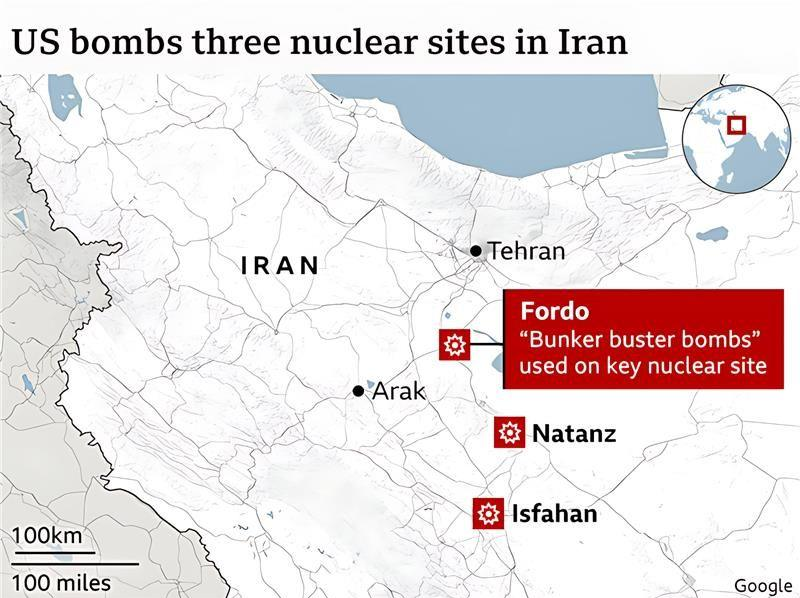
“Military strikes alone cannot destroy Iran’s extensive nuclear knowledge,” the Washington-based Arms Control Association said in a statement after the U.S. strikes with massive bunker-busting bombs on sites including Iran’s two main underground enrichment plants at Natanz and Fordow.
“The strikes will set Iran’s programme back, but at the cost of strengthening Tehran’s resolve to reconstitute its sensitive nuclear activities, possibly prompting it to consider withdrawing from the nuclear Non-Proliferation Treaty, and possibly proceeding to weaponisation.”
Israel has also said it has killed Iranian nuclear scientists but, while little is known about the personnel side of Iran’s nuclear programme, officials have said they are sceptical about that having a serious impact on Iran’s nuclear knowledge, even if it might slow progress in the near term.
The West says there is no civilian justification for Iran’s enrichment of uranium to near weapons-grade fissile purity. Iran says its nuclear objectives are solely peaceful and it has the right to enrich as much as it wants.
After the U.S. withdrawal in 2018 and the re-imposition of U.S. sanctions, Iran pushed past and then far beyond the limits imposed by the deal on items like the purity to which it can enrich uranium and how much it can stockpile.
URANIUM STOCK
At least until Israel’s first strikes against its enrichment installations on June 13, Iran was refining uranium to up to 60% purity, a short step from the roughly 90% that is bomb-grade, and far higher than the 3.67% cap imposed by the 2015 deal, which Iran respected until the year after Trump pulled out.
The last report on May 31 by the International Atomic Energy Agency, the U.N. nuclear watchdog that inspects Iran’s nuclear facilities, showed Iran had enough uranium enriched to up to 60%, if enriched further, for nine nuclear weapons, according to an IAEA yardstick. It has more at lower levels like 20% and 5%.
The exact impact of Israeli and U.S. strikes on Iran’s nuclear facilities and materials has yet to be determined. In addition to the enrichment sites, the U.S. struck Isfahan, where officials have said much of Iran’s most highly enriched uranium stock was stored underground.
One important open question is how much highly enriched uranium Iran still has and whether it is all accounted for.
 June 22, 2025 at 12:17 pm #26586
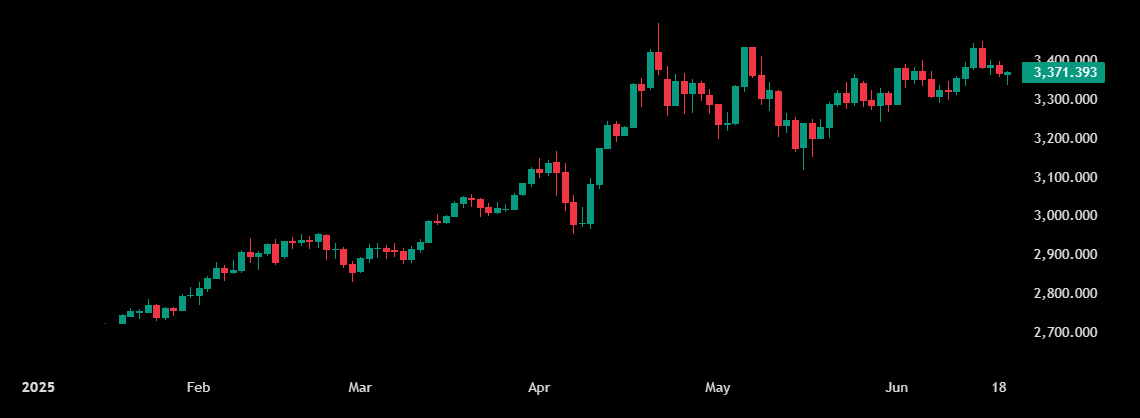
Gold set to surge as geopolitical tensions intensify
Gold prices are expected to rally sharply as escalating geopolitical tensions in the Middle East—triggered by a reported US airstrike on Iranian nuclear facilities—fuel a global flight to safety. Analysts are now projecting gold to trade between $3,500 and $3,700 as investors hedge against both geopolitical instability and inflationary risks.
On Friday, gold initially dipped on expectations that President Trump might pursue diplomatic efforts. However, prices fully recovered by the close in New York, reflecting a swift market reassessment of the likelihood of US military involvement. A long lower shadow on the day’s chart suggested traders had partially priced in a weekend escalation.
Akshay Chinchalkar of Axis Securities noted, “As long as spot gold stays above $3,314, we anticipate an upside target of $3,770, with interim resistance in the $3,450–$3,520 range. Options skew across one-week to three-month tenors is tilting bullish, indicating strong upside positioning.”
Silver, meanwhile, is seen targeting $40, with downside support at $33.68. “Given the positive 60-day rolling correlation between gold and silver over the past decade, we expect silver to benefit from gold’s rally, though likely at a slower pace,” Chinchalkar added.
In 2025 so far, gold has gained over 25 percent, while silver has risen more than 24 percent—highlighting growing investor appetite for precious metals amid rising uncertainty.
“Gold remains the second-largest reserve currency globally, anchoring over $21 trillion in safe-haven assets. In the current environment, gold is set to soar,” said a market expert. While gold benefits from its haven appeal, silver—60 percent of whose demand is tied to industrial and renewable sectors—may lag. Analysts warn that a deepening conflict could spur recessionary fears, putting medium-term pressure on silver.
In a recent note, Goldman Sachs reiterated its structurally bullish view on gold, citing robust central bank demand as a key factor lifting the gold-silver price ratio. The bank does not expect silver to match gold’s pace and sees gold outperforming.Goldman’s base case projects gold at $3,700 per ounce by year-end and $4,000 by mid-2026. In a recession scenario, accelerating ETF inflows could push gold to $3,880 by the end of 2025. Under extreme risk conditions—such as concerns over Federal Reserve independence or shifts in US reserve policy—prices could surge to $4,500.
 June 22, 2025 at 12:11 pm #26585
Crude poised to surge amid escalating Middle East tensions; risks mount for global markets
Crude oil prices are set to spike further in response to heightened geopolitical tensions in the Middle East, following a reported US airstrike on Iranian nuclear facilities. The escalation has triggered a global risk-off sentiment, likely to pressure financial markets worldwide.
Analysts expect crude to open around $80 per barrel and potentially surge past $100, with worst-case scenarios projecting levels above $130 if the Strait of Hormuz is shut.
So far in June, crude prices have rallied 24 percent to reach $75 per barrel, building on a 4 percent gain in May. The Strait of Hormuz—a strategic chokepoint that handles nearly 20 percent of global oil flows—is now at the center of concern, with markets pricing in potential supply disruptions.
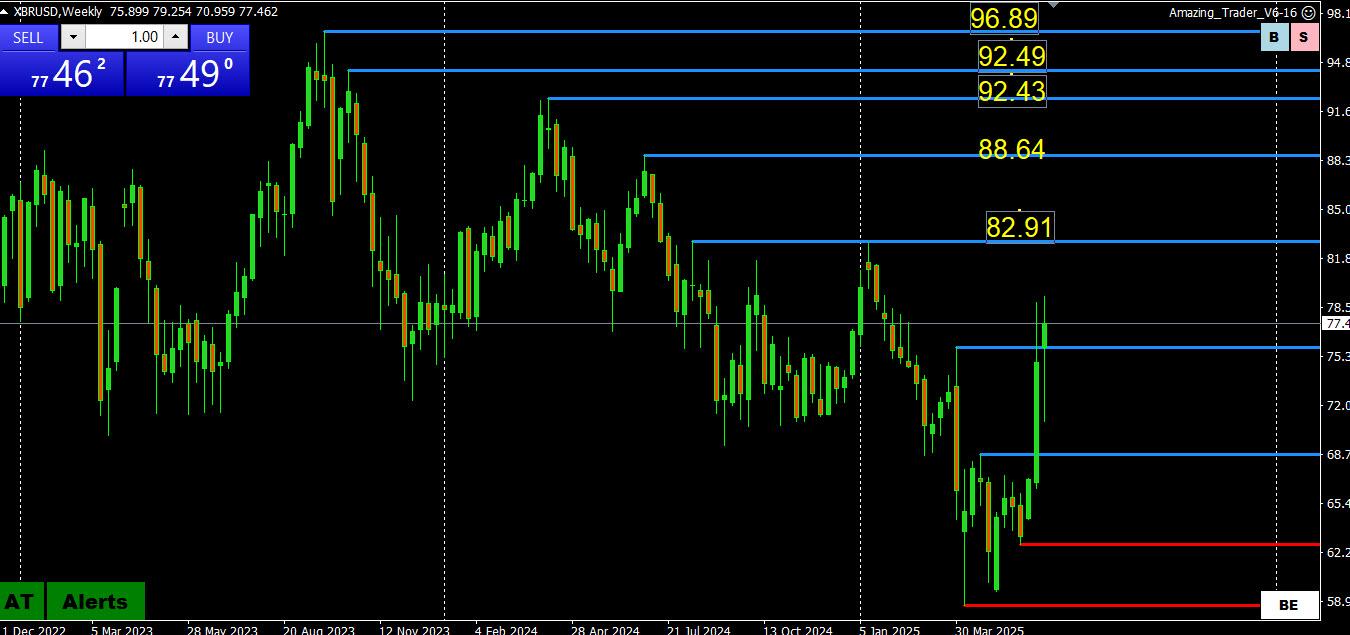
Akshay Chinchalkar of Axis Securities noted, “Brent crude has climbed in the past three weeks and is testing a key trendline from the September 2023 highs around $97. As long as prices stay above $79 and don’t drop below $66.81, we expect an immediate move past the previous swing high of $83. The options market shows a clear bullish bias, with traders favoring upside calls over puts.”
For India—reliant on imports for over 85 percent of its energy needs—the rise in oil prices presents significant macroeconomic challenges. A $10 per barrel increase in crude could widen India’s current account deficit by 0.3 percent of GDP and add to inflationary pressures, eroding real yields.
Experts warn that if Iran retaliates by disrupting traffic through the Strait of Hormuz, crude could spiral to $120–130 per barrel, sharply impacting global equities and triggering a flight to safe-haven assets. “A cornered Iranian regime may target oil shipping in the Persian Gulf and Red Sea, potentially via proxies like the Houthis in Yemen. This raises the stakes significantly,” said analyst, adding that China may need to play a stabilizing role in keeping oil flows intact.
Despite the turmoil, JP Morgan remains cautious in its long-term outlook. In a note dated June 12, the bank maintained its base-case forecast for Brent crude to average in the low-to-mid $60s in 2025, and $60 in 2026. However, it flagged a potential price range of $120–130 per barrel in the event of a full-scale military conflict and prolonged closure of the Strait of Hormuz.While the future trajectory of crude prices remains uncertain, market sentiment is increasingly being shaped by geopolitical developments, leaving little room for complacency, experts added.
 June 22, 2025 at 12:05 pm #26584
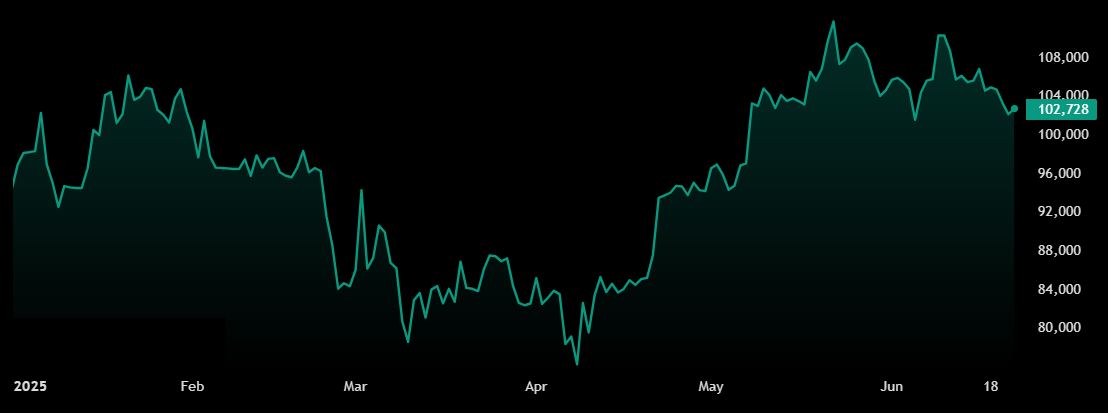
Bitcoin Dominance Skyrockets as ETH and Other Altcoins Plummet
Bitcoin’s price took another turn for the worse in the past 24 hours after the US attacked multiple Iranian nuclear sites, and the asset plunged to a multi-week low.
The altcoins have posted even more notable price declines, which is evident from the growing BTC dominance.
Bitcoin Tries to Recover
The business week began on a different note as the primary cryptocurrency shot from under $105,000 to $109,000 by Tuesday. However, it faced an immediate and violent rejection that pushed it south hard as the tension in the Middle East continued to rage on.
In a matter of hours, BTC dumped to $103,500 before the bulls initiated an impressive leg up that drove the asset higher by around $3,000. Nevertheless, the overall negative market sentiment continued, and bitcoin started to lose value once again in the following days.
The culmination came earlier today as the US launched “successful” attacks against multiple nuclear sites in Iran, as described by the POTUS. Moreover, Trump warned that there will be more violent strikes if Iran decides to retaliate in any form.
Bitcoin’s price tumbled below $101,000 for the first time in almost three weeks. However, it remained within a six-digit price territory and has recovered to $102,500 as of now.
Its market cap is down to $2.040 trillion on CG, but its dominance over the alts has skyrocketed to almost 63% as most bleed out.Alts Deep in Red
The rising BTC dominance in times when the cryptocurrency’s price is dropping means only one thing – the alts have it even worse. Interestingly, it’s not just the lower caps that are suffering badly. Ethereum, the largest of the bunch, has dumped by over 7% in the past 24 hours and is close to breaking below $2,200. Recall that ETH stood tall close to $2,800 just until a week ago.
Solana, Dogecoin, Cardano, SUI, LINK, HBAR, and LINK are also deep in the red from the bigger alts. Even more painful declines come from VIRTUAL, APT, INJ, TIA, TAO, SEI, JUP, FET, and PEPE, as all of them are down by double-digits on a daily scale.
These developments are only supporting a recent report, which claimed that those hoping for an altseason are relying mostly on “wishful thinking” rather than any hard data.
 June 22, 2025 at 10:12 am #26582June 22, 2025 at 10:12 am #26583June 22, 2025 at 10:01 am #26580June 22, 2025 at 9:50 am #26579June 22, 2025 at 9:47 am #26578June 22, 2025 at 1:53 am #26574June 22, 2025 at 12:51 am #26573June 22, 2025 at 12:28 am #26572June 21, 2025 at 11:04 pm #26571June 21, 2025 at 3:00 pm #26570
Crypto Market Slows Down As Fed Rate Cut Expected In September
Bitcoin is hovering near $103,700. There is growing uncertainty in its price action as global tensions rise. Retail sentiment is also weakening, adding to the pressure on BTC. But the current dip may just be a cool-off phase, and not the end of the bull cycle.
Retail Sentiment Hits April Lows
Crypto analytics firm Santiment shared recently that the retail sentiment has turned sharply negative, hitting its lowest point since early April. This is similar to levels seen in April, just before Bitcoin rebounded. With bearish comments rising, the panic could signal a rebound.
The Fed rates are also steady, which has kept BTC stuck between $100K and $ 110 K. On-chain data shows that whales are accumulating while traders pull back.
A Healthy Cool-Off Phase?
The crypto market is currently in a slow correction phase. Altcoins have been declining since December, while Bitcoin remains stuck between $100K and $ 107K. Ethereum is struggling below $3,000, and overall trading volume is dropping, which are clear signs that retail investors are staying out for now.
However, there have been no major crashes or negative events. This is a typical cooling-off period within a larger uptrend, similar to what happened in 2017 and 2021. These phases often follow major rallies and can last a few months.
Looking ahead, there is a positive macro signal too. The Fed may cut rates in September, with a 71.8% chance according to CME FedWatch. This could boost crypto markets, and even the anticipation of rate cuts can lift sentiment and bring life back to risk assets.
Cycle May Extend Into 2026
Real Vision CEO Raoul Pal also believes that the current crypto market closely resembles 2017, when Bitcoin rose steadily before exploding in December. He notes that macro conditions indicate that this cycle could be longer than expected, possibly extending into Q2 2026.
Many long traders were recently wiped out on Binance as open interest dropped. This “cleanup” happened right after the Fed paused rate hikes. With fewer traders now in risky positions and past trends showing Bitcoin often rises after such events, CryptoQuant analysts see this as a potential setup for a Bitcoin bounce.

-
AuthorPosts




- You must be logged in to reply to this topic.
Search
© 2024 Global View