
- This topic has 28,643 replies, 54 voices, and was last updated 5 hours, 24 minutes ago by GVI Forex 2.
-
AuthorPosts
-
June 5, 2025 at 12:53 pm #25875
Stocks pop, USD follows on Trump-Xi headline… watch for details from BOTH sides given Trump’s tendency to paint a rosy picture.
 June 5, 2025 at 12:51 pm #25874
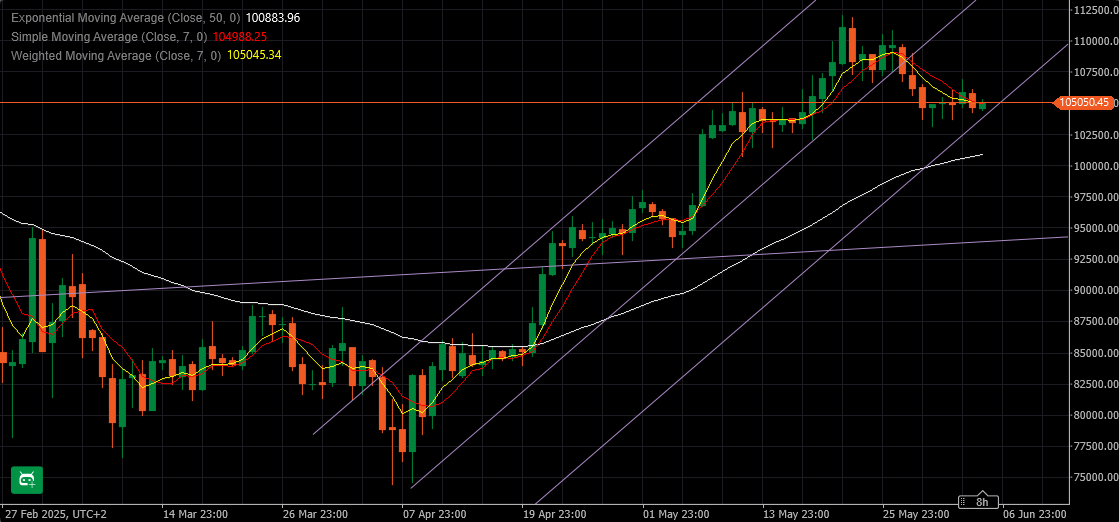
Bitcoin supply shock? Percentage of BTC on exchanges nears 2018 levels
Key takeaways:
· Bitcoin’s percent supply on exchanges has dropped below 11% for the first time since 2018.
· Institutional adoption is accelerating BTC withdrawals from public exchanges.
· Trust in centralized platforms is shaky post-FTX.
Bitcoin’s BTCUSD percent supply on exchanges has dropped to near seven-year lows, falling below 11% for the first time since March 2018, according to Glassnode data.
The peak occurred around March 2020, when over 17.2% of the BTC supply was held on exchanges. Since then, over 6% of the total supply, or roughly 1.26 million BTC, has been withdrawn from exchange wallets.
Bitcoin’s Holding rises to a two-year high
Bitcoin investors are holding onto their coins at the highest level in over two years, according to the latest Exchange Flows to Network Activity Ratio chart by CryptoQuant.
The ratio, measuring the volume of BTC flowing to exchanges relative to on chain network activity, has fallen to its lowest reading since early 2023, signalling subdued exchange deposits despite rising prices.
Historically, such low levels have marked periods of strong conviction among long-term Bitcoin holders, with investors preferring cold storage to trading.
This reduces available supply, with fewer coins potentially up for sale even as Bitcoin nears all-time highs.
Institutional custodians replacing crypto exchanges
The rise of institutional custody solutions is another major factor behind Bitcoin’s decreasing supply across exchanges.
Instead of public exchanges, large financial institutions like BlackRock, Fidelity, and Franklin Templeton prefer third-party custody platforms.
Coinbase Prime, for example, reported over $212 billion in assets under custody in Q1 2025, driven by “inflows from ETF issuers, corporations, and high net worth individuals.”
 June 5, 2025 at 12:44 pm #25873June 5, 2025 at 12:43 pm #25872June 5, 2025 at 12:34 pm #25869
Weekly Jobless claims miss … higher than expected.. highest since Oct 25, 2024
 June 5, 2025 at 12:25 pm #25868
Next up:
US WEEKLY JOBLESS CLAIMS
MONTHLY TRADE BALANCE
key focus will be jobless claims
See our Economic Data Calendar
June 5, 2025 at 12:22 pm #25867June 5, 2025 at 12:14 pm #25865June 5, 2025 at 11:24 am #25864June 5, 2025 at 11:13 am #25863FX, China Economic Report Roil Asian Stock Markets
Asian stock markets were mixed on Thursday as traders weighed foreign exchange rates and reports on China’s economy.
Hong Kong and Shanghai finished in the green, while Tokyo lagged. Other regional exchanges gained ground.
In Japan, the Nikkei 225 opened lower and failed to recover, finishing down 0.5% as a stronger yen undercut export-related issues.
The benchmark Nikkei 225 fell 192.96 to 37,554.49, as losing issues outnumbered gainers 181 to 41.
Leading the upside was semiconductor manufacturing equipment maker Lasertec, up 5.6%, while Sumitomo Pharma declined 6.7%.
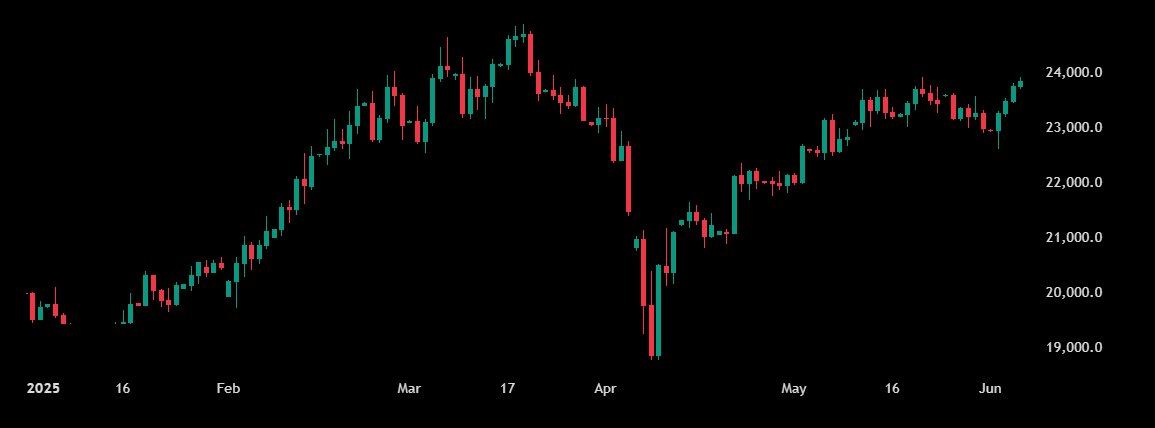
In Hong Kong, the Hang Seng Index finished up 1.1% after a report indicated China’s service sector was expanding.
The broad gauge Hang Seng rose 252.94 to 23,906.97, as gaining issues outnumbered losers 60 to 21. The Hang Seng TECH Index gained 1.9% on the day, while the Mainland Properties Index rose 1.2%.
Leading the upside was smart phone components maker Sunny Optical Technology, gaining 5.6%, while shipping line Orient Overseas International declined 5.9%.
On the mainland, the Shanghai Composite rose 0.2% to 3,384.10.
In economic news, the headline final China services purchasing managers index (PMI) posted at 51.1 in May, up from 50.7 in April, and striking further above the 50-mark that separates growth from contraction, reported S&P Global.
The China composite PMI, a combination of the service and manufacturing sectors, declined to 49.6 in May, down from 51.1 in April, due to a soft factory segment, added S&P Global.
On the other regional exchanges, the S. Korean KOSPI rose 1.5%; the Taiwan TWSE advanced 0.3%; the Australian ASX 200 was steady; the Singapore Straits Times Index rose 0.4%, and the Thai Set gained 0.8%. In late trading in Mumbai, the Sensex was up 0.6%.
Hangseng Chart
 June 5, 2025 at 10:45 am #25862June 5, 2025 at 10:44 am #25861
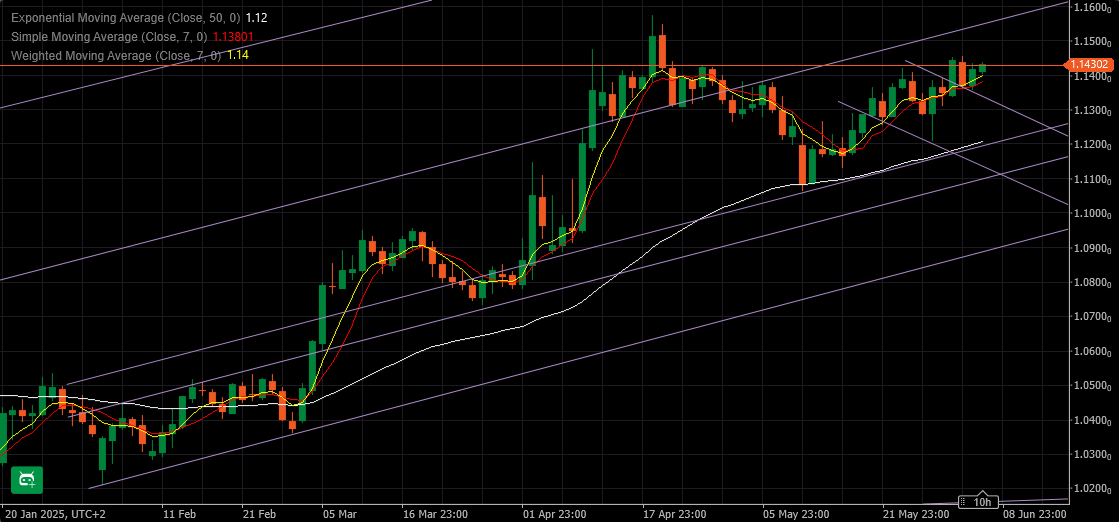
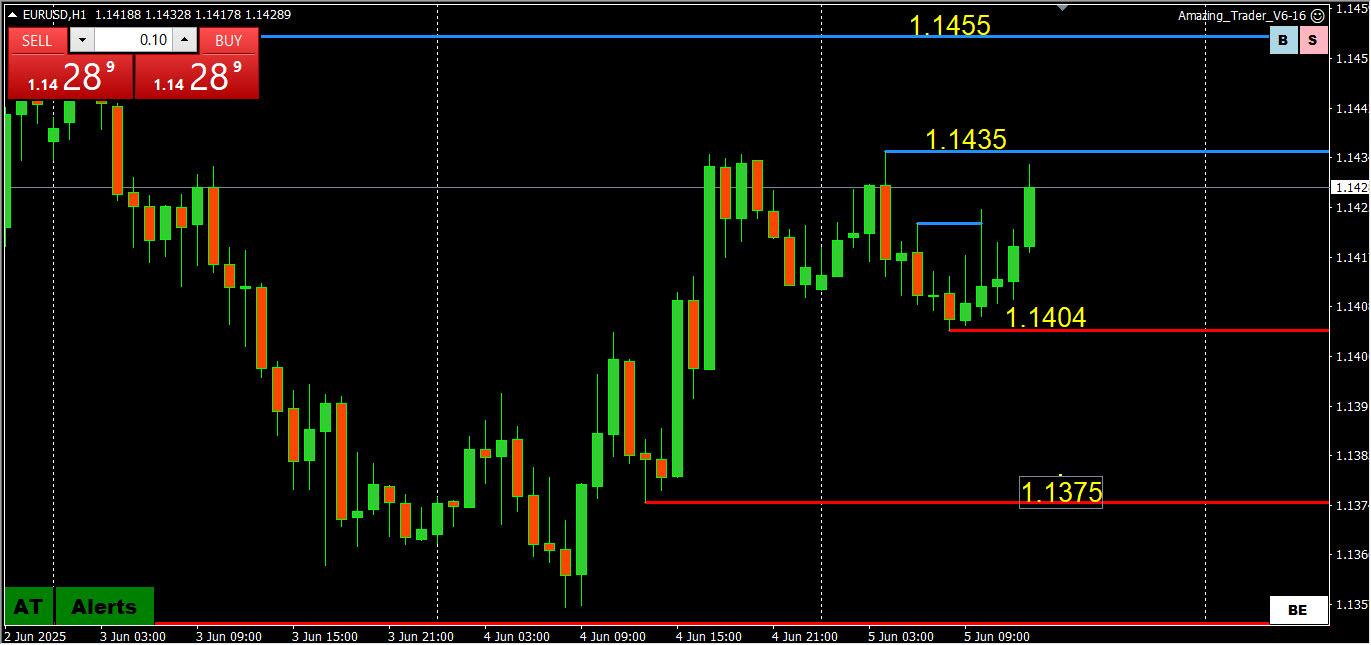
EURUSD
EUR started this morning straight in our direction.
As I said, it is most important that EURUSD overcomes 1.14550 today to be able to continue towards 1.15400
In next 2h it has to hold on the gains and push through 1.14350 and later on 1.14550
Supports: 1.14200, 1.14100 & 1.13800
Right now pressure is Up, but we need to take out 1.14350 soon, to avoid any intraday correction.
 June 5, 2025 at 10:28 am #25860June 5, 2025 at 10:09 am #25859
BofA’s analyst expects more emerging market gains as Dollar drops
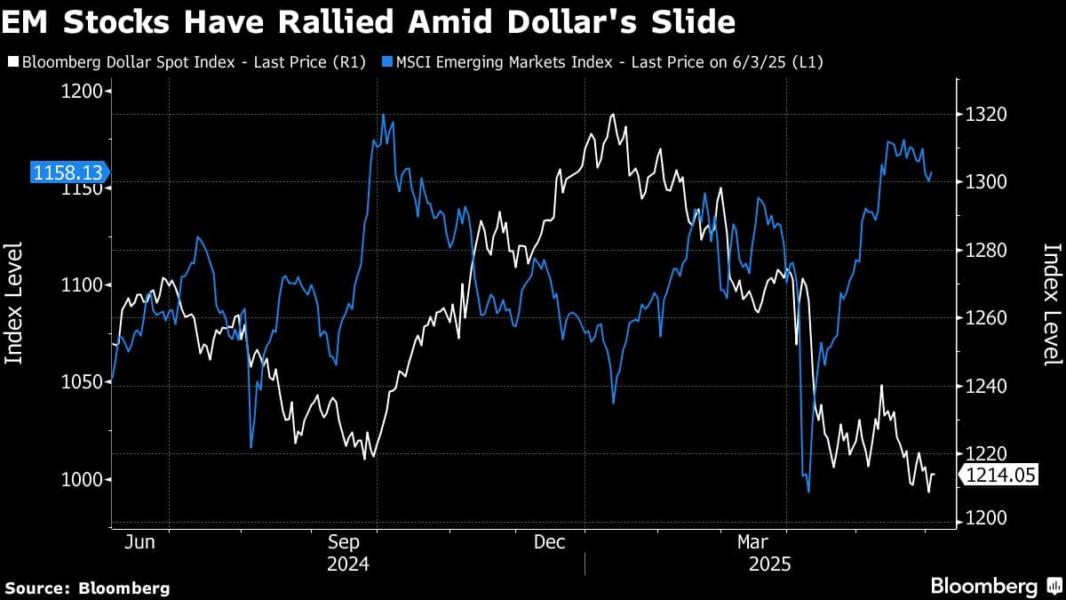
Emerging-market assets look poised to deliver “several percent” returns this year on expectations of a continued decline in the US dollar, according to BofA Securities.
BofA Securities is bullish on the Eastern European currencies and equities. In fixed income, Brazil remains its top pick as interest rates are very high in the South American nation and rate cuts could begin by the end of the year
The US dollar is trading near two-year lows. Wall Street banks, including Morgan Stanley and JPMorgan Chase & Co., expect further weakness in the US currency due to likely interest-rate cuts, slowing economic growth, and ongoing fiscal and trade policy uncertainty. This may accelerate the rotation of funds from US assets into developing nations.
In a context where the dollar weakens, the currency that improves most among the big currencies is the euro. That normally means that the whole European time zone should be doing best because these currencies benefit most when the euro goes up.
This year’s emerging-market rally has been underpinned by local-currency bonds and stocks. Local sovereign debt has handed investors an average total return of 5.7%, led by Brazil where a carry rush has fuelled a 20% gain. Ten other countries have yielded returns of 10% or more.
Stocks, on their part, have ended seven years of underperformance relative to the US market. The MSCI EM index is beating the S&P 500 by more than 7%, led by China and India.
 June 5, 2025 at 10:09 am #25857June 5, 2025 at 10:04 am #25856June 5, 2025 at 9:52 am #25855June 5, 2025 at 9:15 am #25854
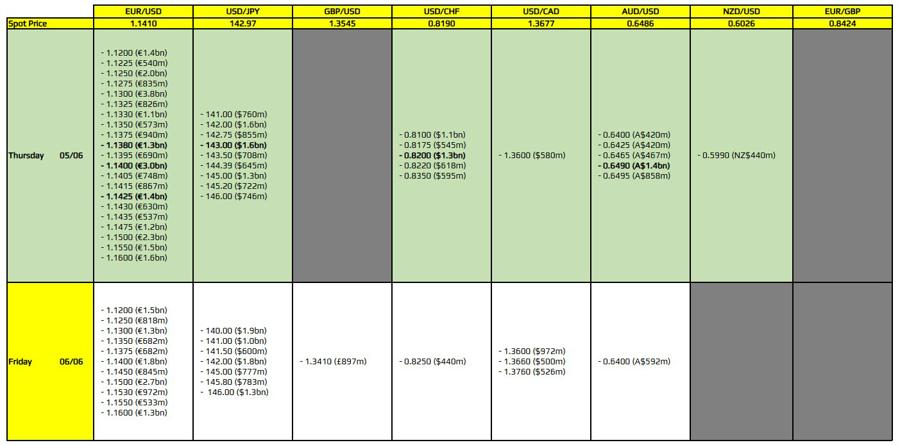
FX option expiries for 5 June 10am New York cut
There are quite a number to take note of on the day, as highlighted in bold.
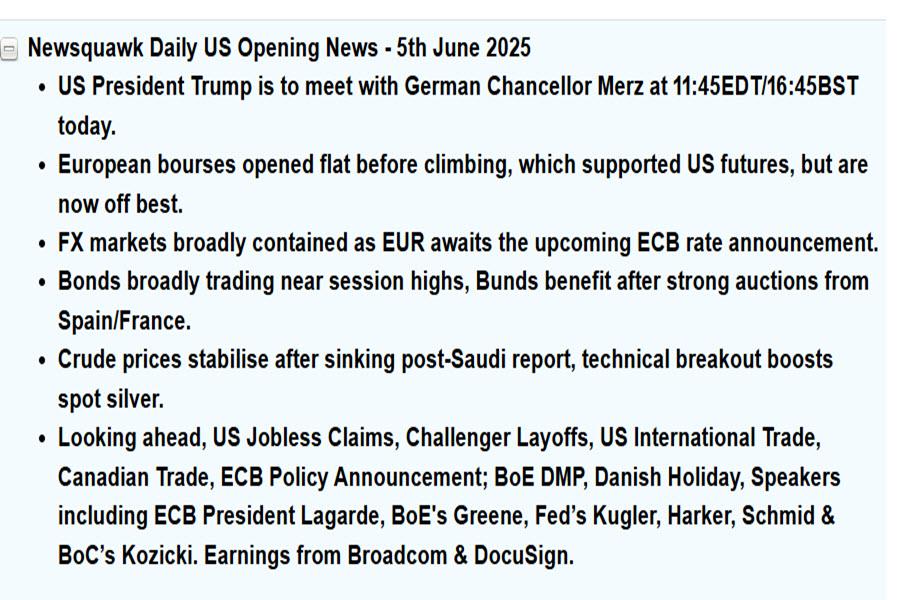
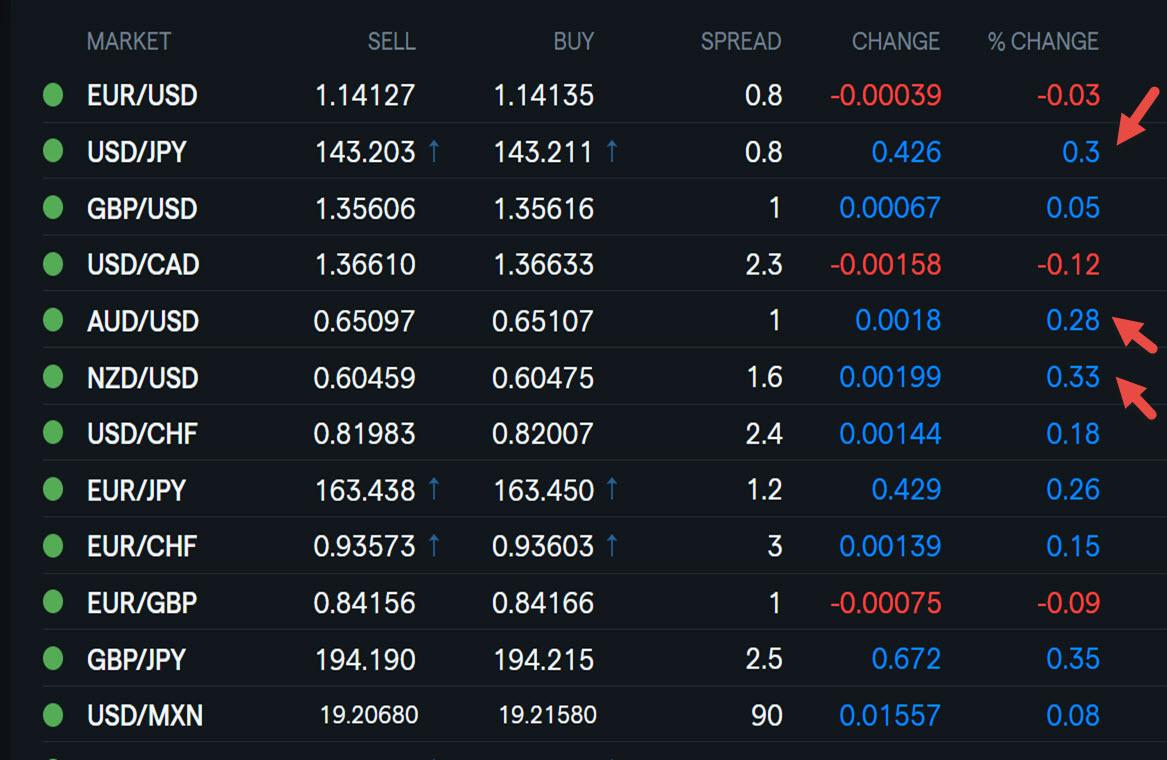
The first ones are for EUR/USD at the 1.1380, 1.1400, and 1.1425 levels. The large ones in particular hold closer to the figure level and are likely to hold price action in and around the 1.1400 mark. That especially with the euro itself eyeing the ECB policy decision later today, even if market pricing already confirms a 25 bps rate cut. The odds priced in are at ~97% currently. So, the expiries should just act as bookends in case we see some extension in dollar sentiment.
Meanwhile, there are also ones for USD/JPY at the 143.00 level. That might play a role in locking price action a fair bit before we get the next swing in the dollar again. It has been a back and forth week for the pair so far, with the larger moves typically coming in US trading.
Similarly, that will also apply to the expiries for USD/CHF at the 0.8200 level. They aren’t ones to hold any technical significance, so any potential impact will follow the same as per the ones for USD/JPY above. But remember, dollar flows/sentiment is still the name of the game as we await more trade headlines and the US jobs report tomorrow.
And lastly, there are ones for AUD/USD at the 0.6490 level. And that alongside the 0.6500 mark should help limit any major upside for the pair unless buyers find enough conviction to finally break free of the figure level. But to do so, it will need to be accompanied by broader dollar selling elsewhere. So, that is the bigger thing to be mindful about.
 June 5, 2025 at 12:17 am #25852June 4, 2025 at 10:47 pm #25851
Tariffs
–
The stream of FED yakkers appear to sing from the same page claiming that tariffs are having an impact on the economy but that the longer term effect in not clear. Trump had set today as deadline for trade partners to come with their “best” tariff and investement offers , but looks like he ll have to be bit flexible. There is 5 weeks left on the reprieve timeline.Xi is proving belligerent and difficult.
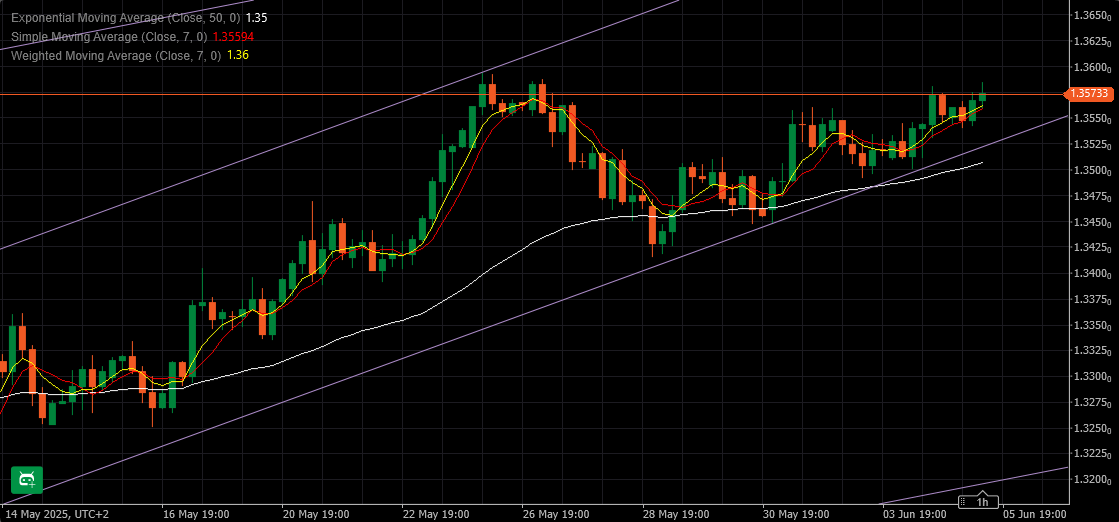
at least so far.June 4, 2025 at 10:20 pm #25849June 4, 2025 at 10:20 pm #25850Usdcad 1.3676
Post-BoC which kept its powder dry and stayed flat on its rate call
–
Canadian « elbows up » patriots screaming at PM carney to retaliate on steel and alum 50% with a canadian 50% tariff NOW.
Trump’s tariff levy effectively closes US market to canadian exports as putting not just canadian jobs at near death but also smelter communities at risk of POOF! setting politicians’ hair on fire.June 4, 2025 at 10:10 pm #25848June 4, 2025 at 8:20 pm #25847June 4, 2025 at 8:08 pm #25846June 4, 2025 at 8:03 pm #25845June 4, 2025 at 7:52 pm #25844June 4, 2025 at 7:38 pm #25843June 4, 2025 at 7:32 pm #25842June 4, 2025 at 7:27 pm #25841 -
AuthorPosts




- You must be logged in to reply to this topic.
Search
© 2024 Global View