
- This topic has 28,293 replies, 54 voices, and was last updated 3 hours, 2 minutes ago by GVI Forex 2.
-
AuthorPosts
-
July 15, 2025 at 11:13 am #27534
Japanese upper‑house (House of Councillors) election:
Election Overview Date: July 20, 2025
• Half of the 248 seats (124 seats) are up for grabs, using a mix of single-seat districts and proportional representation  .
• The ruling coalition of the Liberal Democratic Party (LDP) and Komeito currently holds 75 seats not contested this time out of a needed 125 for a majority .What the Polls Say
• A Kyodo poll suggests the LDP could win fewer than 40 of the 125 contested seats, potentially triggering calls for Prime Minister Ishiba’s resignation .
• An Asahi Shimbun survey estimates LDP will capture ~34 seats, Komeito ~9, totaling roughly 118 seats—7 short of a majority .
• Smaller and populist parties like Sanseito and the Democratic Party for the People (DPP) are gaining support.Political and Economic Stakes
• PM Ishiba, leading a minority government since October 2024, is under pressure. A loss in this election could further weaken his position .
• Mounting cost-of-living pressures—especially for food staples like rice—and voter dissatisfaction over stagnant wages are fueling support for opposition calls for tax cuts and welfare expansion .
• The bond market is jittery: long-term government bond yields have hit multi-decade highs, with the 10-year at 1.59%—the highest since 2008—and the 20–30-year yields at century highs, driven by worries about fiscal looseness and potential populist economic policies .International Context
• Japan urgently needs to finalize a U.S. trade deal by August 1 to avoid 25% tariffs—a process that may be complicated if the ruling coalition loses and fiscal or leadership instability emerges .
• A loss could also intensify friction with the U.S. on trade and defense commitments under Prime Minister Ishiba’s leadership (from the Internet) July 15, 2025 at 10:36 am #27533July 15, 2025 at 10:33 am #27532
SocGen’s Overnight Economic News Summary
— US dollar trims gains ahead of United States consumer price index, President Trump open to more trade negotiations. European Union submits target list of U.S. retaliatory goods to heads of state consisting of industrial goods (65.7 billion euros and smaller section of agri 6.3 billion euros.
— Long end on a knife edge: 30-year US Treasury on cusp of returning above 5%, Bund clears 3.25%, 30-year Japanese government bond scales record high of 3.219% ahead of Upper House election on Sunday, ruling coalition may struggle to hold onto a majority. JGB spillover risks?
—China Q2 GDP +1.1% quarter over quarter (5.2% year ove year), down from +1.2% in Q1. June retail sales slow to 4.8% year over year, industrial production up 6.8%, FAI year-to-date down to 2.8%, property investment slumps 11.2% year over year. USDCNY bid above 7.17. 10-year CGB yield -1bp at 1.66%.
— Day ahead: U.S. CPI, SocGen forecast 0.3% for headline and core. Federal Reserve speakers Bowman, Barr, Collins, Barkin. Germany ZEW survey. Bank of England Governor Bailey Mansion House speech. Canada CPI.
— Nikkei +0.4%, EUR 10-year IRS unchanged at 2.69%, Brent crude -0.4% at $68.9/barrel, Gold +0.4% at $3,357/oz.
USDCNY Chart
 July 15, 2025 at 10:31 am #27531July 15, 2025 at 10:28 am #27530
Euro Off from Recent Highs
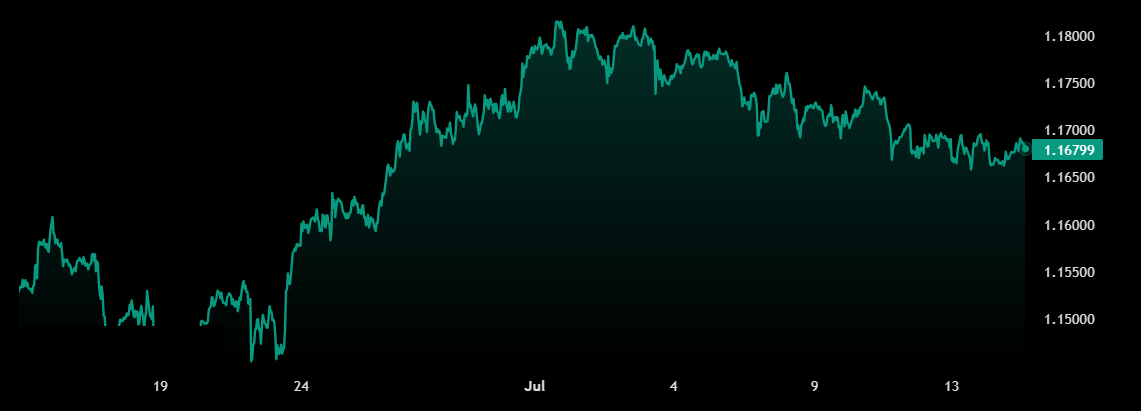
The euro traded around $1.17, hovering near a three-week low, as traders weighed ongoing trade developments.
US President Trump announced a 30% tariff on imports from the European Union starting August 1st, though he later signalled openness to negotiations.
In response, the EU reiterated its commitment to securing a trade agreement and said it would hold off on immediate countermeasures, extending the suspension of planned retaliatory tariffs until early August to allow for continued dialogue.
On the monetary policy front, investors largely expect the ECB to keep borrowing costs unchanged at next week’s meeting.
However, markets are still pricing in one more 25bps rate cut later this year.
Despite the recent pullback in July, the euro remains up nearly 13% against the dollar year-to-date, supported by broad dollar weakness and renewed optimism about the eurozone’s economic outlook, particularly after Germany’s shift toward increased fiscal spending.
 July 15, 2025 at 10:23 am #27529
FX option expiries for 15 July 10am New York cut
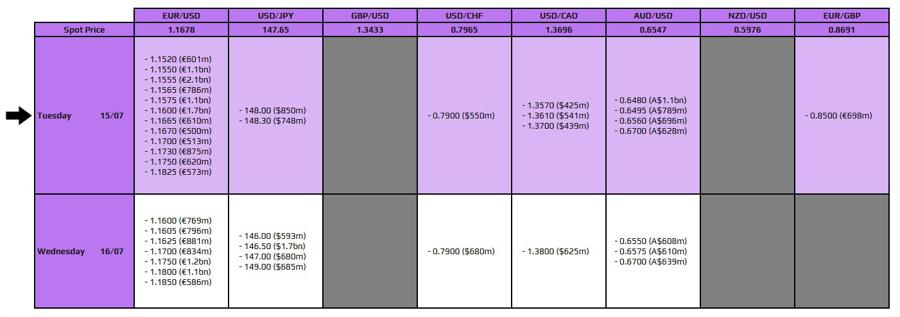
There aren’t any major expiries to take note of on the day, with the larger ones being quite a distance away from the current spot prices.
As such, there won’t be much influence from these on price action all before we get to the US CPI report later in the day. That is the make and break for trading sentiment as we get into the thick of things this week. So, that should lead to a bit more of a quieter session in Europe on the major currencies front; all else being equal.
 July 15, 2025 at 10:13 am #27528
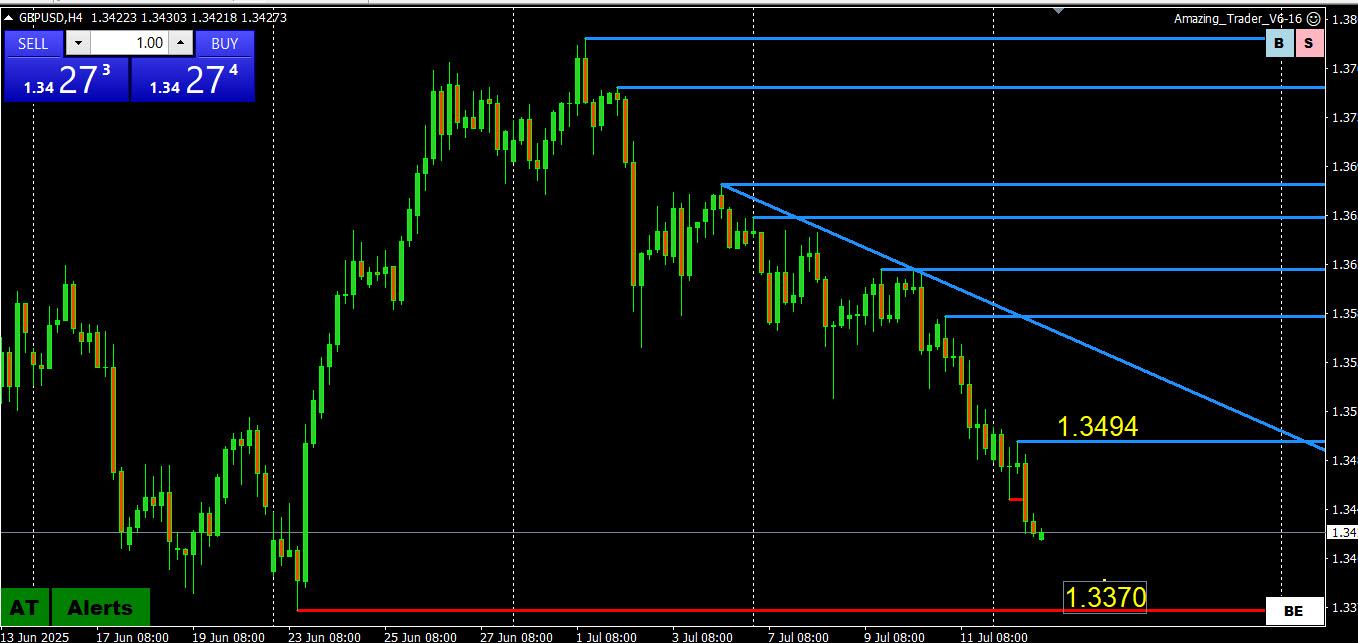
GBPUSD
2 red Amazing Trader (AT) ladder lines drawn off the low indicate a potential change in direction (from down to up) BUT to negate the downside risk 1.3494 would need to be regained.
Otherwise, it is just a retracement with a potential for the low to be in place.
Note, the catalyst for Monday’s fall was a firmer EURGBP, which has backed off Tuesday, easing the selling pressure on GBPUSD.
GBPUSD 4 HOUR CHART
 July 15, 2025 at 10:02 am #27527July 15, 2025 at 9:46 am #27526
USDX (US DOLLAR INDEX)
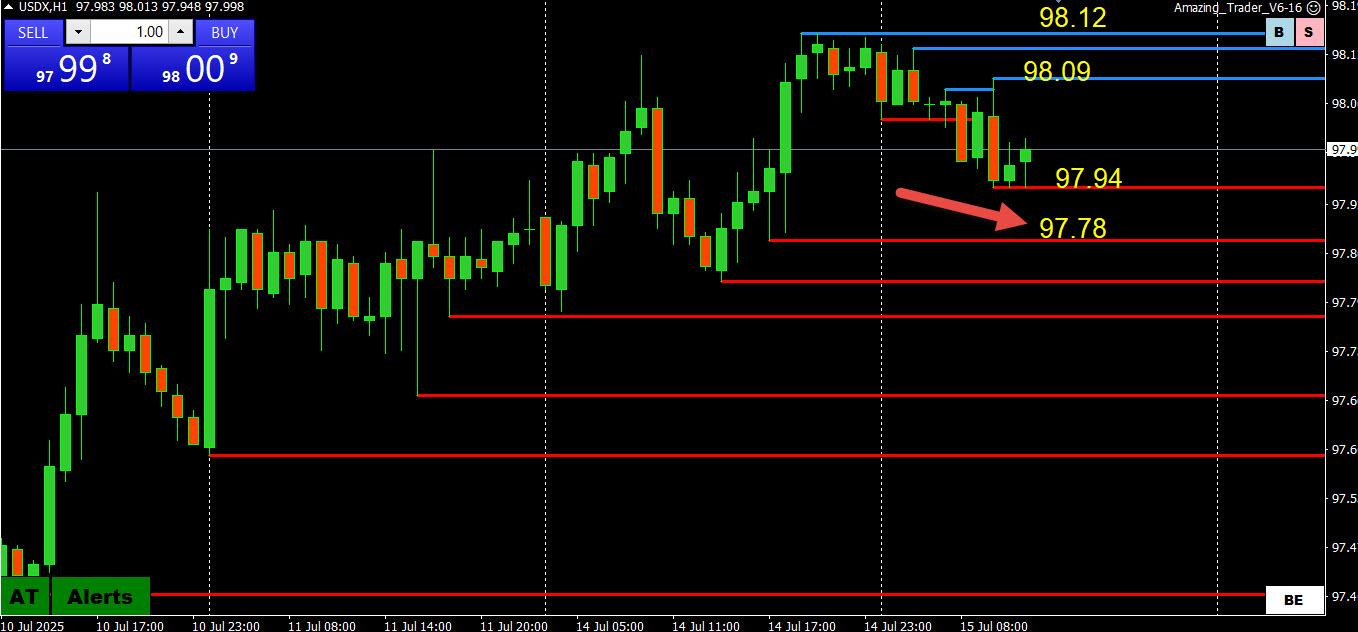
Potential change of direction (lower blue AT lines) but only back below 97.78 would confirm a break of the uptrend.
With EURUSD representing 57.6% of USDX, a mov e back above 1.1700 and then 1.1714 would be needed to put 97.78 at risk.
Otherwise, it is consolidation with an eye on EURUSD for direction.
USDX 1 HOUR CHART
 July 15, 2025 at 9:37 am #27525July 15, 2025 at 9:25 am #27524July 15, 2025 at 9:24 am #27523
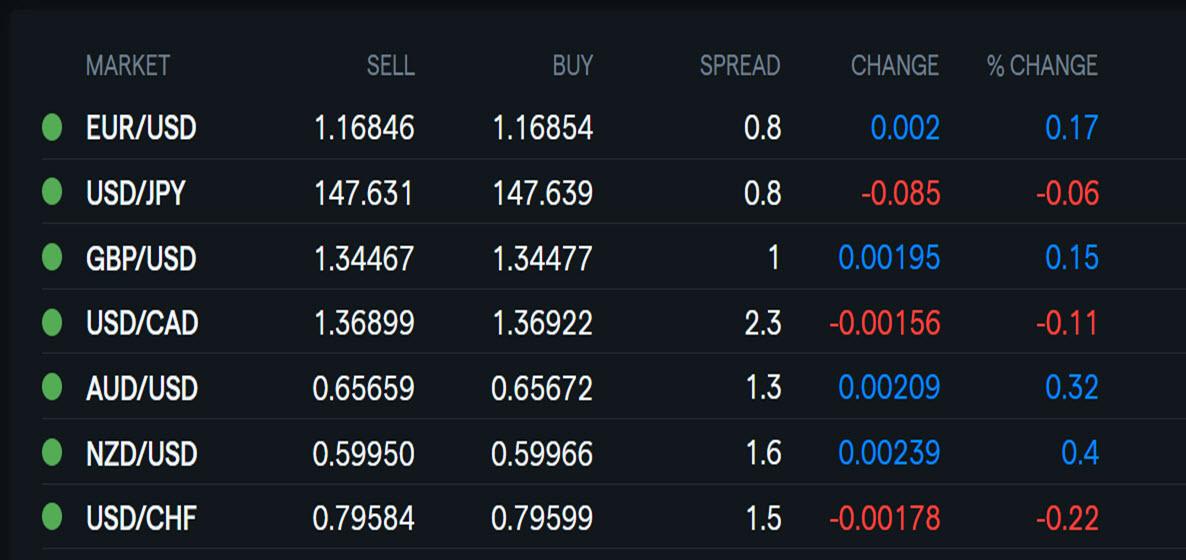
Using my platform as a HEATMAP shows…
… markets getting a reprieve from a hyper focus on tariff news as they await the release of U.S. June CPI
The dollar trading lower as it consolidates after opening the week on a firmer note
USDJPY backed off after making a run at 148 (high 147.82) but remains above 147.50
EURUSD is up but still beloow 1.17
Gold is firmer. Bitcoin is lower
US stocks are firmer
US bond yields down slightly ahead of CPI
 July 15, 2025 at 8:49 am #27522July 15, 2025 at 5:35 am #27521July 15, 2025 at 1:03 am #27520July 15, 2025 at 1:01 am #27519July 15, 2025 at 12:58 am #27518July 14, 2025 at 10:16 pm #27517July 14, 2025 at 9:52 pm #27516July 14, 2025 at 9:01 pm #27515July 14, 2025 at 7:50 pm #27514
NAS100 (NASDAQ)
Impressive start to the week here as well, shrugging off a lower gap opening, finding support in our 22600-60 band and then bouncing back in range of its record 22935 high BUT
To expose the high, 22877 needs to become support. Otherwise, expect support as long as it trades above 22600.
NAS100 4 HOUR CHART
 July 14, 2025 at 7:46 pm #27513July 14, 2025 at 7:43 pm #27512July 14, 2025 at 7:02 pm #27511July 14, 2025 at 6:55 pm #27510July 14, 2025 at 6:48 pm #27509July 14, 2025 at 6:42 pm #27508July 14, 2025 at 6:39 pm #27507July 14, 2025 at 6:29 pm #27506July 14, 2025 at 6:25 pm #27505
THIS WEEK’S MARKET-MOVING EVENTS (all days local)
The upcoming economic data releases for the week of July 14, 2025, are set to reveal how ongoing global trade tensions—particularly between the U.S. and China—are reshaping economic performance across major regions. In Asia, China’s Q2 GDP is expected to grow at a slightly slower pace of 5.1% year-over-year and 0.9% quarter-over-quarter, reflecting the early effects of recent tariff escalations. Chinese trade data, including a forecasted $112.6 billion surplus, will be closely watched for signs of export resilience or redirection, particularly toward Europe. Meanwhile, Singapore and India will also publish trade and inflation figures, and Australia’s labor market data will help clarify the Reserve Bank’s recent decision to hold interest rates steady.
In Europe, data suggest the continent may be benefitting indirectly from the U.S.-China trade standoff. German trade posted a solid €18.4 billion surplus in May, though exports to the U.S. dropped sharply. Indicators like the RWI/ISL container throughput index and the North Range Index point to increased shipping activity, implying that China could be rerouting goods to European markets to avoid U.S. tariffs. Eurozone inflation is expected to remain stable at 2.0% y/y, offering some policy stability ahead.
In the U.S., markets will be focused on the June CPI report, retail sales, and the Fed’s Beige Book. Inflation is projected to edge higher to 2.7% y/y, with core inflation hitting 3.0%, though lower energy prices may help limit the headline figure. Retail sales are likely to remain sluggish, with a forecasted 0.1% monthly increase, as consumers appear fatigued from prior front-loaded spending. The Beige Book may provide critical qualitative insight into how businesses are navigating this volatile environment, especially in light of recent hiring slowdowns and muted demand.
Econoday
-
AuthorPosts










- You must be logged in to reply to this topic.
Search
© 2024 Global View