
Headline News
Have you ever been watching your trading platform when a currency pair (or any asset you trade) suddenly jump or drops 20 pips or more even though no economic report or central bank announcement was scheduled?
Sometimes the price returns to its starting point almost immediately.
At other times, the initial move grows larger. A currency might suddenly rise or fall 50 pips and remain firmly bid or offered. The same thing can happen in stocks, bonds, gold, oil, cryptocurrencies, and stock indices.
When traders cannot find an obvious reason for the move, they may be left scratching their heads. However, the explanation is often an unexpected headline that has been detected and acted upon by news-trading algos.
Markets have always responded to breaking news. There were times when only those with budgets to spend could afford to subscribe to major news feeds. What has changed is not just wider access to major news feeds but to other secondary sources of news headlines that can move markets. But that is just part of the story. It is the speed of the reaction and the range of headlines capable of setting prices in motion.
Scheduled News Is Only Part of the Story
Most traders associate market-moving news with scheduled events such as:
- Inflation reports
- Employment data
- Central bank meetings
- Interest-rate decisions
- Economic growth figures
- Speeches by monetary policymakers
- Corporate earnings announcements
Because these events are listed on economic calendars, traders generally know when to expect increased volatility.
Unscheduled news is different. It can appear without warning and instantly change market expectations.
Examples include:
- An off-the-cuff comment from a political leader
- An unexpected central bank remark
- A report involving trade or tariffs
- A sudden diplomatic development
- A military escalation or ceasefire report
- A government policy announcement
- A social media post from an influential official
- An unconfirmed report attributed to anonymous sources
Political and geopolitical headlines have become especially important. Comments involving tariffs, trade negotiations, armed conflicts, sanctions, or relations between major countries can immediately affect currencies, oil, gold, bonds, and stock indices.
The market may react before traders have had enough time to decide whether the news is credible, important, or likely to produce a lasting change.
What Causes the Instant Market Reaction?
One of the principal drivers of these sudden price movements is news trading algos.
News-trading algorithms are automated systems designed to monitor electronic newswires, official announcements, economic releases, and, in some cases, social media. They can scan incoming information for words and phrases that have historically affected financial markets.
Depending on their programming, these systems may evaluate:
- Whether a headline is positive or negative
- Which markets are likely to be affected
- Whether the information was expected
- How important the source appears to be
- Whether the headline contains market-sensitive keywords
- How the new information differs from previous expectations
Once a potential trading signal is identified, an algo may submit an order in a fraction of a second.
Human traders cannot read, interpret, and react to a headline at the same speed. By the time a person understands what has happened, automated systems may have already executed the first wave of trades.
This helps explain why markets sometimes move before the reason appears on a trader’s screen.
The “Act First, Reassess Later” Reaction
The initial response to a breaking headline can sometimes feel like a case of “act first and ask questions later.”
An algo may recognize a market-sensitive phrase and execute a trade based on its expected meaning. Other automated systems may detect the price movement and join it. Stop-loss orders can then be triggered, adding further momentum.
This can create a rapid sequence:
- A headline reaches the newswires.
- News algos identify significant keywords.
- Automated orders enter the market.
- Prices move sharply.
- Stop-loss and momentum orders are triggered.
- Human traders begin interpreting the news.
- The market decides whether the initial reaction was justified.
Reaction to a weaker-than-expected (July 2026) U.S. employment (NFP) report
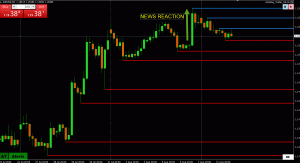
The first move is the market’s immediate response. The second phase is the reassessment.
That distinction is extremely important
Why Some Headline Moves Reverse
A sudden price spike does not necessarily mean that the market has begun a sustainable move.
After the first reaction, traders and institutions examine the complete story. They may discover that:
- The headline lacked context
- The comment repeated an existing policy
- The source was unreliable
- The report was later denied
- The statement was less important than it initially appeared
- The market had already priced in the development
- The news did not change the broader outlook
If the headline fails to justify the original reaction, the price may quickly return to where it began.
These “blink and you will miss it” moves are often the result of a fast automated response followed by a more thoughtful market reassessment.
A sharp move that immediately reverses may indicate that the initial headline did not alter the underlying balance between buyers and sellers.
Why Other Headline Moves Continue
Sometimes the initial reaction holds and develops into a much larger move.
This can happen when the headline:
- Changes expectations for interest rates
- Alters the outlook for economic growth or inflation
- Increases geopolitical risk
- Threatens the supply of an important commodity (e.g. crude oil)
- Changes government trade or fiscal policy
- Confirms an existing market concern
- Catches traders positioned in the wrong direction
Positioning can be especially important. If traders are heavily long and unexpected negative news appears, the initial decline may force them to sell. Stop-loss orders and position liquidation can then accelerate the move.
The same process can occur in the opposite direction when a market is heavily short.
A sustained reaction suggests that the news may have changed expectations or exposed a market that was vulnerable to a move.
Reaction to news later in the U.S. trading say may have a harder time reversing (assuming it was overdone) until markets close and a new day begins.
6 Essential Ways Traders Should Spend Time Analyzing the Markets
Geopolitical Headlines Can Affect Several Markets
Geopolitical news frequently produces reactions across multiple asset classes.
A headline suggesting an escalation in the Middle East, for example, could initially lift oil prices because of concerns about production or transportation. Higher oil prices could then affect inflation expectations, bond yields, stock indices, and currencies belonging to oil-producing or oil-importing countries.
Similarly, a headline involving tariffs could influence the currencies of the countries involved, shares of affected companies, government bonds, and expectations for inflation and economic growth.
The reaction in the first market can spill over into other markets as algos and traders process the broader implications.
This is one reason traders should not examine a sudden move in isolation. Oil, gold, bonds, currencies, and stock indices can provide clues about how the market is interpreting the same headline.
Traders Cannot Beat News Algos on Speed
Trying to compete directly with news-trading algorithms is generally a losing battle.
This is particularly true during scheduled economic releases. Professional systems may receive data through specialized high-speed feeds and compare the figures with market expectations almost instantly.
By the time a retail trader sees the number and clicks an order, the initial move may already be over. Spreads may also widen, liquidity may disappear, and the order may be executed far from the expected price.
Surprise headlines can create slightly different conditions because the entire market is caught off guard. Even then, automated systems normally maintain a significant speed advantage.
A trader’s advantage is not speed. It is the ability to interpret the reaction, consider the context, and decide whether the move is likely to continue or reverse. Thinks of it as man vs. machine.
The Reaction Can Matter More Than the Headline
One of the most useful lessons in headline-driven trading is that the market’s reaction may reveal more than the news itself.
Suppose a currency receives what appears to be positive news but cannot hold its gains. That failure may indicate weak underlying demand or that traders were already positioned for the result.
On the other hand, if negative news produces only a brief decline before buyers return, the market may be stronger than it appears.
Traders should ask:
- Did the price hold its initial move?
- Was there follow-through?
- Did the market quickly reverse?
- Were related markets confirming the reaction?
- Did the move break an important technical level?
- Was the market already leaning heavily in one direction?
- Did the headline actually change the broader outlook or was it simple stop loss driven?
The answers can provide valuable information about market sentiment and positioning.
How Traders Can Handle Headline-Driven Volatility
Traders do not need to predict every headline, but they should be prepared for unexpected volatility.
A practical approach includes:
- Maintaining access to a reliable real-time news source
- Being in sync with the prevailing market theme and what is driving prices.
- Avoiding oversized positions
- Using appropriate risk controls
- Monitoring related markets
- Waiting for the full headline or story before drawing conclusions
- Distinguishing the initial reaction from the secondary reassessment
- Watching whether key technical levels hold or break
- Avoiding the temptation to chase a move after it has already occurred
Charts remain essential, but price action is easier to understand when traders know what is driving it.
When an unexplained move appears, the first question should not necessarily be, “What does my indicator say?” It may be, “Was there a headline?”
To sum up, online trading, instantaneous news distribution, social media, and news-trading algos have created a new normal in financial markets.
A single headline or even a few important keywords can produce an immediate burst of volatility. Sometimes that reaction disappears almost as quickly as it began. At other times, it becomes the start of a lasting move.
Traders cannot match the speed of the news algos, but they can learn to recognize their possible impact and take advantage of the reaction. The goal is to understand what may have triggered the move, evaluate the importance of the news, and watch how the market behaves after the first reaction.
Keep your seat belt fastened. A sudden move that appears to come from nowhere may be the market reacting to a headline before most human traders have even seen it.