
Currency crosses
A forex chart shows where a currency pair is trading. It does not always explain why it is moving.
You might see GBPUSD rally while EURUSD barely changes. At another time, the euro falls while sterling rises, leaving traders who are focused on the dollar searching for an explanation.
One place to look is the currency crosses.
Even if you trade only dollar pairs, watching the crosses can help you understand the buying and selling pressure affecting your market. More importantly, it can help you identify which currency is doing most of the movingand which side of a transaction the market appears to have more difficulty absorbing.
That is where the relationship becomes useful. Identifying the side to trade is a major part of the job. Finding a suitable entry and a worthwhile risk/reward opportunity comes next.
What Are Currency Crosses?
Currency crosses are currency pairs that do not include the U.S. dollar. Examples include EURGBP, EURJPY, GBPJPY, AUDNZD and EURCHF.
Each cross measures one currency against another. A rising EURGBP means the euro is strengthening relative to sterling. A falling EURGBP means sterling is strengthening relative to the euro.
Neither move tells you, by itself, whether both currencies are rising or falling against the dollar. The cross shows their relative performance.
This distinction matters because currencies do not need to move together against the dollar. One can rise while another falls, or both can move in the same direction at different speeds.
How Currency Crosses Connect to Dollar Pairs
Currency crosses and their related dollar pairs are linked mathematically. Understanding that relationship gives you a practical framework for reading their movements.
The U.S. dollar also serves as a vehicle currency for some foreign exchange transactions. Crosses can trade directly, while dealers may use dollar pairs to execute or hedge related exposure. The mathematical relationship does not mean every cross order must pass through two dollar trades.
Currency Crosses
Calculating EURGBP
The relationship is:
EURGBP = EURUSD ÷ GBPUSD
Using illustrative prices:
- EURUSD = 1.1194
- GBPUSD = 1.3250
The calculation is:
1.1198 ÷ 1.3250 = approximately 0.8448
The dollar cancels out, leaving the value of one euro in British pounds.
If EURUSD stays unchanged while GBPUSD rises, EURGBP must fall. If GBPUSD stays unchanged while EURUSD rises, EURGBP must rise.
Calculating EURJPY
The relationship is:EURJPY = EURUSD × USD/JPY
Using illustrative prices:
- EURUSD = 1.1194
- USDJPY = 158.10
The calculation is:
1.1194 × 158.10 = approximately 176.98
Here, multiplying the two dollar exchange rates removes the dollar and leaves the value of one euro in Japanese yen.
These calculations illustrate the relationship using single prices. Actual executable quotes also reflect bid/ask spreads.
Currency Crosses – What Buying or Selling a Cross Means
Consider a simple question.
An institution needs to buy euros and sell British pounds. Which direction does that transaction represent in EURGBP?
It is a purchase of EURGBP: buying the first currency and selling the second.
The equivalent directional exposure through dollar pairs is buying EURUSD and selling GBPUSD, with appropriately matched amounts so the dollar exposure offsets.
Reverse the transaction by selling euros and buy pounds through dollar pairs (sell EURUSD and buy GBPUSD).
That gives you the direction of the underlying currency demand. It does not tell you how much each dollar pair will move.
The important question is what happens when that buying and selling meets the available liquidity.
Which Side Is the Market Struggling to Absorb?
A cross transaction contains two sides, but its price impact does not have to be evenly distributed.
Suppose EURGBP is being bought. There is demand for euros and selling pressure on sterling.
EURUSD may encounter enough willing sellers to absorb the euro demand with little movement (e.g. if EURUSD is in a downtrend). . Meanwhile, GBPUSD may have fewer willing buyers available to absorb the sterling selling (.e.g GBPUSD is also in a downtrend)
In that situation, the larger adjustment in spot prices can occur through a fall in GBPUSD.
Now imagine the reverse. Sterling selling is readily absorbed, but euro demand meets limited selling interest. EURUSD may rise while GBPUSD remains relatively steady. (e.g. in this case both are in uptrends).
The cross rises in either case, but the trading opportunity in the dollar pairs can be very different.
The useful clue is which currency moves more readily under the pressure.
This is where watching several related charts can add more information than studying one chart alone.
When EURGBP Falls and GBPUSD Rises
Suppose EURGBP falls while EURUSD holds within a narrow range. In this case, a relatively stable EURUSD means the decline in EURGBP is being reflected primarily through a rise in GBPUSD. Sterling is doing most of the moving.
It is simple algebra:
EURGBP = EURUSD ÷ GBPUSD
That pattern is consistent with sterling buying having the greater price impact. It does not prove that a specific institutional sell order in EURGBP caused the move, but it identifies a potential flow that gives a clue to GBPUSD strength.
When EURGBP Rises and GBPUSD Falls
Now suppose EURGBP rebounds while EURUSD remains relatively steady.
The adjustment is occurring mainly through a fall in GBPUSD.
Sterling weakness is driving the cross higher, rather than a substantial rise in the euro against the dollar.
The observation matters because a trader watching only EURGBP might describe the move as euro strength. The related dollar pairs show that sterling weakness is carrying more of the move.
Opposite Moves Against the Dollar Offer a Useful Clue
When EURUSD and GBPUSD move in opposite directions, their divergence offers a useful clue.
For example:
- EURUSD falls.
- GBPUSD rises.
- EURGBP falls.
The euro is weakening against the dollar while sterling is strengthening. Both movements contribute to the decline in EURGBP.
This is difficult to explain as a uniform dollar move. It points toward a difference in the forces affecting the two currencies.
However, opposite moves are not proof of a single cross order. Separate economic developments, interest-rate expectations or other currency-specific influences can produce the same pattern. However, all things being equal, when two related currencies movie in opposite directions vs. the dollar, it gives a clue that a “real money” cross flow is driving the price action.
The value of the cross is that it makes the relative movement easier to see.
Crosses can also move significantly when both dollar pairs rise or both fall. If GBPUSD rises faster than EURUSD (lags), for example, EURGBP can decline even though both currencies are gaining against the dollar.
The Hard Trade: Why Tough Trading Decisions Can Win
Why Retail Traders Should Watch Related Markets
Retail traders generally do not have a complete view of customer orders across the forex market. Even a dealer who sees its own customer business sees only part of the picture.
That makes price behavior especially useful.
Rather than assuming you know who is buying or selling, compare the cross with its related dollar pairs:
- Which currency is moving most?
- Which pair is holding despite apparent pressure?
- Is the cross breaking a level while a dollar pair remains trapped in a range?
- Does the relationship persist, or does it quickly reverse?
- Keep in mind the overall dollar trend as it will give a clue to which side of the cross flow will be harder for a market to absorb.
A currency that holds firm despite apparent selling pressure may be showing resilience. A currency that falls readily may be showing vulnerability.
Those observations can help you judge the side to consider trading. They are clues to weigh alongside the price levels, news and conditions affecting your chosen pair.
How to Use Currency Crosses in Your Trading Analysis
You do not need to monitor every cross. Start with the ones most closely connected to the currency pair you trade.
Compare the Relevant Pairs
For EURUSD and GBPUSD, watch EURGBP alongside both dollar pairs. EURJPY, compare EURUSD and USDJPY. For GBPJPY, compare GBPUSD and USDJPY.
Use the same time frame chart so that you are comparing the same move.
Identify Where the Adjustment Is Happening
Ask whether the cross is moving because of the first currency, the second currency, or both.
Then observe which related dollar pair responds most strongly and which absorbs the pressure with relatively little movement.
This can help explain why one pair breaks out while another remains stuck.
Use the Relationship to Build a Scenario
Suppose EURGBP is declining, EURUSD is stable and GBPUSD is advancing.
Your working scenario might be that sterling remains the stronger currency while that relationship holds.
Next, identify what would weaken the scenario. Perhaps GBPUSD loses its breakout level, or the cross reverses its decline.
An if–then approach makes the observation useful without treating it as a certainty.
Find the Entry and Define the Risk
Identifying relative strength is only part of a trade.
You still need an entry, a point where the idea is invalidated and enough potential reward to justify the risk. A convincing cross relationship does not make an overstretched entry attractive.
Use the cross to help choose the side. Use the market you are trading to decide whether the opportunity is worth taking.
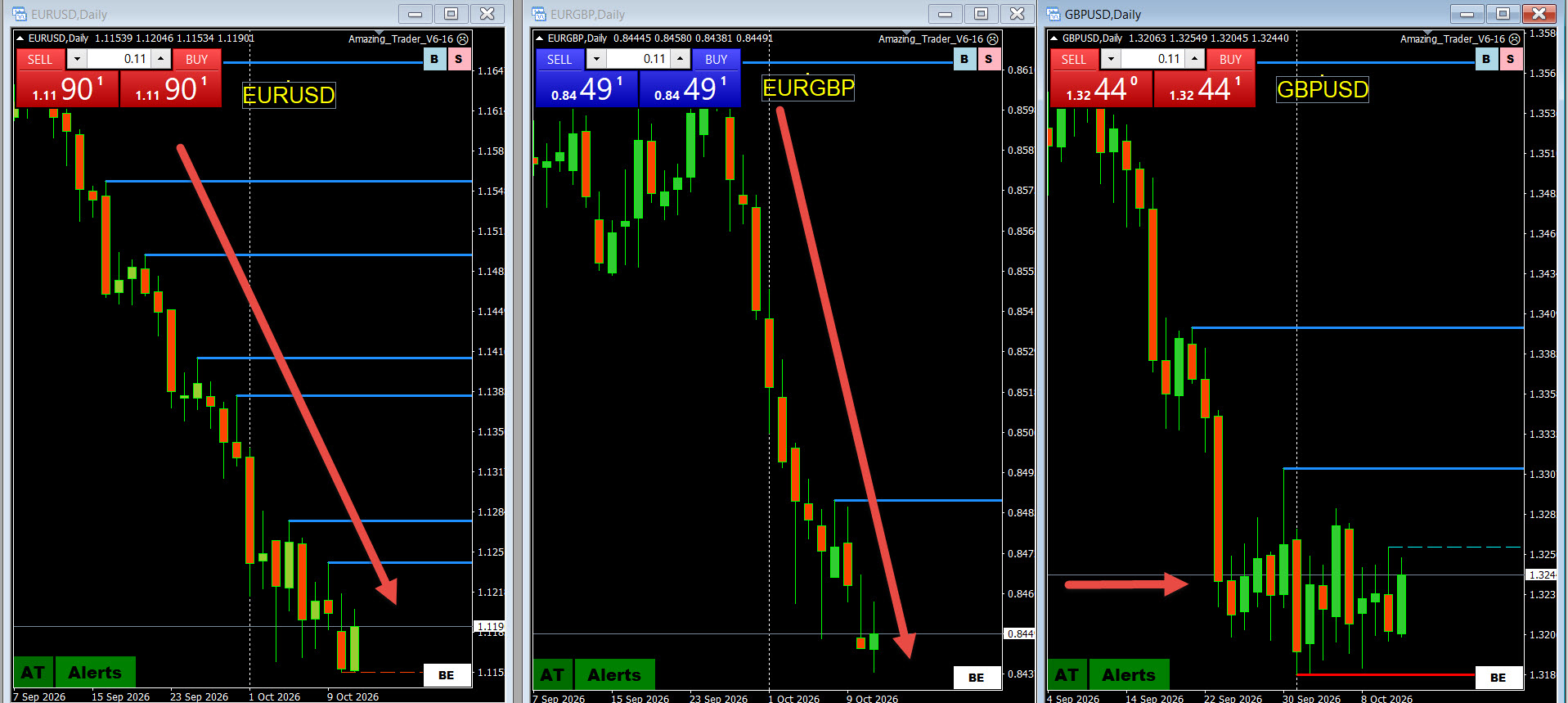
A Fresh Example: Follow the Sequence Across Three Charts
Intra-day: EURUSD (up) => USDJPY (up) => EURJPY (up)
Two currencies moving in opposite directions suggests a real money EURJPY buy order, creating a tug-of-war between the two currencies.;

Daily: EURUSD (down) => GBPUSD (consolidating) > EURGBP (down)
Two currencies moving in the same direction until GBPUSD traded inoo a range while EURUSD continued lower as market had trouble absorbing the euro sell side in the cross
 .
.
Let Currency Crosses Help You Find the Side to Trade
Trading a dollar pair in isolation can leave you missing part of the explanation for its movement.
Currency crosses add perspective. They show how currencies are performing against each other and help you identify where buying or selling pressure is having the greater impact.
The most useful question is not simply whether EUR/GBP or EUR/JPY is rising or falling. It is:
Which currency is driving the move, and which side does the market appear to have more difficulty absorbing?
]n the old days when it was a dollar centric world, all currencies moved in the same direction vs. the dollar but at a different pace. In those days, a trader had to simply pick what side of the dollar to trade.
In the current multi-currency world, cross currency flows are more common and can offer a valuable clue for those trading the respective spot pairs., It is not only important to pick the side of the dollar to trade but to be be aware of any cross flows that would cause the currency you are trading to lead, lag or diverge from the overall dollar trend.
The answer can help you identify the side to trade. A suitable entry, defined risk and worthwhile potential reward determine whether that idea becomes a trade.