News trading algos
News is one of the biggest sources of volatility in the financial markets.
Economic data, central-bank decisions, political developments and geopolitical events can move currencies and other markets dramatically, particularly when the outcome differs from what the market expected.
That makes news incredibly attractive to short-term traders.
It also creates a problem.
Retail traders are playing the news game against machines that are built to react faster than humans ever can.
The mistake isn’t trading the news.
The mistake is believing you can beat the algorithms to it.
News Trading Algos Have a Structural Advantage
When an important economic release hits the market, the first reaction can happen almost instantly.
A currency pair, gold, stocks and other markets can move sharply before a retail trader has fully processed the headline.
By the time the number appears on your screen, you may already be looking at a market that has moved significantly.
That isn’t necessarily because the market has suddenly become irrational.
It may simply be because someone, or something, got the information first and acted on it.
This is where news trading algos have a major advantage.
These systems can receive market moving information extremely quickly and execute trades with a speed that a human trader cannot match.
A retail trader has to read the headline, understand the number, compare it with expectations and then decide what it means.
An algo can potentially do much of that almost instantaneously.and that difference in reaction time matters.
News trading algos – What Are News Trading Algos?
A news trading algo is essentially a system designed to use news and economic information to make trading decisions.
But there is an important distinction.
There are automated trading systems available to retail and institutional traders, and then there are highly sophisticated systems designed specifically to react to market-moving information at extraordinary speed.
Those are the systems that matter here.
The precise methods used by individual firms are obviously not public, but it is reasonable to assume that some systems can rapidly process headlines, economic releases and deviations from market expectations.
For example, if economists expect an economic indicator to come in at a particular level and the actual number is significantly different, an algo can potentially identify that surprise and react before most human traders have finished reading or even seen the release.
That creates a huge advantage but necessarily because the algorithm understands the news better. It simply gets to the market first.
Why Even Second-Tier Economic Data Can Move Markets
One of the more frustrating aspects of news trading is that the market doesn’t always react according to the importance of the economic release.
A relatively minor piece of economic data can sometimes generate a surprisingly large move.
At another time, the same release might barely register a reaction.
Why?
The answer is because markets don’t trade in a vacuum. Positioning, liquidity, expectations and the presence of automated trading systems can all influence how the market reacts to new information.
A relatively small surprise can become significant if it triggers a wave of algo buying or selling..
Once the initial move begins, other strategies can get involved.
Stops can be triggered.
Liquidity can disappear.
Momentum systems can join the move.
What started as a reaction to a single economic headline can suddenly become a much larger market event.
And to the trader watching it happen in real time, the move can look completely irrational.
Supply and Demand: The Force Behind Every Market Move
News trading algos – When the Market Makes No Sense
This is where traders can get themselves into trouble.
Sometimes a news reaction simply doesn’t make sense. The headline doesn’t appear important enough to justify the move. The data doesn’t seem particularly bullish or bearish. The market appears to have completely misinterpreted the information.
The natural reaction is to fade it.
That can be a very expensive decision.
The fact that you don’t understand the move doesn’t mean the move is wrong. There may be information being processed by the market that you cannot see.
There may also be positioning, liquidity or automated strategies influencing price in ways that aren’t obvious from the headline itself.
That is why patience can be more valuable than being right.
Let the initial reaction happen.
Let the market show its hand.
Then decide whether the move deserves to continue.
News trading algos – The Three Choices After a News Reaction
For a short-term trader, there are essentially three ways to approach a sudden news-driven move.
-
Chase the Move
The first option is to jump in and trade in the direction of the initial reaction.
This is the most obvious approach and often the most dangerous.
If the market has already moved 30 or 40 pips before you enter, you’re no longer trading the original opportunity.
You’re trading whatever is left of it.
You may be acting like a liquidity provider to those taking profits.
The risk is that you enter just as the first wave of buying or selling is running out of momentum.
-
Wait for a Pullback
The second option is to let the initial move happen and wait.
This approach accepts a simple reality: You don’t have to be first to make money from a move.
If the news genuinely changes the market’s outlook, there may be opportunities to enter after the initial reaction.
A pullback can provide a better entry and, just as importantly, more information about whether the market actually intends to continue in the original direction.
Instead of competing with the algos during the first few seconds, you’re allowing the market to reveal what happens after the initial shock.
-
Fade the Reaction
The third option is to bet against the move.
Sometimes this works. Markets can overreact. Headlines can be misinterpreted. Initial algo reactions can reverse once human traders digest the details.
But fading a powerful news reaction simply because it looks irrational is dangerous.
The market doesn’t have to become rational on your timetable.
There is a reason the old trading warning remains relevant:
The market can remain irrational longer than you can remain solvent.
Being correct eventually doesn’t help if you’re stopped out before the reversal occurs.
How Economic News Affects Stocks, Bonds, Commodities, Crypto and Forex
The Retail Trader’s Real Advantage
So what is the answer?
Stop trying to compete with the algos on their strongest advantage. Speed isn’t the retail trader’s edge.
There will always be someone with faster data, faster connections and faster execution. Trying to beat that technology by reacting faster is a losing proposition.
The retail trader’s potential advantage is patience.
You can wait.
You can observe the initial reaction.
You can see whether price holds the move or reverses it.
You can analyze the details of the economic release instead of simply reacting to the headline.
And you can wait for the market to provide a second opportunity.
That is a completely different game.
Don’t Trade the Headline. Trade the Reaction.
This is perhaps the most important distinction.
The headline is information.
The market’s reaction to the headline is information too.
Sometimes the second piece of information is more valuable than the first.
A strong economic number may initially send a currency or any asset higher.
But what happens next?
Does the currency, for example, continue higher?
Does it immediately reverse?
Does price fail at a major technical level?
Does the market give back the entire move?
Does the reaction look strong but produce no follow-through?
These are the questions that a short-term trader can potentially exploit.
The goal isn’t necessarily to predict the first move.
It is to understand what the market does after the first move.
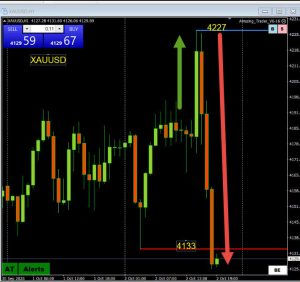
XAUUSD (GOLD): October 2, 2026 following a weaker-then-exeected U.S. Sept jobs report
Initial reaction: Spike to 4227… then reverse reaction plunge to 4124
News Creates Opportunity But Not Always Where You Expect
Traders are addicted to news for good reason. News creates volatility, and volatility creates opportunity.
But the opportunity isn’t necessarily in being the first trader to react.
In many cases, trying to anticipate or chase the initial reaction simply puts the retail trader in direct competition with the fastest participants in the market.
That’s a contest the retail trader is unlikely to win.
A better approach is to recognize the structural disadvantage and adapt to it.
Let the algos react.
Let the stops get triggered.
Let the first wave of volatility pass.
Then look at what remains.
Is there a trend?
A reversal?
A failed breakout?
A pullback?
A liquidity event?
A market reaction that has gone too far?
Those may be the opportunities worth trading.
Stop Trying to Beat the Machines
The evolution of algo trading has changed the way markets respond to news.
The first reaction to an economic release, for example, can happen faster than a human trader can read the headline, let alone analyze it.
That doesn’t mean retail traders should stop trading news. It means they need to stop trying to win a race they were never designed to win.
You can’t beat the news algos on speed.
But you don’t have to.
The objective isn’t to be first.
The objective is to understand what the first move creates.
Sometimes the best trade isn’t the reaction to the news.
It’s the reaction to the reaction.