U.S. Jobs Report – A weak U.S. jobs report would once have been clearly bullish for bonds. Friday showed why that relationship may be becoming far less reliable.
September’s employment report initially delivered what rate-sensitive markets were looking for: weaker-than-expected nonfarm payrolls, a tick up in the unemployment, slower wage growth and downward revisions to the prior two months. It was like a perfect storm. Treasury yields fell sharply and other markets followed its lead.
Then the trade reversed.
Treasury yields moved higher, the dollar recovered, while gold and Bitcoin more than gave back their initial gains. U.S. stocks also retreated from session highs.
The takeaway was clear: bad economic news may no longer be automatically good news for bonds or risk assets.
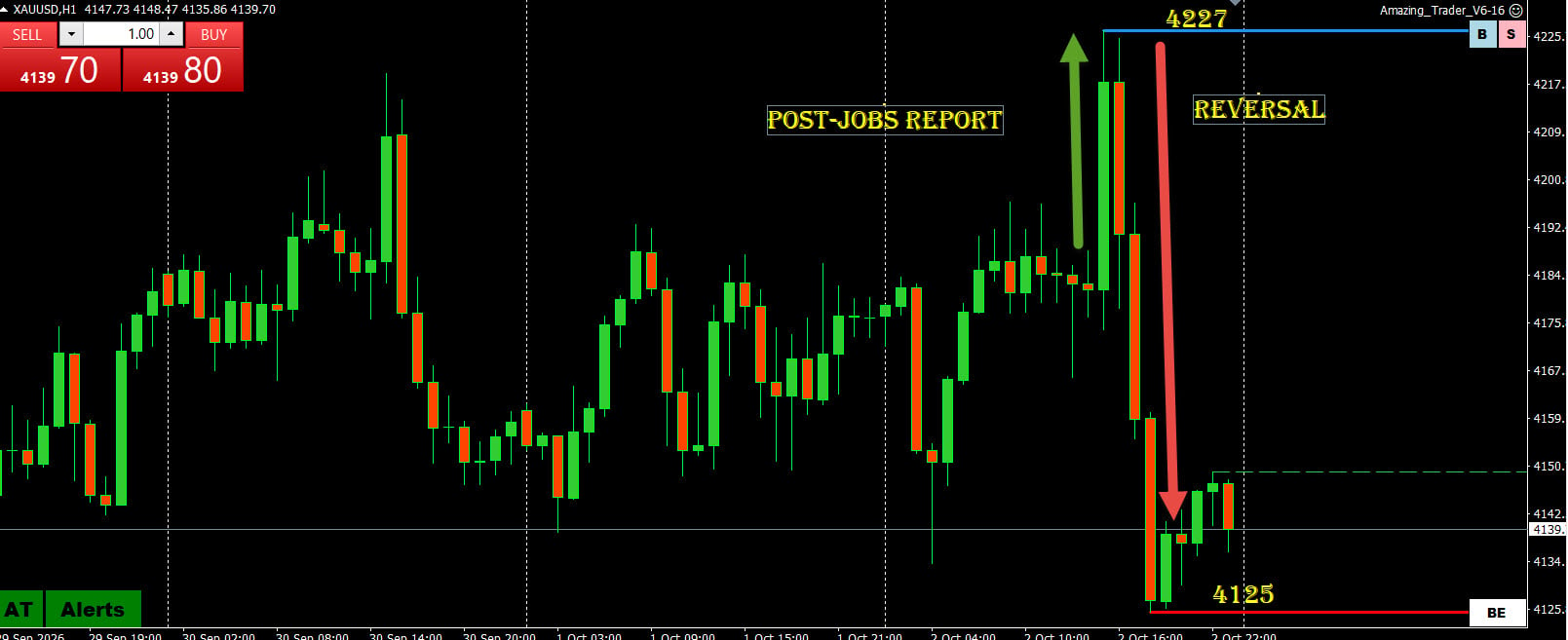
Chart: XAUUSD (GOLD) reversed course froim a post-data high at 4229 to a low at 4125
U.S. Jobs Report – Weak Jobs Data Initially Sends Treasury Yields Lower
The September employment report triggered an immediate dovish reaction.
The U.S. economy added just 29,000 jobs, well below economists’ expectations of roughly 84,000. Downward revisions to previous employment figures reinforced concerns about weakening labor-market momentum.
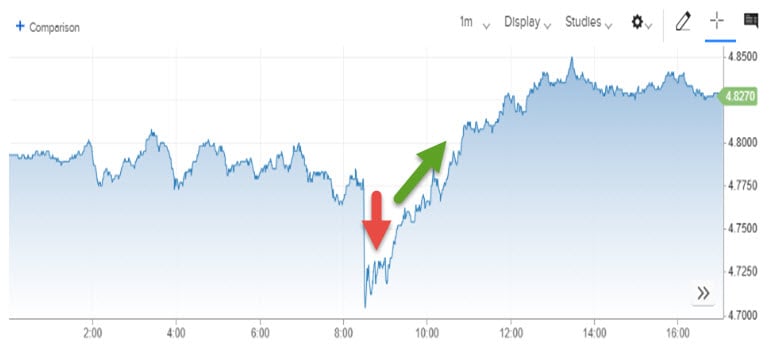
The 2-year Treasury yield fell about 8 basis points, while yields across the curve also moved lower as investors increased expectations for a less restrictive Fed.
But the rally quickly faded.
Longer-term Treasury yields reflect more than expectations for the next Fed meeting. Inflation, economic growth, government borrowing and Treasury supply also influence demand for longer-dated bonds. As investors reassessed those risks, the initial support from weaker employment began to disappear as a sharp rebound in yields more than exceeded pre-data levels.
Chart: U.S. 2-year fell from 4.78% => 4.70% and then rebounded to a high around 4.84%
U.S. Jobs Report – Why Did the Treasury Rally Reverse?
The key question for markets was no longer simply whether the jobs data justified lower rates. It was whether the Fed could ease policy without allowing inflation to become more persistent.
A weaker labor market strengthens the case for easier monetary policy. But if inflation remains elevated, the Fed has less room to cut rates aggressively without risking renewed price pressures.
That tension quickly shifted attention from the weak employment figures to the broader inflation outlook, helping push longer-term Treasury yields higher.
Markets Price Out an October Hike, but December Remains Important
The jobs report significantly reduced expectations for an October rate increase, but it did not eliminate the possibility of another hike later in the year.
December remains an important focal point for Fed expectations, leaving traders focused on the path of monetary policy rather than simply the next meeting.
A weakening labor market can reduce expectations for an immediate hike while persistent inflation keeps the prospect of further tightening alive.
U.S. Jobs Report – Three Forces Driving Treasury Yields Higher
Persistent Inflation Risk
Sticky inflation remains one of the biggest constraints on the Fed.
If policymakers pause or slow tightening while price pressures remain elevated, longer-term inflation expectations could become harder to contain. That matters particularly for longer-duration Treasuries, whose yields reflect expectations for inflation, growth and monetary policy.
U.S. Fiscal and Debt-Supply Concerns
Heavy Treasury issuance is another potential source of upward pressure on yields.
Large amounts of government borrowing can require investors to demand higher yields to absorb new debt, particularly at the longer end of the curve.
As a result, Treasury yields are increasingly being shaped by fiscal concerns and debt supply as well as Fed policy.
Geopolitical and Energy Risks
Geopolitical tensions, particularly in the Middle East, continue to create uncertainty around energy markets and global supply chains.
A sustained rise in energy prices could push headline inflation higher and complicate the Fed’s policy decisions, giving policymakers another reason to remain cautious about easing financial conditions too quickly.
The Fed’s Dual-Mandate Dilemma
Friday’s market reaction highlighted the Fed’s central challenge: balancing maximum employment with stable prices.
A slowing labor market supports the case for easier policy. Persistent inflation argues for caution.
That helps explain why markets are responding less predictably to economic data. A weak jobs report can support bonds initially while at the same time raising concerns about what prolonged policy accommodation could mean for inflation.
U.S. Jobs Report – What Traders Should Watch Next
With the labor market showing signs of slowing, upcoming inflation data could become even more important.
Traders should also watch the prices components of the ISM and S&P Global PMIs. These measures can provide an early indication of changes in input costs and companies’ selling prices. A renewed rise in these price measures could reinforce concerns about sticky inflation even if employment and growth weaken.
Key indicators include:
- Consumer Price Index (CPI), especially the core
- Producer Price Index (PPI), especially the core
- PCE, said to be the Fed’s favored inflation indicator
- ISM and S&P Global PMI prices components
- Average hourly earnings
- Import porices
- Treasury yields and the yield curve
- Fed funds futures
- U.S. dollar price action
- Energy prices
The interaction between these indicators may matter more than any single economic release
Why the U.S. Treasury Yield Curve Matters and What It May Signal Ahead
Markets Are No Longer Trading the Jobs Report in Isolation
Friday’s reversal showed why the traditional relationship between weak economic data and lower yields may have become less reliable.
The weak employment report initially pushed Treasury yields lower, but concerns about inflation, fiscal pressures and the Fed’s limited room to ease policy quickly changed the market’s interpretation.
The dollar recovered, gold and Bitcoin surrendered their initial gains, and stocks pulled back from their highs.
The key issue for markets is therefore not simply whether the labor market is weakening. It is whether inflation is cooling quickly enough to give the Fed room to respond.
That makes upcoming inflation data, PMI price indicators and Treasury-market signals particularly important for the outlook across bonds, currencies, precious metals, cryptocurrencies and equities.