Will history repeat and see U.S. stocks rally sharply after the midterm elections, or will this year be different?
History strongly favors higher stock prices. However, investors face several headwinds that could complicate the outlook, including concerns about AI valuations, elevated oil prices, developments in the Gulf and the direction of U.S. Treasury yields.
While the election may remove one source of uncertainty, it will not automatically remove the economic and financial pressures affecting markets.
That leaves traders with a familiar challenge: weighing an impressive historical pattern against the conditions in front of them.
What History Says About Stocks After Midterms
According to J.P. Morgan Asset Management, going back to 1950, the S&P 500 has delivered a positive return in the 12 months following every midterm election, averaging approximately 15%.
The shorter-term record is also encouraging. The S&P 500 has averaged a 6.6% return during the fourth quarter of midterm election years. Importantly, that figure covers the entire October–December quarter, including the period before Election Day.
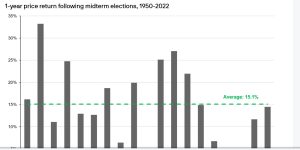
Source: J.P. Morgan Asset Management, published October 7, 2026.
It is hard to argue with that record. Nevertheless, a 100% historical success rate does not mean a 100% probability of another gain.
As with trading, past performance is no guarantee of future performance. The record also describes where the market finished after 12 months, without promising a smooth journey getting there.
Why Do Markets Rally After Midterm Elections?
Election Uncertainty Begins to Clear
Markets dislike uncertainty because it makes future conditions harder to assess.
Before an election, investors must consider different outcomes for taxes, spending, regulation and control of Congress. Once the results become clear, they can evaluate the political landscape and adjust their expectations.
The benefit comes partly from having an answer. Investors can move beyond debating possible outcomes and start assessing what the result means for businesses and markets.
However, election uncertainty may linger if close races delay a clear result.
Divided Government Can Limit Policy Changes
Investors often view political gridlock as a positive as it is seen as a potential restraint on sweeping policy changes.
When control is divided between the parties, major changes to taxes, spending or regulation may become harder to pass. That can make the policy outlook more predictable for businesses.
Still, gridlock is no automatic prescription for higher stock prices. Budget impasses, debt-ceiling confrontations and executive actions can create fresh uncertainty.
What matters is whether the political arrangement improves confidence about future business conditions.
Attention Returns to Economic Fundamentals
Once election headlines fade, investors can refocus on the forces that drive company valuations: earnings, inflation, interest rates and economic growth.
Political developments influence those forces, but the election result alone cannot determine whether stocks are attractively priced.
A relief rally may begin with reduced uncertainty but sustaining it generally requires support from earnings and the broader economy.
Four Headwinds That Could Challenge a Post-Midterm Rally
AI Valuations and Infrastructure Spending
One concern is whether expectations for artificial intelligence have moved ahead of the profits it can generate.
Massive infrastructure investment raises questions about future returns, financing costs and the cash flows needed to support that spending. Where borrowing is involved, investors must also consider debt-servicing requirements.
The issue is not simply whether AI will transform businesses. It is whether the earnings generated will justify the prices investors are paying today.
That makes corporate results and forward guidance especially important. When high expectations are demanded, even respectable results can disappoint. This will leave traders and investors hyper focused on quarterly AI related corporate earnings reports.
You Can’t Beat the News Algos So Stop Trying
Oil Prices and Inflation Pressure
Elevated oil prices can squeeze consumers while increasing transportation, production and operating costs for businesses.
The direction matters as much as the level. Oil that stabilizes or retreats could ease pressure on inflation expectations. Another sharp rise could complicate the outlook for interest rates and corporate margins.
Energy strength also affects sectors differently. It may support energy producers while creating difficulties for companies that struggle to pass higher costs to customers.
Developments in the Gulf
The outlook in the Gulf adds another layer of uncertainty.
Diplomatic progress could reduce the risk premium embedded in energy prices and improve market confidence. Escalation could have the opposite effect, particularly if investors become more concerned about energy supplies or shipping disruptions.
A continuing impasse could leave markets vulnerable to sudden headlines.
The midterms will settle congressional contests. They will not settle the geopolitical risks confronting investors.
Treasury Yields and the Fed’s Dilemma
Higher Treasury yields can pressure stocks by increasing borrowing costs and giving investors a more competitive alternative to equities.
They can also weigh on valuations, particularly for companies whose investment appeal depends heavily on profits expected further into the future.
The Fed faces a difficult balancing act. Persistent inflation argues for restraint, while higher energy costs can weaken household purchasing power and economic activity.
The central bank held its benchmark rate at 3.75%–4.00% in October. Following the September inflation report, markets were pricing a high probability of a December increase. That remains an expectation, rather than a confirmed decision.
What Would Help History Repeat?
Several developments could improve the backdrop: stronger earnings, clearer evidence that AI spending is generating returns, easing oil prices and more stable Treasury yields.
Progress on inflation could also reduce concerns about further monetary tightening.
Conversely, disappointing earnings combined with higher energy prices and rising yields would make a sustained rally harder to achieve.
For traders, price action provides another test. Can stocks hold gains after favorable news? Do pullbacks attract buyers? Are rallies broadening beyond a handful of influential companies?
Those reactions can reveal whether confidence is improving or whether rallies are struggling to gain traction.
Will History Repeat This Time?
History makes it difficult to dismiss the possibility of higher stocks after the midterms. However, treating that record as a trading signal by itself would overlook the conditions that determine risk and reward.
The fourth-quarter average and the following 12-month return also represent different tests. A disappointing quarter would not automatically end the longer-term pattern.
Twelve months is a long time in markets. Headwinds can fade, new risks can emerge and expectations can change quickly.
The jury is still out. Whether the historical record extends or finally breaks, the road is likely to have plenty of potholes.