You enter a trade with a clear plan. You know why you are buying or selling, where your stop belongs and when you intend to take a profit.
Then prices start flashing.
The market moves against you and approaches your stop. You question your entry. Perhaps the direction was right but the timing was wrong. Price stalls, turns and returns to your entry point.
Relieved, you close at breakeven only to watch the market move exactly where you originally expected.
You check the clock. The whole experience lasted five minutes.
It felt like hours.
This is part of the appeal of AI trading bots and automated systems. They can execute a strategy without the fear, frustration or impatience that can derail a human trader.
But removing emotion does not automatically create a profitable strategy. A machine can follow a bad plan as faithfully as a good one. Give it too much freedom, and it may take risks the trader never intended.
Why Emotions Undermine Trading Discipline
Having a strategy and following it are different skills.
After several losses, a trader may hesitate to take a valid setup. After several winners, confidence can turn into overconfidence, encouraging larger positions and less selective entries.
Once money is at risk, ordinary fluctuations can feel unusually significant. A small loss becomes a reason to question the analysis. A small profit becomes something to protect immediately.
The result is familiar: closing winners early, moving stops farther away, chasing missed moves or increasing exposure to recover losses.
Automation can reduce these mistakes by following predefined instructions. Whether those instructions provide a trading edge is another question.
Trading Algos vs. AI Trading Bots
A conventional trading algo follows programmed rules. It might enter after a breakout, calculate position size from the stop distance and exit when specified conditions occur.
It does not need artificial intelligence to do this.
AI trading bots may use models trained on data to evaluate signals, classify market conditions or make predictions. Some combine fixed trading rules with an AI filter. Others give AI greater control over entries, exits and exposure.
The distinction matters. Executing a tested rule is different from allowing a system to decide what the rule should be.
An AI model might assign a higher score to one setup than another. But that score remains an estimate whose usefulness must be demonstrated through testing.
Consistent Execution Is Not Consistent Profit
A bot can follow its instructions perfectly and still lose money.
Consider a breakout strategy. It may perform well when markets move decisively beyond established ranges. In congestion, repeated breaks can fail, producing one loss after another.
The system has remained disciplined. Market conditions have become unfavorable.
Automation improves adherence to a strategy. It does not create an edge simply by removing emotion.
Results still depend on the strategy, position sizing, trading costs and execution quality. AI adds value only if its contribution improves results after those costs.
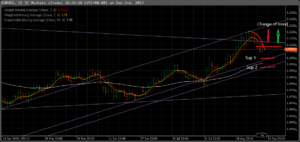
XTIUSD (WTIUSD) CFD 1 HOUR CHART
How would an algo or AI bot react to a sudden news related fall? Would it try to buy the dipo (i.e. at red lines) vs. what a human might do?

How AI Might Improve Trading Results
AI may be most useful when it has a specific job and clear boundaries.
Filtering Market Conditions
An AI model could help assess whether a market is trending, consolidating or becoming unusually volatile.
For a trend-following strategy, avoiding some congested periods could be more useful than generating additional signals.
However, filters can reject major winners as well as losing trades. Their value must be measured across all opportunities.
Monitoring Combined Exposure
Several trades can look different while representing much the same risk.
Buying EURUSD, buying GBPUSD and selling USDCHF can all create exposure against the dollar. Automated monitoring could flag that concentration before another position is added.
Many basic checks require only ordinary calculations. AI may help evaluate more complicated relationships, provided its conclusions are reliable.
You Can’t Beat the News Algos So Stop Trying
Reviewing Trading Decisions
AI can also help analyze trading records.
Are early exits reducing profits? Do results deteriorate after consecutive losses? Are certain sessions producing most of the drawdown? What asset classes overperform and which ones underperform? Which units within an asset class better than others (e.g. which currencies, which stock indices, etc)? Are discretionary overrides helping?
These findings require verification, but this can be a useful application of AI without giving it authority to place trades.
When Too Much AI Freedom Becomes Dangerous
Permission to analyze a setup should not automatically include permission to increase position size, widen stops or change the strategy.
Increasing Risk to Pursue Returns
An instruction such as “maximize profits” leaves critical questions unanswered.
Over what period? With how much leverage? What drawdown is acceptable?
A system given a poorly defined objective could favor larger positions or concentrated exposure because those choices improve the metric it is pursuing.
An AI confidence score should not, by itself, authorize more risk. If the model is wrong, greater confidence can simply produce a larger loss.
Constantly Changing the Rules
Adaptability sounds attractive, but a losing streak does not necessarily mean a strategy has stopped working.
If AI repeatedly changes settings after recent losses, it may chase noise. One failed breakout leads to a different entry threshold. Another loss leads to a wider stop. A missed winner leads to a weaker filter.
Eventually, the live strategy may bear little resemblance to the one that was tested.
Changes need a defined review process. Any ability to adapt during live trading needs its own testing and limits.
Mistaking Historical Patterns for an Edge
AI can examine large amounts of data and discover relationships that look impressive but some will be coincidences.
A model may fit historical movements exceptionally well and struggle with new data, particularly if many versions were tested and only the best result was selected.
Testing on new data excluded from development, followed by forward observation under realistic costs and market conditions, helps assess whether the apparent edge holds up.
Acting on Faulty Information
AI decisions depend on their inputs.
Stale prices, missing data, misleading headlines or incorrect interpretations can produce bad decisions. A language model can also generate a confident explanation containing factual errors.
A convincing explanation is not a substitute for verified data or a tested signal.
What Happens When Markets Become Difficult?
Imagine a NAS100 strategy operating around a major economic release.
Prices surge, reverse and surge again. A human trader might exit because the movement feels uncomfortable. A bot can continue following its rules.
That helps only if the strategy is suited to those conditions.
Wider spreads, slippage and rapid price changes can undermine expected results. A stop order does not guarantee execution at the requested price.
Congestion presents another challenge. An automated system may repeatedly trade apparent breakouts that quickly reverse.
AI might help identify that environment, but it can also misclassify it. The important issue is whether the system operates within tested limits and has a defined response when conditions deteriorate.
How to Keep AI Trading Under Control
- Restrict AI Permissions
- Enforce Independent Risk Controls
- Require Approval for Strategy Changes<
- Set Automatic Shutdown Conditions
- Monitor and Record Trading Activity>
- Maintain a Separate Kill Switch
- Protect Open Positions During a Shutdown
Human Oversight Requires Rules Too
Keeping a person involved does not automatically improve results.
Switching off a bot after ordinary losses and restarting it after missed winners can reintroduce the emotional decisions automation was meant to reduce.
Oversight works better when intervention follows predefined reasons, such as a data failure, breached risk limit or unauthorized change.
Feeling uncomfortable with a valid trade is a different matter.
A hybrid approach can be useful when the trader and the system have clear responsibilities. Its effectiveness still needs to be measured.
Can AI Trading Bots Deliver Better Results?
AI trading bots can improve execution discipline and may strengthen analysis, trade selection and risk monitoring.
Whether they improve profits must be demonstrated.
The absence of fear does not give a machine an edge, and processing more information does not guarantee better decisions. Greater freedom can magnify a flawed model or poorly defined objective.
A trader can abandon a good plan in five emotional minutes. A machine can repeat a bad decision far faster.
The key is to limit what AI is allowed to do and enforce those limits through controls it cannot change. Telling an AI to “be careful” is not enough.
In trading, that means separating the AI’s decisions from the system that authorizes and executes orders.
Give AI a useful job, test whether it performs that job well and keep firm control over the capital it can put at risk.