Trading Psychology
What separates traders who succeed over time from those who repeatedly struggle?
It is tempting to say the answer is a better indicator, a more accurate forecast, or a strategy that wins more often. Traders across forex, stocks, bonds, commodities, futures, and other global markets spend enormous time looking for that advantage. Yet even a good strategy can fail in the hands of someone who cannot follow it.
A trader may know exactly where to exit a losing position but moves the stop farther away when price gets close. Another may identify a promising opportunity, only to close the trade at the first sign of profit. In both cases, the problem lies in the decisions made after entering.
That is why trading psychology matters. Success requires a workable method, but it also requires the discipline to manage risk, accept losses, and give profitable trades the chance your plan intended.
What Is Trading Psychology?
Trading psychology describes how emotions, habits, and beliefs affect decisions in the market. Fear, hope, impatience, overconfidence, and the desire to be right can all influence when a trader enters, exits, or changes a position.
These emotions are normal. The goal is not to become someone who feels nothing when money is at risk. The goal is to avoid letting a passing emotion overrule a decision made for a sound reason.
The difference becomes clear when a trade moves against you. Before entering, you may have decided exactly how much you are willing to lose. Once the loss is real, it can suddenly seem reasonable to give the position “a little more room.” That small change can turn a controlled loss into a much larger one.
Why the Perfect Trading Strategy Does Not Exist
Many traders search for a system that will remove uncertainty. They switch indicators, study a new method, or follow someone who claims to have found the secret to consistent profits.
There are many ways to approach the markets. One trader may use trend analysis, another may focus on price levels, and a third may trade around economic events. A method that suits one person’s temperament and schedule may be difficult for another to follow.
No strategy wins every trade. What matters is whether it has a sound basis, defines its risks, and can be applied consistently. If a trader abandons the rules whenever a position becomes uncomfortable, even a promising method is difficult to evaluate.
Discipline does not replace a trading strategy. It allows the trader to carry one out.
The First Psychological Challenge: Cutting Losses
Accepting a loss sounds straightforward until you have to do it. A losing position can feel like a judgment on your analysis or your ability as a trader. Instead of exiting, you may search for reasons the market will reverse.
Hope can be particularly dangerous here. The market may come back, but it has no obligation to do so within the time or risk you can afford. “I think it will recover” is not a useful exit rule unless that possibility is part of a plan made before the trade. What is true for all traders is that hope is not a trading strategy.
A disciplined trader decides in advance what would invalidate the trade. That might be a price level, a change in market conditions, or a defined maximum loss. The position is then sized so that exiting at that point is manageable.
Stop Trading on Hope: How Discipline and Risk Management Lead to Consistent
Trading Psychology – A Loss Is Part of the Process
Being stopped out does not mean you are a poor trader. It means one trade did not work within the limits you set for it.
This distinction helps keep ego out of trading. You do not need every forecast to be correct. You need to control the damage when one is wrong so that you remain able to trade the next opportunity.
A stop order is a useful way to put an exit plan into practice, although it may fill at a different price during a fast market or a gap. The key is the decision behind it: knowing when the trade is no longer worth holding.
The Second Challenge: Allowing Profits to Build and Develop
Traders often show remarkable patience with losing positions and very little patience with winners. A trade moves into profit, and the urge to take the money becomes difficult to resist.
There are valid reasons to take a quick profit. Some strategies are built around short moves. The problem arises when a trader plans for a larger move but repeatedly exits early out of fear that the gain will disappear.
Over time, that habit can change the results of a strategy. If losses are allowed to reach their planned limit while winners are consistently cut short, even a trader who is right fairly often may struggle to make progress.
Trading Psychology – What “Let Your Winners Run” Really Means
Letting profits run does not mean holding a position forever or refusing to take a reasonable gain. It means managing a winning trade according to the strategy you chose.
A trader might set a profit target, follow a trailing stop, exit near a technical level, or take partial profits while leaving part of the position open. The right choice depends on the method and the market.
The important point is to decide how you will manage a winner before the excitement or fear of an open profit takes control.
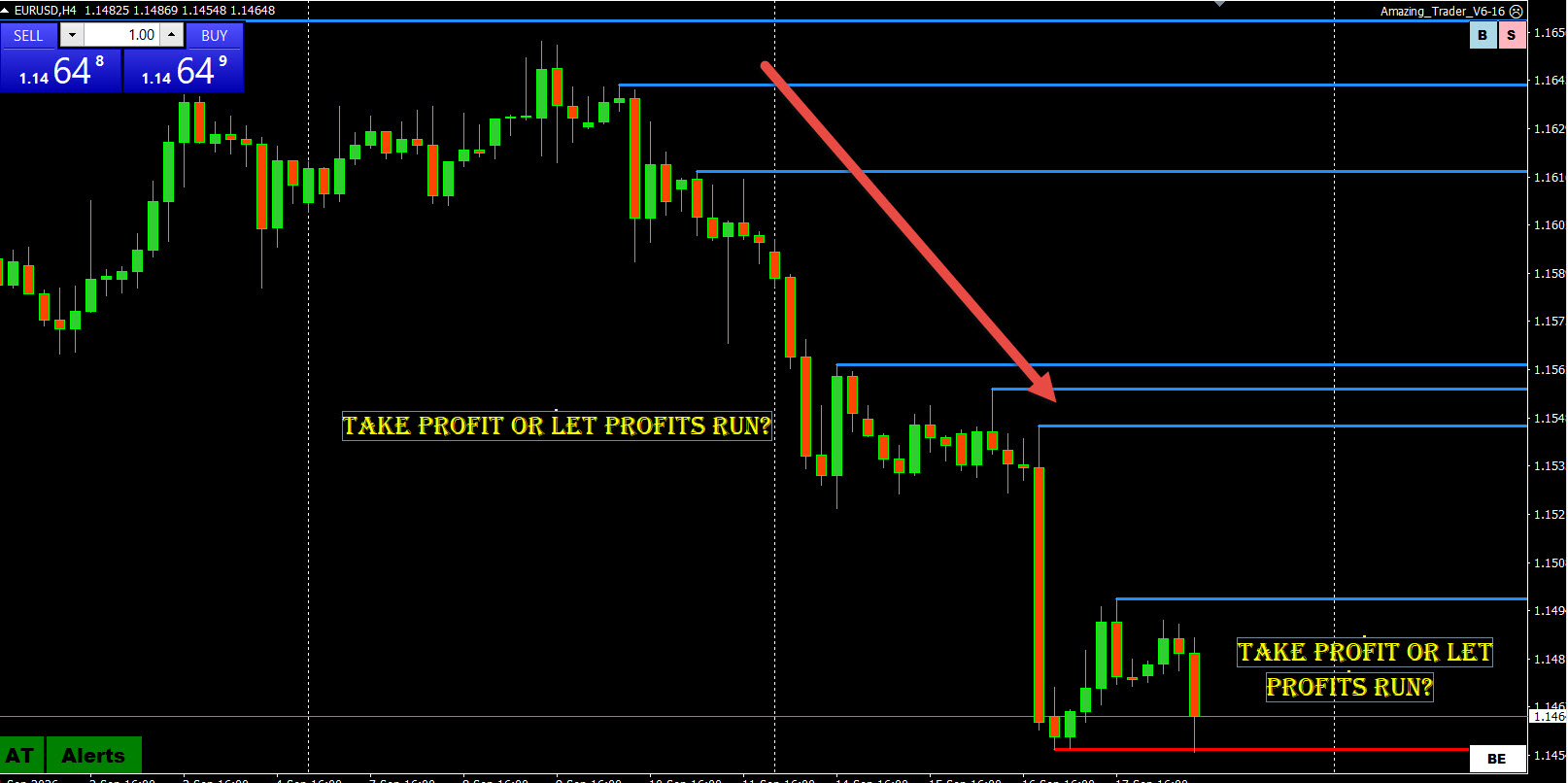
How would yoiu trade if you were short EURUSD with trend pointed down?
- Take profits at the first pause and consolidation (only to see iit fall further after) or let the position ruyn?
- Take profits after a double bottomn at the low?
EURUSD 4 H Chart
Position Size Has a Direct Effect on Psychology
Trading discipline is often presented as a matter of willpower. In practice, position size can make discipline much easier or much harder.
When a position is too large, an ordinary market fluctuation can feel threatening. A trader may close it prematurely, move a stop, or watch every small price change with growing anxiety. At a more manageable size, the same trade may be easier to hold according to plan.
Before entering a position, consider the amount or percentage of capital you could lose if your exit is triggered. Then ask whether you could accept that loss without changing your rules. If the answer is no, the position may be too large.
Risk management and trading psychology are closely connected. A plan is much easier to follow when its potential loss is one you have genuinely agreed to take.
Trading Psychology – How to Strengthen Trading Discipline
Improving trading psychology takes more than telling yourself to be patient. It requires habits that make your decisions clear and reviewable.
- Define the trade before entering. Write down why you are taking it and what would show that the idea is no longer valid.
- Set a risk limit. Decide where you will exit and size the position around the potential loss.
- Plan your profit exit. Know whether you are aiming for a target, following a trend, or using another method to manage a winner.
- Keep a trading record. Note whether you followed your rules, not just whether the trade made or lost money.
- Review repeated behavior. One early exit may mean little. A pattern of moving stops or cutting winners short points to a problem you can address.
The aim is not to make every decision perfect. It is to make your process more consistent and to recognize the habits that repeatedly work against you.
Trading Psychology Is Tested When It Matters Most
It is easy to discuss discipline when no position is open. The real test comes when a stop is near, a winner pulls back, or a series of losses makes you question your approach.
Traders use many different methods across global markets. What successful approaches have in common is a way to manage risk and a trader willing to follow it. The best strategy on paper is of little use if fear, hope, or ego continually changes the rules in practice.
You do not need to be right on every trade. You need to know what you will do when you are wrong, what you will do when you are right, and how much you can afford to risk while finding out.