Where to Place a Stop-Loss
Before entering a trade, most traders ask where the market might go. A more useful first question is: Where would my trade idea be wrong, and what would it cost me to find out?
Your answer determines where you place your stop-loss. The distance between your entry and your stop determines the risk per unit traded. From there, you can calculate your position size and decide whether the potential reward justifies the risk.
This is the first and most important aspect of a stop-loss: it defines the cost of the trade if your idea fails.
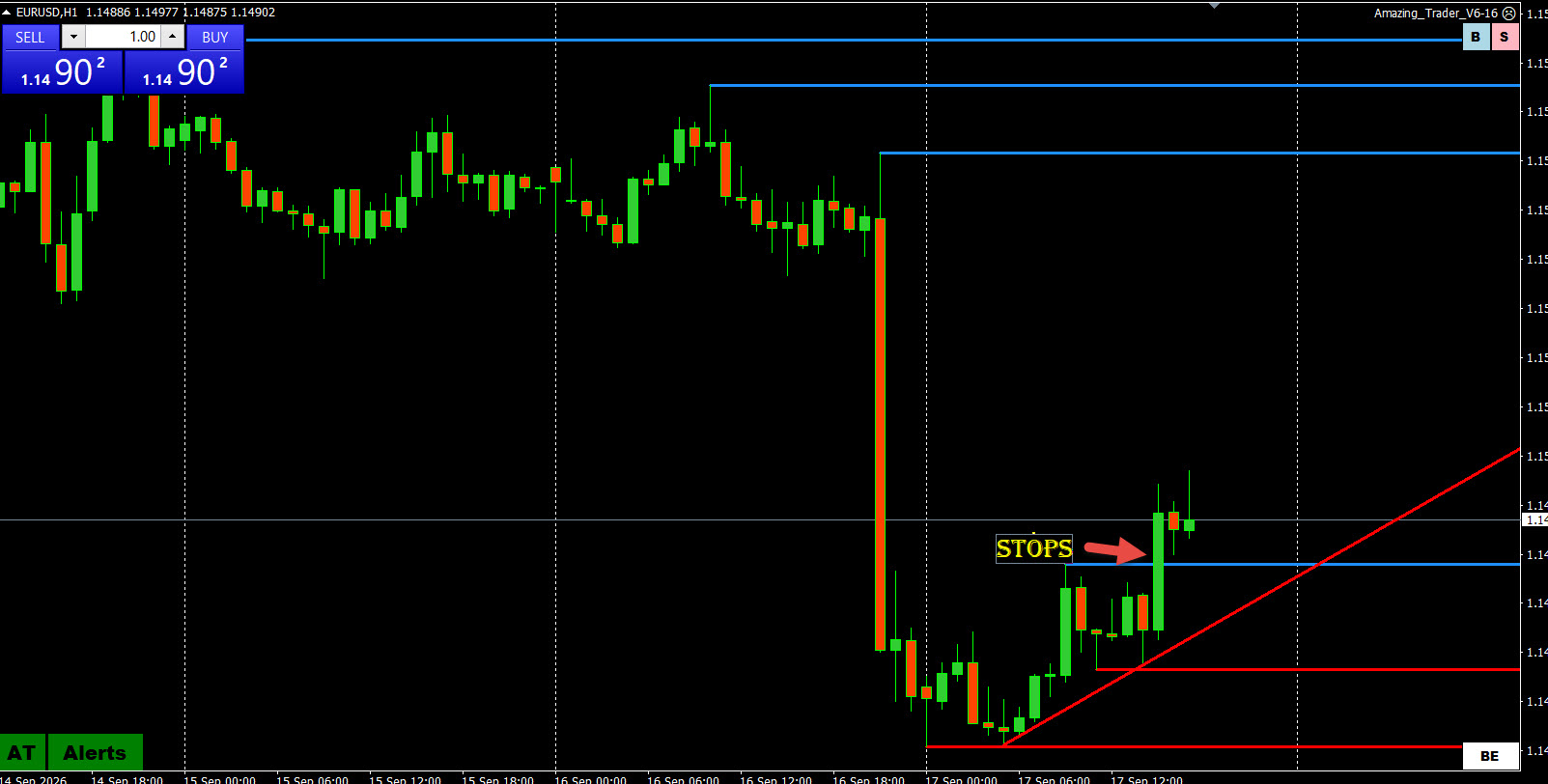
The second aspect is that stop orders are part of the market itself. Traders often place stops around the same visible highs, lows, and technical levels. When price reaches those areas, triggered orders can contribute to a sudden move.
Understanding where stops may be concentrated can help you interpret price action and choose a sensible place for your own stop.
Both aspects matter, but the order is crucial. First decide where the trade is wrong. Then work out what that decision will cost.
A Stop-Loss Should Mark the Point Where Your Trade Idea Fails
A stop-loss is more than a number of pips, points, or dollars you are willing to lose. It should have a reason for being where it is.
Suppose you buy a currency pair because it has pulled back to support and started to rise. If price breaks decisively below that support, the reason for the trade may no longer hold. Your stop belongs at a level that reflects that possibility, allowing for the normal price movement you expect around support.
The same principle applies to a short trade. If you sell after a failed attempt to break above resistance, a sustained move above that area may tell you the market is stronger than you thought.
This does not mean every stop must sit just beyond a familiar chart line. Markets can briefly move through a level and reverse. In fact, that seems to happen more often than not. The question is whether price reaching your stop would make you reconsider the original trade, given the timeframe and strategy you are using.
A stop placed only because it is “20 pips away” may be easy to calculate, but it may have little connection to the trade. If ordinary price movement can reach it while your idea remains valid, the stop may be too close. If it lies far beyond the point where your idea has already failed, it may expose you to an unnecessary loss.
EURUSD Daily Chart: Stops run after a major news event *i.e. FOMC decision)

Where to Place a Stop-Loss – Stop Placement Determines the Cost of the Trade
Once you have identified a meaningful stop level, you can measure the distance from your planned entry. That distance is the starting point for calculating risk.
Imagine you have a $10,000 trading account and decide to risk no more than 1%, or $100, on a trade. Your planned entry is 50 pips from the stop. To keep the planned loss near $100, you would need a position worth about $2 per pip, before trading costs or any difference in the execution price.
If you instead traded at $10 per pip, the same 50-pip move would represent a planned loss of about $500. The stop level has not changed, but the cost of reaching it has.
This is why stop placement and position size must be considered together. A wider stop does not automatically make a trade too risky; you can use a smaller position. A tighter stop does not automatically make a trade safer; it may be reached more often if it sits within normal market movement.
The calculation is straightforward:
Pre=determined risk = distance to stop × value of each pip or point × position size
The exact calculation varies by market and instrument, and trading costs should also be included. The essential principle is the same: know the likely cost before you enter.
A stop order also does not guarantee an exit at its exact price. In a fast market or after a gap, the fill may be worse than planned. Your risk calculation is an estimate, not a promise.
Let the Trade Determine the Stop, Then Adjust the Position Size
A common mistake is to start with the position size a trader wants and move the stop closer until the potential loss looks acceptable.
That reverses the process. The trader may end up with a stop at a price that has no meaning beyond making the numbers fit.
Suppose your analysis says a trade would be invalidated 50 pips from entry, but the position you want to take would make a 50-pip loss too expensive. Moving the stop to 15 pips does not change where the trade idea fails. It only makes it more likely that you will exit while that idea is still intact.
The more disciplined response is to reduce the position size. If the trade is too small to be worthwhile at an acceptable risk, you can pass on it.
This is one of the benefits of deciding on a stop before entering. It gives you a chance to reject a trade whose cost does not make sense, instead of trying to repair the risk after you already have a position.
Where to Place a Stop-Loss – The Cost of Being Wrong Affects the Potential Reward
A trade can have a sensible stop and still offer too little upside.
Suppose your stop is 50 pips from entry, while the next significant resistance level is only 25 pips away. If that resistance is your likely profit target, you are risking 50 pips to pursue 25. You need a strong reason to believe the trade is worth taking under those conditions.
Now suppose the next meaningful target is 150 pips away. The potential reward is larger relative to the planned risk. That alone does not make the trade a good one: the target must still be realistic, and the setup must have a reasonable chance of working.
A useful sequence is:
- Identify why you would enter.
- Decide what price action would show that your idea is wrong.
- Calculate the cost of placing your stop there.
- Adjust your position size to keep that cost acceptable.
- Compare the risk with a realistic potential reward.
Everything follows from the point where the trade is wrong. If you cannot identify that point, it may be too early to enter.
One way is to identify the stop first, set a profit target based on a pre-determined risk/reward, set a position size to maintain that ratio and then execute the trade. If the profit target looks unrealistic, then abandon executing the trade and wait for a better opportunity.
Why Stops Often Gather Around the Same Levels
Your stop is a personal risk decision, but thousands of other traders are making similar decisions. Many look at the same charts and notice the same recent highs, lows, round numbers, and support or resistance areas.
As a result, stop orders can become concentrated around visible levels. Traders who are short may place buy stops above a recent high. Traders who are long may place sell stops below a recent low.
When price reaches one of these areas, triggered stops can add to the buying or selling already underway. A move through a recent high may accelerate as short positions are closed. A move below a recent low may quicken as long positions are sold.
This helps explain why price sometimes moves sharply through an obvious level. It does not mean every move beyond a high or low is a deliberate attempt to trigger stops. A breakout may reflect new information or a genuine shift in supply and demand. Stop orders are one possible contributor to the speed of the move.
Where to Place a Stop-Loss
EURUSD intra-day stops run above the high of the day (day following the FOMC decision)
Should You Avoid Placing a Stop at an Obvious Level?
Knowing that stops cluster around visible prices can be useful, but it can also lead to a different mistake: placing a stop so far away that the potential loss becomes excessive.
If the market can briefly trade below support while your long trade remains valid, placing your stop exactly at that support level may leave little room for normal movement. You might decide that the trade needs more space. If so, reduce your position size to account for the greater distance.
But do not move a stop farther away simply because you fear being stopped out. Ask what price action would actually invalidate the setup. That question should guide the stop level.
No placement can eliminate the possibility that price reaches your stop and then reverses. That is frustrating, but it does not necessarily mean the stop was poorly chosen. A trading plan deals in probabilities. Some trades will be stopped out even when the original analysis was reasonable.
A Stop Is a Decision Made Before Emotions Take Over
Stops become hardest to respect when a position is losing money. At that point, traders can find reasons to move the stop farther away: the market might reverse, a level might hold, or the loss feels too large to accept.
That is why the most important stop decision should be made before entering the trade. You can assess the chart, the potential reward, and the cost while you are still free of the pressure of an open loss.
Market conditions can change, and a trading plan may call for managing a stop as a trade develops. But moving it farther away solely to avoid realizing a loss changes the amount you agreed to risk.
A stop-loss cannot tell you whether your next trade will win. It can tell you what you intend to do if your idea fails.
Supply and Demand: The Force Behind Every Market Move
The Bottom Line on Stop Placement
Where you place your stop is one of the most consequential decisions in a trade. It defines the point at which you will accept that your idea has failed and sets the planned cost of being wrong. That cost then guides your position size and helps you judge whether the potential reward is worth pursuing.
Stops also influence price action when many orders gather around widely watched levels. Understanding those concentrations can improve how you read a sudden move, but it should not replace your own risk plan.
Decide where the trade is wrong. Calculate what it will cost. Size the position accordingly. Then decide whether to take the trade.
Where to Place a Stop-Loss