
- This topic has 27,727 replies, 54 voices, and was last updated 3 hours, 11 minutes ago by GVI Forex 2.
-
AuthorPosts
-
July 7, 2025 at 1:22 pm #27174July 7, 2025 at 12:57 pm #27173July 7, 2025 at 12:42 pm #27172July 7, 2025 at 12:27 pm #27171July 7, 2025 at 12:18 pm #27170
US imports from Vietnam
Top Product Categories
Electronics & Electrical Machinery
Includes broadcasting equipment, computers, phones, semiconductors & components.
Valued at $41.7–$45 billionMachinery (nuclear reactors, boilers, industrial machinery)
Around $28.8–$29.2 billion
Furniture & Bedding
Worth approximately $13–15 billion, including indoor wooden furniture universalcargo.com+1junglescout.com+1.
FootwearAbout $8.8–9.1 billion, covering athletic and leather shoes .
Apparel & Textiles
Includes both knits ($8.5 billion) and woven garments ($6.8 billion)
Plastic & Rubber Products
Plastics: ~$3.7 billion; Rubber goods: ~$1.9 billion
Toys, Games & Sporting Goods
Approximately $2.97 billion
Wood & Wooden Products
Around $2.1 billion in Q1 2025 alone
Shrimp and pangasius worth about $1 billion+
Fruits & Nuts (coffee, coconut, mango, almonds)
Fruits & vegetables: ~$358 million; Seafood & nuts ~$1.06 billion
Iron & Steel; Plastics; Medical Instruments
Iron & steel ~ $2.5 billion;
Medical optics ~$1.6 billion
Handicrafts & Leather Goods
Leather articles (e.g., handbags) ~$1.5 billion; handicraft exports are growing, with the U.S. as top market (35 %)
July 7, 2025 at 12:12 pm #27169July 7, 2025 at 11:45 am #27168July 7, 2025 at 11:29 am #27167BTCUSD 4h – Bitcoin
BTC is under pressure right now and just above important level – support at 108.525
In case it holds the attack, BTC would have a chance to return to offensive and test resistance at 110.820
Interim Resistances waiting at : 109.050 & 109.765
Supports: 108.525, 108.285 & 107.845
To be able to escape a correction BTC has to move above 109.050 within next few hours
 July 7, 2025 at 11:02 am #27166July 7, 2025 at 10:49 am #27165July 7, 2025 at 10:47 am #27164July 7, 2025 at 9:44 am #27163July 7, 2025 at 9:14 am #27162July 7, 2025 at 8:57 am #27161July 7, 2025 at 8:53 am #27160July 7, 2025 at 8:40 am #27159July 7, 2025 at 8:34 am #27158July 7, 2025 at 8:15 am #27157
Bitcoin Rises Toward Record High. Why Trump, Fed Rates, ETFs May Be Driving Cryptos
The Bitcoin price was rising again Monday, defying a stock-market selloff and putting the cryptocurrency on the brink of a new high.
The world’s largest token by total market capitalization was up 0.8% to $108,944 over the past 24 hours, according to data from CoinDesk. It’s less than 3% below the record price of nearly $112,000 it hit back in May.
Other digital assets also rose in early trading. Ethereum was up 1.9%, Solana had gained 2.1%, and XRP had added 1.6% over the past 24 hours, according to data from the crypto exchange Kraken.
It wasn’t obvious what was driving the price action, but one factor could be investors diversifying out of stocks ahead of Washington’s July 9 tariff deadline. Futures tracking the benchmark S&P 500 slid 0.5% Monday as the market fretted about President Donald Trump’s pledge to start setting unilateral levies over the next few days.
The president said “tariff letters and/or deals” will be delivered starting Monday and threatened an additional levy on countries aligned with the Brics group — which includes Brazil, Russia, India and China — in a post on Truth Social overnight.
“Any Country aligning themselves with the Anti-American policies of BRICS, will be charged an ADDITIONAL 10% Tariff. There will be no exceptions to this policy,” Trump said.
Other factors pushing up digital-asset prices could include more institutional investors piling into crypto exchange-traded funds, or a slight shift in the market’s expectations about the chances of the Federal Reserve cutting interest rates later this year.
 July 7, 2025 at 8:13 am #27156
Using my platform as a HEATMAP shows US traders will return from a long holiday weekend to find markets in a risk off mood
… the dollar trading firmer led by a weaker NZD, AUD, JPY, CAD, GBP – EUR – CHF (down about the same) in that order
— Gold weaker
…. US stocks down vs last Thursday’s closing levels
… Oil down after OPEC+ invreases output but off its lows
Tariff confusion after deadline for some countries pushed back to August 1 and Trump threats to BRICS
 July 7, 2025 at 8:11 am #27155
XRP Price Prediction: Can It Turn $2 Into a Launchpad for $5?
XRP is holding its ground as one of the strongest performers in the crypto market right now, even as Ripple’s long legal fight with the U.S. Securities and Exchange Commission (SEC) approaches its final chapter. While the case isn’t officially over, Ripple has announced that it will drop its cross-appeal, and now all that’s left is for the court to decide on the final penalty.
This is a big deal for XRP holders because it removes one of the biggest clouds hanging over the token for the past four years. With that uncertainty slowly clearing, XRP has been trading steadily above the $2 mark, a level it struggled to reach for years. Analyst Crypto Cam opened up about XRP and what’s next for the price:
Ripple’s CEO Sends Out Bullish Signals
Ripple CEO Brad Garlinghouse has been openly positive about what’s coming next. His recent public comments suggest Ripple has big plans ahead. The company is actively working on expanding its services, including applying for a national banking license in the U.S. and securing a Federal Reserve master account. Moves like these could open new doors for Ripple to operate more directly within the traditional financial system.
XRP’s Price Action Looks Promising
Even with global market uncertainty and tensions around the world, XRP has remained solid. Bitcoin may be nearing $110,000, but XRP’s steady climb and resilience above $2 is turning heads. Especially considering how long it spent stuck around $0.50 while the lawsuit dragged on.
Now, with legal worries fading, analysts are turning their attention to new price targets. XRP could soon test the $3, $4, or even $5 levels if current sentiment continues.
Why the XRP Community Is Excited
The mood within the XRP community has shifted too. Ripple’s recent conferences and events have seen huge turnouts, showing just how much support and belief remains around the project. And with Ripple working to bridge traditional finance with blockchain technology, the company seems well-placed to lead in the next chapter of the crypto market.
 July 7, 2025 at 8:06 am #27154
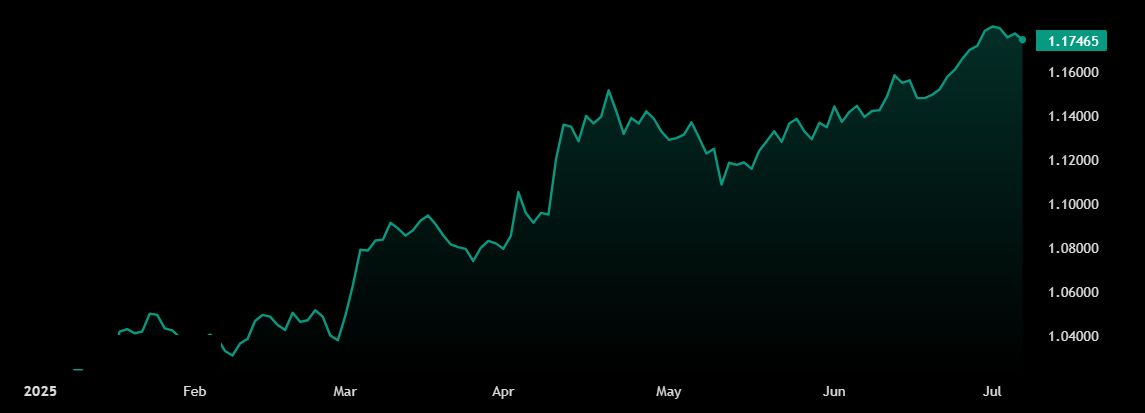
Euro Steady Ahead of US Tariff Clarity
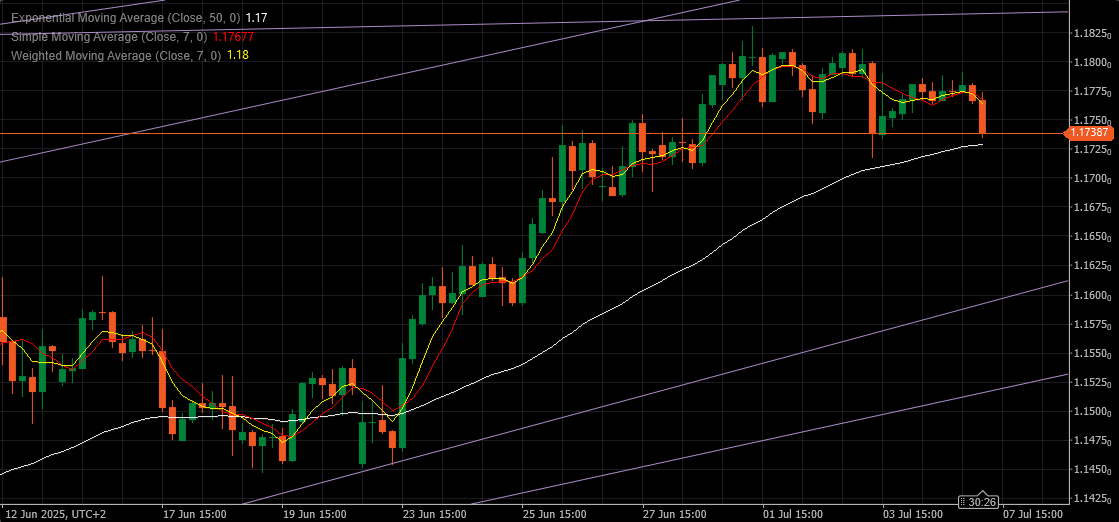
The euro was little changed just below the $1.18 mark, hovering near its highest level since August 2021, as investors awaited clarity on the US administration’s upcoming tariff measures.
President Trump is expected to send around twelve formal letters to trading partners later today, though it remains unclear whether EU nations will be among the recipients.
Meanwhile, Commerce Secretary Howard Lutnick confirmed that the broader tariff package, originally set for a July 9 rollout, will now be delayed until August 1, offering temporary relief but extending uncertainty for importers.
On the monetary policy front, markets now expect only one additional rate cut from the ECB this year.
ECB officials have signaled that rates will likely be held steady at this month’s meeting following eight consecutive cuts since June 2024.
With inflation aligning with the 2% target, policymakers are taking a cautious stance amid persistent global trade tensions and the euro’s recent appreciation.
 July 7, 2025 at 8:02 am #27153
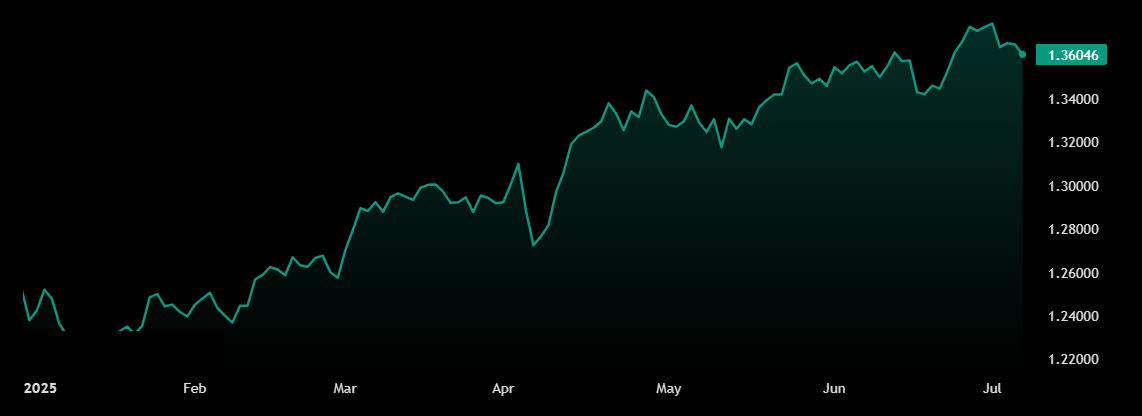
Sterling Falls to 2-Week Low
The British pound fell to $1.362, a two-week low, amid growing concerns over the UK’s fiscal outlook.
Chancellor Rachel Reeves hinted at possible tax hikes in the autumn budget to address a public finance gap, telling The Guardian she wouldn’t rule them out.
This follows Labour’s retreat on welfare reforms to avoid internal rebellion, with Reeves admitting there were costs to those concessions.
On monetary policy, markets still expect the Bank of England to cut rates by 25 basis points in September.
Meanwhile, global trade tensions added to pressure after President Trump confirmed that new reciprocal tariffs will take effect August 1.
Treasury Secretary Scott Bessent noted tariffs would revert to April 2 levels for countries without a deal by then.
Trump also warned of an extra 10% tariff on nations supporting the “anti-American policies of BRICS”.
 July 7, 2025 at 7:58 am #27152
U.S. Futures Decline, European Stocks Mixed
U.S. futures for the S&P 500 were down 0.5% and futures for the Dow Jones Industrial Average declined 0.3%. Changes in futures do not necessarily predict movements after the opening bell.
In Europe, the Stoxx Europe 600 was flat in morning trading. Bilfinger rose 2.3% and Auto1 Group climbed 2.2%. On the other hand, Stellantis sunk 2.8%, and Carl Zeiss Meditec lost 2.8%. The FTSE 100 lost 0.2%. Other stocks in Europe were mixed as France’s CAC 40 was flat and Germany’s DAX climbed 0.4%.
The Wall Street Journal Dollar Index climbed 0.3% to 94.51.
In commodities, Brent crude fell 0.3% to $68.07 a barrel, and WTI crude dropped 0.2% to $66.39 a barrel. The European benchmark price for natural gas, the Dutch futures contract TTF, was down 1.6% to 33.57 euros a megawatt hour.
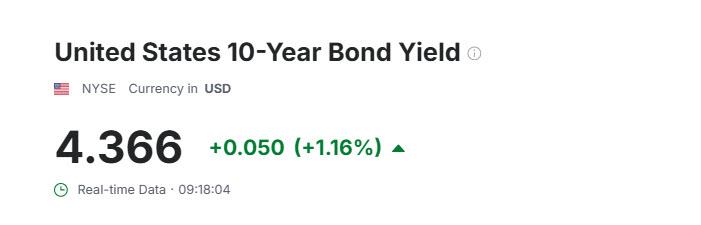
The German 10-year Bund yield rose by 1 basis point to 2.619% from 2.607%, and the yield on the 10-year U.S. Treasury fell by 1 basis point to 4.34% from 4.351%. Bond prices and yields move in opposite directions.
Stocks in Asia were mixed as Japan’s Nikkei 225 index declined 0.6%, and Hong Kong’s Hang Seng declined 0.4%, whereas China’s benchmark Shanghai Composite held steady.
WTI Crude Oil
 July 7, 2025 at 7:32 am #27151July 7, 2025 at 12:11 am #27150July 6, 2025 at 10:33 pm #27149July 6, 2025 at 7:17 pm #27148July 6, 2025 at 5:16 pm #27147July 6, 2025 at 4:33 pm #27146July 6, 2025 at 12:05 pm #27145
 -
AuthorPosts






- You must be logged in to reply to this topic.
Search
© 2024 Global View