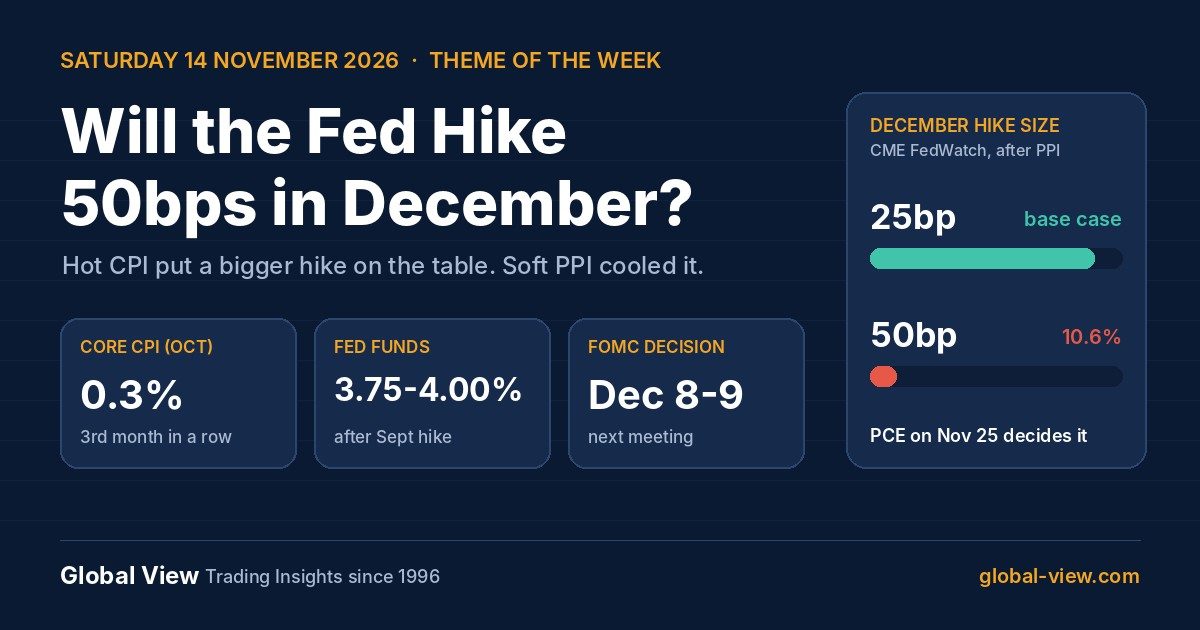
A week ago a 50bps Fed hike in December was not even on the table. Today it is the question every trader is asking. A hot CPI report and some very blunt Fed speakers changed the mood in a few hours. Then Friday’s softer PPI took some of the heat out. So will the Fed hike 50bps in December, or stick with the usual 25? Here is how we see it, and what it means for the dollar, gold and stocks.
Where the Fed stands now
The Fed raised rates in September to 3.75%-4.00%, its first hike since 2023. In October it held, but the vote was 10-2. Two members wanted another hike straight away.
The next meeting is on December 8-9. A 25bps hike to 4.00%-4.25% is already the base case. The fight now is about size.
What changed this week
It started on Tuesday morning in London. Fed Governor Christopher Waller said he would back a 25bps hike in December no matter what. Then he added a condition. If October core CPI came in around 0.3% or higher, a 50bps hike “should be considered.”
A few hours later the October CPI report landed. Headline prices rose 0.4% against a 0.3% forecast. Core rose 0.3% against 0.2%. That was the third 0.3% core print in a row. Waller’s line had been hit almost to the decimal.
Other officials piled in. Dallas Fed President Lorie Logan said rates are still at least half a point below where they would start to bite. Chicago Fed President Austan Goolsbee called the CPI report “borderline disturbing.” Goolsbee is usually one of the calmer voices, so markets took note.
The jobs data gives the hawks cover too. October payrolls rose 165,000, far above the roughly 65,000 expected, and unemployment fell to 4.1%. The Fed does not have to worry much about the labour market right now. It can focus on inflation.
Fed hike 50bps in December
The case for 50bps
- Core inflation is stuck. Three months of 0.3% core is not a blip. Run that pace for a year and you get well above 3.5%, far from the 2% target.
- Credibility. Waller said a 25bps move would put the Fed’s credibility at risk. That is strong language from a governor.
- PCE looks hot. After CPI, Bank of America lifted its estimate for October core PCE to about 0.32%. That would push the yearly rate to 3.3% from 3.1%. PCE is the Fed’s preferred inflation measure.
- Jobs are strong. With unemployment at 4.1%, a bigger hike is easier to defend.
The case for 25bps
- PPI cooled. On Friday, October PPI rose 0.3% against a 0.4% forecast, after a 1.4% jump in September. The yearly rate is still 6.5%, the highest since late 2022. But the monthly pace has slowed.
- The market does not believe it. CME FedWatch put the chance of 50bps at about 14% right after CPI. After PPI it slipped to around 10.6%. A 25bps hike is still the clear favourite.
- Yields are already doing the work. The 10-year Treasury yield pushed above 5% after CPI and was near 5.15% on Friday. Higher market rates tighten financial conditions without the Fed lifting a finger.
- Tech stocks are wobbling. AI and chip shares sold off again on Friday. A shock 50bps move into a nervous stock market is a risk the Fed may not want to take.
- The Fed hates surprises. A Reuters poll before CPI had all 101 economists expecting 25bps. The Fed rarely goes bigger than the market expects without signalling it clearly first.
How markets reacted
Tuesday’s CPI day told the story. The 2-year Treasury yield, the one most tied to Fed expectations, jumped more than 18 basis points. The dollar index rose about 0.6%. Gold dropped about 2.5% to near $4,032.
Gold had its worst week in months. It hit a 13-month low near $3,853 on Thursday and finished the week back below $3,900. The dollar stayed firm all week, even after the softer PPI.
What to watch before December 9
- FOMC minutes (Wednesday, November 18). These cover the October meeting, so they are a bit stale. Look for how many members were already pushing for faster hikes.
- October PCE (November 25). This is the big one. A 0.3% or higher core PCE would keep 50bps very much alive.
- November jobs report (December 4). A second strong month would give the hawks more ammunition.
- Fed speakers. The Fed’s quiet period starts on November 28. If it wants to prepare markets for 50bps, it has to do it before then. Watch Chair Kevin Warsh most of all.
Keep an eye on the CME FedWatch tool for live pricing, and the Fed’s FOMC calendar for dates.
What each outcome means for traders
A 25bps hike with a hawkish message is our base case. The dollar would likely hold its gains but not run much further. USDJPY stays supported. Gold could bounce if traders decide the worst is priced in.
A surprise 50bps hike would hit hard. Expect a sharp jump in the 2-year yield and a strong dollar. EURUSD and gold would be the obvious losers. Stocks, especially tech, would likely take another leg down.
A dovish 25bps, where the Fed hints it may pause after December, is the outside chance. That would knock the dollar back and give gold real relief.
Our take
We think 25bps is still the most likely outcome. But 50bps is now a real option, not a fantasy. The October PCE report on November 25 will decide it. If core PCE comes in hot and the December 4 jobs report is strong, the odds of 50bps could climb fast.
Until then, respect the trend. The dollar is firm, yields are high, and gold is under pressure. Don’t fight that until the data gives you a reason. For more on reading these setups, see our recent pieces on how to trade a liquidating market and why round numbers matter, like gold at $4,000.